Showing posts with label Gifts. Show all posts

Tuesday, November 28, 2023

One In the Spirit (1973) by David C.K. Watson, Book Review

 One In the Spirit (1973) by David C.K. Watson

Before, I had two favorite Anglicans of the past: John C. Ryle (1816-1900) and James I. Packer (1926-2020). But now I want to add another person: David C. Watson (1933-1984). While Ryle and Packer are beloved friends of the Reformation and the Puritans, Watson however was known as a champion of charismatic evangelicalism. In this book, Watson addresses the need to be united in love - "one in the Spirit, one in the Lord." It is sad to see Christians in the past and present divided over the work of the Holy Spirit when undoubtedly He intends to make us united. We need to take heed of the urgent call to unite in Spirit and truth, but not take it to the extreme of syncretism. As the Scripture says, "Be completely humble and gentle; be patient, bearing with one another in love. Make every effort to keep the unity of the Spirit through the bond of peace" (Ephesians 4:2-3).

The first step, as the author begins the book, is to know the person and the work of the Holy Spirit through the Word of God. He is the key to everything in the New Testament Church. "The fifth book of the New Testament should really be called the Acts of the Holy Spirit," writes Watson. "If God had taken the Holy Spirit out of their midst in those days, about 95% of what they doing in their churches would ceased immediately. Everyone would know the difference." But today, sadly, if God would take the Spirit out of our midst, maybe we would not know the difference. Business as usual. And that's the danger! I recalled my observations when I read this book of how we have treated the Holy Spirit unintentionally - in our theology and conduct - as subordinated either to the Bible (by most Protestants) or the Church (by most Roman Catholics). Thus, Watson urges us to have "a fresh recognition of the Third Person of the Trinity, and deep longing for the same wind of the Spirit that energized believers both in the first century and in the revivals of the Church down the years." Amen.

This book is divided into five chapters that mostly derive from 1 Corinthians 12-14 and other passages: 1) The Person of the Holy Spirit; 2) The Holy Spirit in the Individual; 3) The Holy Spirit in the Church; 4) Walking by the Spirit; and 5) The Greatest Is Love. Obviously, David Watson was generally positive about the explosion of the charismatic movement during his time. He was aware of the danger of counterfeits and always pointed out to "not believe every spirit, but test the spirits to see whether they are from God" (1 John 4:1). In the same way, when I read this book, I tested his ideas and interpretations whether they were based on the Scripture or not. And asking, "What is God saying by His Spirit?" This is a good question - and prayer! - to ask when we read other books too, especially the one that He inspired or God-breathed Book (see 2 Timothy 3:16 and 2 Peter 1:21).

#ServeToLead #PreachTheWord #TheHolySpirit #DavidWatson #Unity #TheChurch #TheScripture #LetsMakeReadingCoolAgain

To read my other book reviews/summaries, CLICK HERE

THINK BIG. START SMALL. GO DEEP.

Best Blogger Tips

Sunday, October 1, 2023

Signs of The Apostles: Observations on Pentecostalism Old and New (1973, 1976) by Walter J. Chantry

After I read the first four (of eleven) chapters, I realized that Mr. Chantry is a Reformed cessationist. This explains a lot about how he interprets the Scripture. I first heard about 'cessationism' when I listened to Grace To You's Strange Fire Conference 2013. What is cessationism? It is a view that early on in the history of the Church, the charismatic gifts of the Holy Spirit - such as healing, prophecy, word of knowledge, and tongues - ceased to be practiced. Cessationists typically hold that the miraculous gifts were only given for the Church's founding, between the arrival of the Holy Spirit on Pentecost in Acts 2 and the accomplishment of God's purposes in history, which is typically referred to as either the conclusion of the final book of the New Testament or the death of the last apostle. I understand the main arguments for cessationism but I just can't see it clearly from the plain reading of the Scripture, records from Church history, stories from missiology, and personal experiences. I believe the Scripture - the written word of God, inspired by the Holy Spirit - is final and sufficient but this doesn't mean that the saints cannot be used by God to be equipped with the charismatic gifts of the Holy Spirit for His glory. Misuse of these gifts (which are many today!) cannot invalidate them.

To be fair, most cessationists like this author, believe that while God can and still does perform miracles today, the Holy Spirit no longer uses individuals to perform miraculous signs. Mr. Chantry writes:
"The question of our inquiry is not, 'Should God be working miracles today?' It is rather, 'Should men be doing miracles on behalf of God?'" From here he explores the primary purpose of miraculous gifts in the Scripture, namely, to attest to the commission of the spokesman of God. In the New Testament, they are signs of the apostleship. He also argues that since the canon of Scripture is complete, the pursuit of all the charismatic gifts of the apostolic age can only proceed upon the basis of failure to recognize the sufficiency and finality of the Scripture. "The lack of complete confidence in the Bible on the part of neo-pentecostal is to be greatly deplored," he wrote. He then expands his arguments through biblical exposition such as on 1 Corinthians 13, 2 Corinthians 10-13, Psalm 85, and selected quotes from preachers and authors that 'prove' his points. I learned so much from this book and I agree with most of what he said about the misuse and abuse of God's words and gifts among the Pentecostals today. His high view of the Scripture is also recommendable. But at the end of my reading, I was not convinced by his exegesis leaning on this subject and of his cessationist case. God will never cease to show signs and wonders, He is the supernatural God!

#ServeToLead #LeadersAreReaders #SignsOfTheApostles #Pentecostalism #Cessationism #SpiritualGifts #LetsMakeReadingCoolAgain

To read my other book reviews/summaries,
CLICK HERE

THINK BIG. START SMALL. GO DEEP.


Best Blogger Tips

Sunday, September 4, 2022

Reading Can Activates Your Potential #LeadersAreReaders August 2022


Without reading and writing, there will be no progress to speak of. Without reading and writing, we'd be stuck in the Stone Age. Without reading and writing, there will be no civilization as we know it. These gifts of God to humankind are keys to unlocking our hidden potential. These gifts, writes Burke Hedges, author of Read & Get Rich, "liberates us and activates our dormant minds, much like a catalyst activates an inert chemical solution. Without the catalyst, the chemical just sits there. Add the catalyst and - boom! - there's an explosion of activity."

This reminds me of an old, true story. A young Italian sculptor named Agostino had a huge block of marble delivered to his studio. He had great plans to sculpt the block into a marvelous statue but unfortunately, he found the marble hard to work with. Frustrated, he had the marble removed to make room for a different project. About 40 years later, another Italian sculptor named Michaelangelo spotted the marble block hidden in an abandoned garbage heap. When he saw it, he ordered it sent to his studio. You know what happened next, right?

In case you don't... For many years, he studied the marble block, sizing up its potential, measuring it over and over again, testing its hardness with his chisels, making endless sketches, etc. Slowly but surely he gently smoothed his completed status with his chisels. The result was a masterpiece, the famous statue of David! You see, my fellow social media friends, Michaelangelo did what Agostino failed to do:
he saw the full potential of the marble block and released that potential with his talent, patience, genius - and his chisels. Like that marble block, we are rough and unrefined at first (otak pun keras!) but we have such great potential! Reading (and writing) is the chisel that releases our potential and reveals the work of art within.

Ernest Carr puts it this way,
"Not to be able to read is like one world with one door to enter and nothing is there... Because of literacy, I have been freed from this dark world. Because of literacy, I have 1,000 doors that I can enter now." So you see, reading not only activates your POTENTIAL but also POSSIBILITIES. Read! #ServeToLead #LeadersAreReaders #LetsMakeReadingCoolAgain

To read other articles on reading and book reviews,
CLICK HERE

THINK BIG. START SMALL. GO DEEP.

Best Blogger Tips

Monday, March 7, 2022

Read Books and Beat the Goldfish! #LeadersAreReaders February 2022

Currently, I’m rereading Chris Bailey’s Hyperfocus (2018). When I went to MPH Bookstore the other day, I saw a new book that interest me by Johann Hari entitled Stolen Focus (2022). But the price is so expensive, RM89.90! I understand the book business is having a hard time nowadays and in the same way, owning physical books and encouraging people to be readers is getting hard too (state libraries and discount bookstores like BookXcess are saviors for bibliophiles). Not that I cannot afford to buy the book but as I browse through the contents - besides having newer research and the author’s unique perspectives - I realize that the challenge of managing attention and focus today is the same as yesterday. No new book can claim that this is a new phenomenon. Thus, I reread Hyperfocus and settle with just listening and watching interviews of Johann Hari online… hoping that soon the State Library will have it available. Lord, have mercy.

Reading a book requires a good deal of attention,” writes Chris Bailey, “and with attention becoming a rare commodity, fewer people can devote themselves to reading without distraction.” Attention is our most limited and constrained resource. According to Microsoft Attention Spans Research Report*, the average human attention span in 2000 is 12 seconds and in 2013, it decreased drastically to 8 seconds (I don’t know how they measure this, but the goldfish have an average attention span of 9 seconds. 1 second longer than the average human!). In today’s fast-paced world of information overload, we’re constantly flooded with social media notifications, text messages, and games. Smartphone users, like you and me, check our devices about 80 to 90 times a day. No wonder we are so distracted. This is one of the reasons for the decline of book-reading culture in Malaysia and the world in general.  We still read but read bits and pieces of information. We have amassed lots of random information but lack actual knowledge, depth, and wisdom. This is not just affecting the overall quality of our work-life (or study-life, if you’re a student) but also the state of our mental health and spirituality.

Therefore, you must cultivate a love for reading books. It helps to train you (or force you, at the beginning) to increase your attention spans. It requires attention and it improves your attention. Jessalyn Lau, from the neuroscience perspective, says: “Reading has been proven to increase your focus, attention span, concentration, and to improve memory.” Perhaps you say you don’t have time to read books. I get what you mean. You have works to do, family to care for, products to promote, etc. But “no time” is a myth. Unless you move at the speed of light and the theory of special relativity applied to you, we all have the same amount of time. It's not about you don’t have time but it's about you MAKE time. We have no problem carving out time for things we want to do. So, take or buy a book that interest you, set an uninterrupted time (10 to 15 minutes for a start) today, turn off or switch your smartphone to silent mode and put it away from your reach, make a cup of hot coffee or tea or chocolate and start reading! Start small but do it frequently. At first, you will still be easily distracted. However, over time it will become a habit. And soon, you will be proud of yourself because you have beat the goldfish attention span record! Congratulation!

*https://www.scribd.com/document/265348695/Microsoft-Attention-Spans-Research-Report  

#ServeToLead #Hyperfocus #AttentionSpans #BeatTheGoldfish #LetsMakeReadingCoolAgain

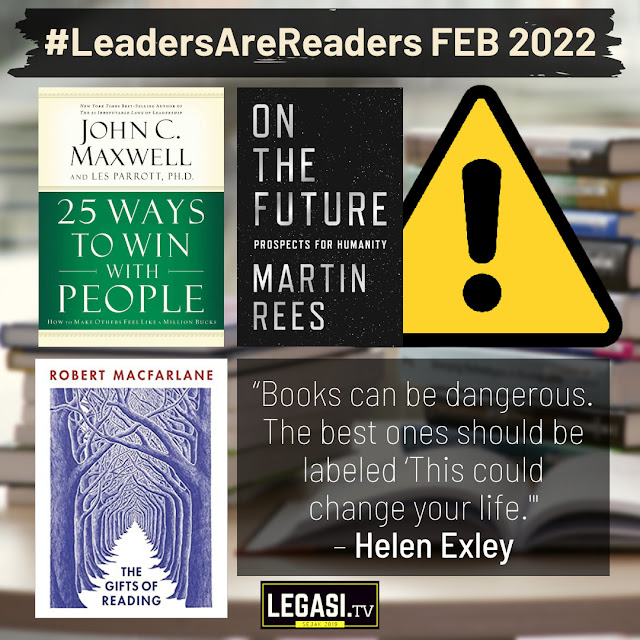
To read my book reviews of #LeadersAreReaders FEBRUARY 2022, CLICK LINKS below:

1) On the Future: Prospects for Humanity (2018) by Martin Rees https://bit.ly/OnTheFuture

2) The Gift of Reading (2016) by Robert Macfarlane https://bit.ly/MacfarlaneReading 

3) 25 Ways to Win With People (2005) by John C. Maxwell https://bit.ly/25WaysPeople 

4) The Previous book reviews https://bit.ly/1Book1Week 


FB Page: https://facebook.com/LEGASI.tv/                             
Podcast: http://bit.ly/LegasiSpotify                            
YouTube: https://www.youtube.com/c/LEGASItv/                        

THINK BIG. START SMALL. GO DEEP.
Best Blogger Tips

Friday, February 11, 2022

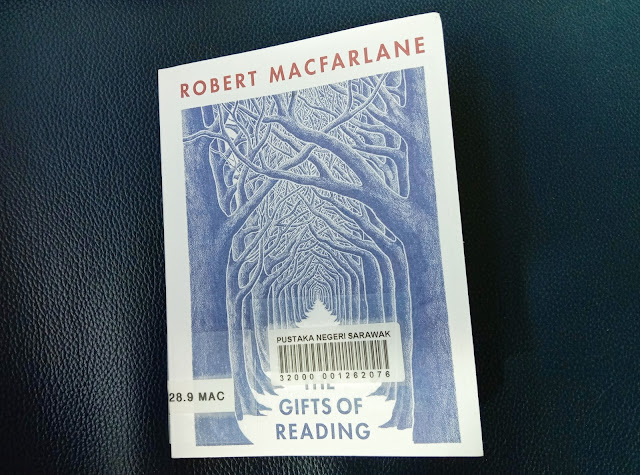
The Gifts of Reading (2016, 2017) by Robert Macfarlane, Review

In summary, this short essay by Macfarlane, the author of prizewinning and bestselling books about nature, place, and people, is his reflections on the unique emotional resonance of books given and received and how these acts of generosity "incite generosity." He begins by telling how he met his elderly friend, Don, who gave him books and their walks and conversations about their common love for literature. In between the essay, he shared about half a dozen of books that make a difference in his life and others around him, especially, Patrick Leigh Fermor's A Time of Gifts.

"Not all books received as gifts are transformative, of course. Sometimes the only thing a book gives its reader is a paper cut," writes Macfarlane. Funny and true. Then he continues, "But having been given so many astonishing books over the years, I now, in turn, give away as many books as I can. Birthdays, Christmases - I give books, and pretty much only books, as presents."

This reminds me of what I have done joyfully and aggressively in the past. When I first started blogging in 2010 - and I have a pretty good salary back then when I was working in the management and entertainment industry - I used to giveaways 3 to 5 books per month. I lost most of the connections with the recipients now (since I'm not active on social media anymore except for LEGASI.tv) but I do receive some good feedback from them years after that through email and WhatsApp. Their joy (I assume they were rejoicing) when receiving free books and my joy of giving books are interconnected and mutual. Today I still enjoy giving books but not as often as before. Perhaps this is what Macfarlane meant when he explains, "the gift can be transformative and that the act of giving encourages the onwards circulation of generosity."

Macfarlane ends his essay by telling how he and Don always wrote and sent books to each other after their farewell. One day, Don wrote to say that he had been diagnosed with cancer, and a year or so later, Don died. Rachel, Don's daughter, wrote an email to Macfarlane telling him about the news and letting him know that "reading kept [Don] alive right till the end." I closed the book and walked toward the glass window facing a peaceful lake outside Pustaka Negeri Sarawak library and whispered a thanksgiving prayer: "Thank you for the gifts of reading, Lord. Amen" 

#ServeToLead #LeadersAreReaders #TheGiftsOfReading #LetsMakeReadingCoolAgain

To read my other book reviews, CLICK HERE

FB Page: https://facebook.com/LEGASI.tv/                       
Podcast: http://bit.ly/LegasiSpotify                        
YouTube: https://www.youtube.com/c/LEGASItv/                    

THINK BIG. START SMALL. GO DEEP.

Best Blogger Tips

Saturday, November 20, 2021

The Corinthian Agenda (1982, 2004) by Michael Green, Summary-Review

 The Corinthian Agenda (1982, 2004) by Michael Green

“The apostle
[Paul]’s love for his wayward church at Corinth is very obvious,” concludes the late Dr. Michael Green, an author, evangelist, and theologian. “He had after all found it. He had visited them at considerable inconvenience on numerous occasions. He had poured out his heart in letters to them and sent colleagues to help them. They were very dear to him. And yet, like any good father, he has to correct their failures and weaknesses. I am thankful he did. For what he has to say is of enormous value for the contemporary church, if only we will heed it.” I agree. God’s church in Corinth was very privileged in the early New Testament times. Paul testified: “I always thank my God for you and for the gracious gifts He has given you, now that you belong to Christ Jesus. Through Him, God has enriched your church in every way…” and “you have every spiritual gift you need…” (1 Corinthians 1:4-5, 7).

But with all of these gifts, it doesn’t guarantee that the church is all well. The issues within the church in Corinth were very serious and yet it is a blessing for us today. Why? Because without them, we won’t know how to think theologically and handle practically based on the Scripture the same issues facing the church today! So we should thank God for using Paul to give us these two sacred letters - 1 and 2 Corinthians. These letters (the scholars suggest that perhaps Paul have written at least three or four letters to the Corinthians, two of them completely or partially lost) are a remarkable record of the relations “between the greatest of church planters and one of the most influential communities [Paul] founded and cared for.” In the period of reading this book, I also took time to read 1 & 2 Corinthians in the New Living Translation (NLT) and listened to audio Bible in King James Version (KJV) read by the legendary voice of Alexander Scourby. In this way, I can get the most from the Scripture and the book. I recommend this practice especially if you’re reading Bible commentary!

In this book, Michael Green (1930 - 2019) selected some very important issues or major themes and devoted a short chapter for each. This is not a verse by verse commentary but the author just wants to show how “Paul speaks directly to us over a broad range of issues in the Christian life, and speaks with an incisiveness, clarity, and authority that are rare.” There are 3 parts (The Church, The Members & Authority) and 17 short chapters on Mission, Baptism, The Lord’s Supper, Body Life, Love, Worship, Prophecy, Intellect, Freedom, Giving, Sex, Suffering, Death, Leaders, Women & Apostles. As you can see, some of these themes are still hot issues nowadays and very much debate between and within the Christian denominational circles. Of course, I don’t agree with everything Dr. Green writes but if I only read books that I agree with, what benefits will I get? For sure, he was very passionate for the word of God, always trying to provide a balanced view on difficult issues, making sure that important points have Scripture references, and aim to be as plain and practical as possible so that we can apply these truths or principles in our everyday life. The Corinthian Agenda (first published as To Corinth with Love) is a good overview of these sacred letters. But if you want to study in-depth I suggest getting a set of 1 & 2 Corinthians MacArthur New Testament Commentary and those from The Bible Speaks Today commentary series.

#ServeToLead #LeadersAreReaders #GrowingLeaders #MichaelGreen #TheCorinthianAgenda #GodsChurch #LetsMakeReadingCoolAgain

To read my other #1Book1Week book reviews, CLICK HERE

FB Page: https://facebook.com/LEGASI.tv/                                 
Podcast: http://bit.ly/LegasiSpotify                  
YouTube: https://www.youtube.com/c/LEGASItv/              

THINK BIG. START SMALL. GO DEEP.

Best Blogger Tips

Sunday, July 25, 2021

The Element: How Finding Your Passion Changes Everything (2009) by Ken Robinson, Ph.D, Book Review


The Element: How Finding Your Passion Changes Everything (2009)
by Ken Robinson, Ph.D. (with Lou Aronica)

"My aim in writing [this book]," writes the late Sir Robinson (1950 - 2020) in the introduction, "is to offer a richer vision of human ability and creativity and of the benefits to us all of connecting properly with our individual talents and passions." This aim resonates with my own belief and probably that was why I bought the book when I first saw it (or subconsciously I was influenced by his most popular TED talk of all time, Do Schools Kill Creativity? Check out his other TED talks too). As a student of the Word of God and a temporary citizen of the world, I firmly believe in the depths of human depravity and at the same time, I have a high view of human ability and potential. The lens of which I read this book is from the Biblical worldview but let me write this review from the humanistic worldview as it is written.

What is the Element? Sir Robinson defines it as "the place where the things we love to do and the things we are good at come together." I find that this concept is not unique. For example, Jim Collins' The Hedgehog Concept consists of these two factors and another one, namely, what drives your economic engine. And the Japanese Ikigai is more detailed which consists of what you love, what you are good at, what the world needs, and what you can be paid for. But what makes Ken's Element interesting is that - besides its simplicity - it takes a holistic approach not just from an individual perspective (like Ikigai) or from the business standpoint (like Jim Collin's Good To Great) but the discovery of the Element will not only makes us more fulfilled "but because, as the world evolves, the very future of our communities and institutions will depend on it." In The Afterword, he is making a good case about this. Of all the inspiring stories told in the book about how people like Richard Branson, Paul McCartney, Arianna Huffington, Paulo Coelho, etc. from very different backgrounds and circumstances found their Elements and self-help antidotes permeate throughout the pages (I love the chapters on Think Differently, Beyond Imagining, Finding Your Tribe & What Will They Think?), one subject that sparks my most interest is on EDUCATION (the last chapter Making the Grade focus on this).

"Many of the people we've met in this book didn't do well at school, or at least didn't enjoy being there," emphasized Sir Robinson. "Of course, many people do well in their schools and love what they have to offer. But too many graduate or leave early, unsure of their real talents and not knowing what direction to take next. Too many think they're not good at anything." This is exactly the problem that I see in most of the education systems in the world today especially in Malaysia. In school and university, I was an average student based on the system standards. My teachers think I'm smart at mathematics because I get an A and dumb in English because I get a D but in my job now it doesn't require my math skill to succeed but my ability to communicate well that is more important. My parents gave me approval when I get a B+ for history and disappointed when I get a C for science but as it turns out I'm more interested in the wonder of science now than the history lessons of Kesultanan Melayu Melaka. I studied civil engineering in the university to secure a good future vocation but God ends up calling me to be in the full-time Christian ministry. I appreciate every experience and education that I've learned when I was in school and university but truth be told I only discover my Element - what I love to do and the things that I'm good at - years after I left that 'cage' and enter the real world.

I'm not anti-education (as you can see from the volume and variety of interests that I have and the books that I read) but I'm against standardizing education. "One size does not fit all," said the author. For example, in school, the measure of our smartness or intelligence is based on our test or exam results. If you have a good memory, are very intellectual, and know the 'right' answers, you will definitely get good grades. But human intelligence is not limited to knowledge-based or one-right-answer for everything. Our human intelligence, explains Sir Robinson, is extraordinarily diverse, tremendously dynamic, and entirely distinctive (or unique). The question we should ask is not "How intelligent are you?" which suggest limitation but "How are you intelligent?" which suggest many possibilities. By schooling standard, culinary arts is probably the secondary subject (if any) but look at what Datuk Chef Wan has accomplished and sports or PJK may be seen as a recreational subject but see what Pandelela Rinong has become. Both of them have discovered their Elements in the less known (or order of importance) subjects in school. How about others who have these talents too but are unable to express them because they are stuck in a mathematics group study, language class, and science tuition to get good grades at school which may or may not be relevant to them in the ever-changing future?

"The fact is that given the challenges we face, education doesn't need to be reformed - it needs to be transformed." Sir Robinson continues: "The key to this transformation is not to standardize education but to personalize it, to build achievement on discovering the individual talents of each child, to put students in an environment where they want to learn and where they can naturally discover their true passions. The key is to embrace the core principles of the Element. Some of the most invigorating and successful innovations in education around the world illustrate the real power of this approach." Yes, I agree wholeheartedly! There are other gems and aha moments that I get from this book. I haven't mentioned another subject that I'm very interested in, namely, CREATIVITY. But enough for me to say: if you're still in search of your Element and you want to be inspired and if you are in the business of helping others to discover their Elements, read this book!

[Note: There is a follow-up book after this one, Finding Your Element: How to Discover Your Talents and Passions and Transform Your Life (2014). I suggest, if you already read The Element, you don't need to read this one because the contents are apparently not that good. Average. Just find his keynotes and talks on this subject online. Try YouTube videos.]

#ServeToLead #LeadersAreReaders #GrowingLeaders #KenRobinson #TheElement #EducationSystem #LetsMakeReadingCoolAgain

To read my other reviews of #1Book1Week CLICK HERE

FB Page: https://facebook.com/LEGASI.tv/                           
Podcast: http://bit.ly/LegasiSpotify            
YouTube: https://www.youtube.com/c/LEGASItv/        

THINK BIG. START SMALL. GO DEEP.

Best Blogger Tips

Wednesday, September 25, 2019

Angelus' Quote: The 10 Commandments for Guiding Your Children


I have no credential to teach parents 🚫 Its easier to say (and post) until one has their own children. So, with the help of J. David Branon, regular contributor to Our Daily Bread (ODB) Ministry, 😉 here are 10 Commands for guiding your children:

1) Teach them, using God's Word (Deuteronomy 6:4-9)

2) Tell them what's right and wrong (1 Kings 1:6)

3) See them as gifts from God (Psalms 127:3)

4) Guide them in godly ways (Proverbs 22:6)

5) Discipline them (Proverbs 29:17)

6) Love them unconditionally (Luke 15:11-32)

7) Do not provoke them to wrath (Ephesians 6:4)

8) Earn their respect by example (1 Timothy 3:4)

9) Provide for their physical needs (1 Timothy 5:8)

10) Pass your faith along to them (2 Timothy 1:5)

#ServeToLead #GrowingLeader

THINK BIG. START SMALL. GO DEEP.


Best Blogger Tips

Tuesday, September 3, 2019

Angelus' Quote: Faithful Friend Is Very Valuable


Rosalie Carter, wrote a great poet on friendship 😉🔥👇:

I think that God will never send,
A gift is so precious as a friend.
A friend who always understands,
And fills each need as it demands.
Whose royalty will stand the test,
When skies are bright or overcast.
Who sees the faults that merit blame,
But keeps on loving just the same.
Who does far more than creeds could do,
To make us good, to make us true.
Earth's gifts a sweet contentment lend,
But only God can give a friend!
_______________________________________


THINK BIG. START SMALL. GO DEEP.

Best Blogger Tips

Monday, September 2, 2019

Angelus' Quote: God Has Given Us Different Gifts for Doing Certain Things Well


Deep within the human spirit lie a longing and a capacity to do significant things. Because you are made in the image of God, you inherited from him the desire to create, to accomplish, to make things happen.

God wouldn't give you these desires without the ability to carry them out. These abilities are gifts from God to help you accomplish great things for him and to live a fulfilling life. How you use or misuse them ultimately determines your quality of life - not defined by comfort or the accumulation of wealth, but by strong character, joy, and lasting satisfaction.

Your goal is to discover your abilities, develop them, and channel them toward what will achieve the greatest good for the people you lead. When God asks you to accomplish something, he gives you the resources to get the job done. Therefore, if God has put you in a position of leadership, he has given you the abilities you need 😉
_______________________


THINK BIG. START SMALL. GO DEEP.

Best Blogger Tips

Tuesday, February 5, 2019

Maximize God-give Time: 4 Basic Time Management Tools

Alan Lakein puts it this way: “Time = life; therefore, waste your time and waste of your life, or master your time and master your life.” Ouch! It is difficult to manage time if you don't have the right tools. Here are the tools that I use personally. For me, it doesn't matter whether your tool is paper or Apps base, as long as you have them, use it!


THINK BIG. START SMALL. GO DEEP.
Best Blogger Tips

Monday, January 21, 2019

Making the Very Best of What Small Talent or Skill(s) that You Have


I believe that anyone – and that mean you and me – can make it BIG. As I read about successful people (Steve Jobs, Richard Branson, Thomas Edison, Bill Gates, etc), not just those who make it financially but also spiritually (J.I. Packer, C.H. Spurgeon, Martin Luther, etc), to learn from them and work out how they made things happen, it became more and more obvious that every single person I studied was pretty much a doer and not just a dream – they try things. No magical power or secret plan – they try things. It’s not about knowledge, or to make it more accurate, it’s not just about knowledge (maybe with the exception of Leonardo da Vinci). No matter how much or little knowledge someone has, none of us will ever make it unless we GIVE SOMETHING A GO.

Most people who are deemed successful are simply making the very best of what small talent or skills they have. They have simply taken steps to maximize a tiny amount of potential (see my previous post) by constantly honing and perfecting one specific area of their talent or skill until it grew. Then, they always surround themselves with good books and/or people who can help them to exploit that talent or skill. Robert Collier once said, “Success is the sum of small efforts, repeated day in and day out.” Mark Twain put it another way: “The secret of getting ahead is getting started. The secret of getting started is breaking your complex, overwhelming tasks into small manageable tasks, and then starting on the first one.” Or as I always say, the philosophy of my blog:


THINK BIG. START SMALL. GO DEEP.
Best Blogger Tips

Use Your God-Given Potential


THINK BIG. START SMALL. GO DEEP.
Best Blogger Tips

Monday, December 24, 2018

Three Feet from Gold: Turn Your Obstacles Into Opportunities! (2010) by Sharon Lechter with Greg Reid, Book Review


Three Feet from Gold: Turn Your Obstacles Into Opportunities! (2010)
by Sharon Lechter with Greg Reid

One of the most common causes of failure is the habit of quitting when one is overtaken by temporary defeat.” This interesting success journey allegory (or fable) is based on Napoleon Hill’s revolutionary bestseller Think and Grow Rich. It is about a young entrepreneur, Greg Reid (co-author as the character), who was struggling in his business and life, went through a life-changing series of encounters with some of today’s foremost business leaders and inspirational figures. When he was about to give up, only “three feet from gold,” his mentors inspired him with their stories and encouragements. When I read his story, I read mine. Truly, Napoleon once said: “Every adversity, every failure, and every heartache carries with it the seed of an equivalent or greater benefit.

The title Three Feet from Gold is based on a real-life story of R.U. Darby (you can find it in Think and Grow Rich introduction). His uncle had been struck by gold fever. He had traveled west to get rich in the mining business. In the book, Don Green, one of Greg interviewees told him the story: “This would-be prospector had many more hopes than solutions, you see because he had not invested the time to learn how to do what he wanted to accomplish. He just wanted to find gold… Fortunately, after weeks of manual labor, Darby’s uncle was rewarded with the discovery of gold, and lots of it! While it was a good problem to have, he quickly realized that he really wasn’t prepared. He needed machinery to remove the enormous amount of heavy rocks and dirt that covered the shining ore…” to own machinery it will cost lots of money, so Darby’s uncle covered the mine and traveled back to his home to persuade his family and friends to invest for the equipment needed. After that, he and young Darby return to the gold mine and start digging for the promised treasure. Sure enough, they found high-quality gold!

Don continues, “Darby and his uncle were convinced they were about to make a huge fortune from their gold mine. Then tragedy struck… the gold simply disappeared. Just when their hopes were at their highest, the Darbys were crushed to reach the end of the rainbow – the proverbial pot of gold was no longer there… Discouraged and defeated, Darby and his uncle sold both their mine and their equipment to a local junkman… With that, [they] caught the next train and returned to their home in Maryland, ending their quest for gold… [But] the junkman hired a mining engineer to inspect the claim, and together they discovered what is known as a fault line. The engineer explained that gold ran in long veins and that the previous owners had simply drilled through one side of the vein and come out the other. The engineer explained that if the junkman were to go back and dig in the other direction, perpendicular to where the Darbys had made their first discovery, he would most likely tap back into the treasure… [He] followed these simple instructions and, sure enough, he hit one of the largest pockets of ore ever uncovered – a mere three feet away from where the Darbys had quit mining…” They quit only three feet from gold!

Darby learned his lesson and used that experience as motivation for him not to quit his next chosen work. Hill recorded him saying: “I stopped three feet from gold, but I will never stop because men say ‘no’ when I ask them to buy insurance.” You know what? Darby became one of the most successful salesmen of his time. When Greg heard this story, he was determined not to quit from pursuing his dreams in business and life. Through ups and downs, external circumstances and internal conflicts, Greg don’t – but almost – quit! By the end of the chapter, Greg and his co-author, Sharon Lechter (both as characters in the book itself) produced a book based on his interviews and life experiences. They came out with The Success Equation, namely, ((P + T) x A x A) + F. P stands for Passion, something that makes your heart sing; with T stands for Talent, something you excel in; multiply it by the right A stands for Association, successful people or organizations; and A stands for Action, concrete steps you can take toward your goal; and then add your F stands for Faith, the unwavering belief in yourself. So, keep moving toward your God-given dreams, never giving up or quitting – you are Three Feet from Gold!

THINK BIG. START SMALL. GO DEEP.

Best Blogger Tips

Sunday, December 16, 2018

Angelus' Quote: You Already Have RM86,400 In Your Bank Account Daily


Let's say this is real. An officer calls from the bank and tells you, "Someone who loves you very much and is very wealthy has given you a large sum of money. This anonymous donor will be depositing Rm86,400 into your account every single day." "Who is that? Why?" you ask curiously. "He wants to be known as an anonymous giver, but he loves you very much. Every single day, he will deposit Rm86,400 into your account." "That's pretty huge amount?!" You're surprised and still curious.

"But there is one condition," the officer continues. "You have to spend it every single day. You can't save it up. You can't add it to the next day's balance. Every day, you must spend that money. What is not spent will be taken away. The man will do the transaction every day, but the condition is that you must spend the money." Still surprised, you push a calculator App and calculate, 86,400 x 365 days = Rm31,536,000 or Rm31.535 million a year! That's a humongous amount and unreal... Yes, this is only a fantasy.

But let's deal with reality. Someone who really does love you very much deposits into your bank of time 86,400 seconds every single day. That someone is God. In Christ, He refused to be unknown to us anymore. Jesus, God with us, Emmanuel. That's grace-bank-account. So, the condition is that you must spend it. You can't save up time today and apply it toward tomorrow—there's no such thing as 25 hours or 23 hours a day. Only 24 hours for each person. Each and every day, you have the opportunity to invest your precious commodity of time.

The psalmist wrote, "Show me, O Lord, my life's end and the number of my days; let me know how fleeting is my life" (Psalm 39:4). Paul also has a very time-conscious line: "Be very careful, then, how you live—not as unwise but as wise, making the most of every opportunity, because the days are evil. Therefore do not be foolish, but understand what the Lord's will is" (Ephesians 5:15-17). This my time theology: Lost time is never found again so use God-given time wisely. Every second count! How do you spend your time? Do you invest in it or waste it? Do you seize the day or let it slip?

Instagram -> Richard_Angelus

THINK BIG. START SMALL. GO DEEP.
Best Blogger Tips

Sunday, September 30, 2018

If Your Gift Is Writing (or Whatever Your Gifts Are), Do It to Honor God and to Benefit Others (Read 1 Kings 3:1-15)


So far, King Solomon had carefully lived by God's Wonderful Law and He gave him success. Solomon asked God for wisdom, and with it, God gave him economic prosperity and fame. "[Give] to Your servant an understanding heart to judge Your people, that I may discern between good and evil…," (1 Kings 3:9, NKJV) asked Solomon. God was pleased with Solomon's prayer, He replied, "Because of you have asked this thing… for yourself understanding to discern justice, behold, I have done according to your words; see, I have given you a wise and understanding heart, so that there has not been anyone like you before you, nor shall any like you arise after you. And I have also given you what you have not asked…" (1 Kings 3:11-13). Solomon asked for wisdom to lead God's people; God gave him the wisdom to serve others. In short, God had given you gifts, talents, and potentials so that we can use it to do His will. When we do, everyone else benefits.

"I recently flew to St. Louis on a commercial airline," recalled Max Lucado in his book Cure for the Common Life (2005), "The attendant was so grumpy I thought she'd lemons for breakfast. She made her instructions clear: sit down, buckle up, and shut up! I dared not request anything lest she pushes the eject button. Perhaps I caught her on a wrong day, or maybe she caught herself in the wrong career.

Two weeks later I took another flight. This attendant had been imported from heaven. She introduced herself to each passenger, had us greet each other, and then sang a song over the intercom! I had to ask her, ‘Do you like your work?' ‘I love it!' she beamed. ‘For years I taught elementary school and relished each day. But then they promoted me. I went from a class of kids to an office of papers. Miserable! I resigned, took some months to study myself, found this opportunity, and snagged it. Now I can't wait to come to work!'…

"You can do something no one else can do in a fashion no one else can do it. Exploring and extracting your uniqueness excites you, honors God, and expands His Kingdom. So ‘make a careful exploration of who you are and the work you have been given, and then sink yourself into that' (Galatians 6:4, The Message). Discover and deploy your knacks," concluded Max. If you were given Solomon's opportunity to ask for anything, what would you choose? Would your requests benefit others if God granted them?

In your prayer, as you about to finished reading this blog post,
Ask God for your heart's desire (I always wanted to inspire others).
Trust in God's generosity to you (He gave me the wisdom to write).

THINK BIG. START SMALL. GO DEEP.
Best Blogger Tips

Saturday, August 25, 2018

Book Review: Sit, Walk, Stand (1957) by Watchman Nee


Sit, Walk, Stand (1957) by Watchman Nee
 Compiled and Edited by Angus I. Kinnear

Nee To-sheng or Watchman Nee (1903-1972) is remembered for his leadership of an indigenous church movement in China, as well as for his books especially The Normal Christian Life, which continue to enrich Christians throughout the world. Beginning in the 1930s, Nee helped establish local churches in China that were independent of foreign missionary organizations and were used to bring many into the Kingdom of God. From these roots sprang many of the house churches that continued to meet after Western missionaries were forced to leave the country during the Cultural Revolution. Arrested in 1952 and found guilty of a large number of false charges, Watchman Nee was imprisoned until his death in 1972. Sit, Walk, Stand was compiled from the spoken ministry of Nee at Foochow during "the spacious days of the evangelistic witness in China just prior to the Japanese war, when the author and his fellow Christians enjoyed a liberty in the service of God that is rare today,” writes Kinnear.

In this small book or rather, in his sermon talks, Nee "expresses [the believers'] triumphant assurance in the finished work of Christ." To show this, Nee summed up the epistle of Ephesians ("the highest spiritual truths concerning the Christian life") into two parts, and three sections as follow:

A) Doctrinal (Chapter 1 to 3)
1. SIT: Our Position in Christ (1:1-3:21)
B) Practical (Chapter 4 to 6)
2. WALK: Our Life in the World (4:1-6:9)
3. STAND: Our Attitude to the Enemy (6:10-24)

In the first section of the letter to the Ephesians, Nee notes the word "sit" (2:6), which is the secret of a true Christian experience. God has made us sit with Christ in the heavenly places and every Christian must begin his or her spiritual life from that place of rest. "Christianity does not begin with walking," writes Nee, "it begins with sitting." He continues, "Most Christians make the mistake of trying to walk in order to be able to sit, but that is a reversal of the true order… Christianity is a queer business! If at the outset we try to do anything, we miss everything. For Christianity begins not with a big DO, but with a big DONE." We are invited at the very outset to sit down and enjoy what God had done for us; not to set out to try and attain it for ourselves. We must start with "sit" and not "walk" or "stand." Walking implies effort, whereas God says that we are saved, not by works, but "by grace… through faith" (Ephesians 2:8).

In the second section, Nee select the word "walk" (4:1) as expressive of our life in the world, which is its subject. We are challenged to display in our Christian walk conduct that is in keeping with our high calling. Nee rightly observes that "too many of us are caught acting as Christians. The life of many Christians today is largely a pretense." So what we should do? He says, "Our life is the life of Christ, mediated in us by the indwelling Holy Spirit himself, and the law of that life is spontaneous. The moment we see that fact we shall end our struggling and cast away our pretense. Nothing is as hurtful to the life of a Christian as acting; nothing so blessed as when our outward efforts cease and our attitudes become natural – when our words, our prayers, our very life, all become a spontaneous and unforced expression of the life within." Though Christian life begins with sitting, sitting is always followed by walking. We found our strength in sitting down, then we must begin to walk. Sitting is our position, while walking is our practice.

And finally in the third section, Nee emphasizes the key to our attitude towards the enemy contained in the one word "stand" (6:11), expressive of our place of triumph at the end. Yes, Christian experience begins with sitting and leads to walking, but it does not end there. Every Christian must also learn to stand. "Each one of us must be prepared for the conflict," encouraged Nee. "We must know how to sit with Christ in heavenly places and we must know how to walk worthy of him down here, but we must also know how to stand before the foe." Who is our archenemy? It is Satan and his fallen angels! Ephesians 6 is Paul's plea for us to stand against them. But we stand not by our own might and determination, we stand "merely on the ground which the Lord Jesus has gained for us." Nee confidence that when our eyes are really opened to see Christ as our victorious Lord, we can stand firm. No doubt!

I breathe "amen" as I finished reading this book; I gave praises to God for these refreshing words; I repositioned myself to sit near to Him. I'm reading Ephesians again in the new light! Dear friends, the Christian life really consists of sitting with Christ, walking by Christ, and standing in Christ. Watchman Nee concludes this precious book this way: "We begin our spiritual life by resting in the finished work of the Lord Jesus. That rest is the source of our strength for a consistent and unfaltering walk in the world. And at the end of a grueling warfare with the hosts of darkness, we are found standing with Him at last in triumphant possession of the field." Unto Him… be the glory… forever. Amen.

THINK BIG. START SMALL. GO DEEP.

More on Watchman Nee:

1) Secrets of Watchman Nee: His Life, His Teachings, His Influence (2005) by Dana Roberts (click HERE: http://richardangelus.blogspot.com/2017/10/book-review-secrets-of-watchman-nee-his.html)

2) Watchman Nee: Man of Suffering (1998) by Bob Laurent (click HERE: http://richardangelus.blogspot.com/2017/10/book-review-watchman-nee-man-of.html)


Best Blogger Tips

They Click it A lot. [Top 7 last 7 Days]