Showing posts with label Digital Life. Show all posts

Monday, March 7, 2022

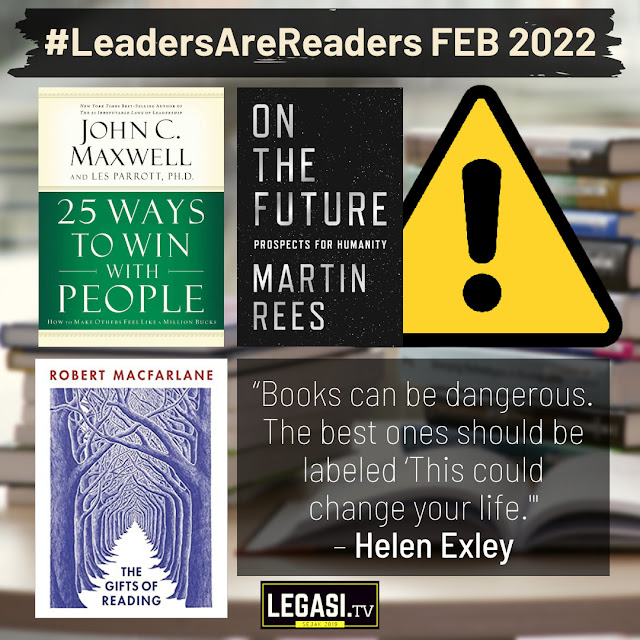
Read Books and Beat the Goldfish! #LeadersAreReaders February 2022

Currently, I’m rereading Chris Bailey’s Hyperfocus (2018). When I went to MPH Bookstore the other day, I saw a new book that interest me by Johann Hari entitled Stolen Focus (2022). But the price is so expensive, RM89.90! I understand the book business is having a hard time nowadays and in the same way, owning physical books and encouraging people to be readers is getting hard too (state libraries and discount bookstores like BookXcess are saviors for bibliophiles). Not that I cannot afford to buy the book but as I browse through the contents - besides having newer research and the author’s unique perspectives - I realize that the challenge of managing attention and focus today is the same as yesterday. No new book can claim that this is a new phenomenon. Thus, I reread Hyperfocus and settle with just listening and watching interviews of Johann Hari online… hoping that soon the State Library will have it available. Lord, have mercy.

Reading a book requires a good deal of attention,” writes Chris Bailey, “and with attention becoming a rare commodity, fewer people can devote themselves to reading without distraction.” Attention is our most limited and constrained resource. According to Microsoft Attention Spans Research Report*, the average human attention span in 2000 is 12 seconds and in 2013, it decreased drastically to 8 seconds (I don’t know how they measure this, but the goldfish have an average attention span of 9 seconds. 1 second longer than the average human!). In today’s fast-paced world of information overload, we’re constantly flooded with social media notifications, text messages, and games. Smartphone users, like you and me, check our devices about 80 to 90 times a day. No wonder we are so distracted. This is one of the reasons for the decline of book-reading culture in Malaysia and the world in general.  We still read but read bits and pieces of information. We have amassed lots of random information but lack actual knowledge, depth, and wisdom. This is not just affecting the overall quality of our work-life (or study-life, if you’re a student) but also the state of our mental health and spirituality.

Therefore, you must cultivate a love for reading books. It helps to train you (or force you, at the beginning) to increase your attention spans. It requires attention and it improves your attention. Jessalyn Lau, from the neuroscience perspective, says: “Reading has been proven to increase your focus, attention span, concentration, and to improve memory.” Perhaps you say you don’t have time to read books. I get what you mean. You have works to do, family to care for, products to promote, etc. But “no time” is a myth. Unless you move at the speed of light and the theory of special relativity applied to you, we all have the same amount of time. It's not about you don’t have time but it's about you MAKE time. We have no problem carving out time for things we want to do. So, take or buy a book that interest you, set an uninterrupted time (10 to 15 minutes for a start) today, turn off or switch your smartphone to silent mode and put it away from your reach, make a cup of hot coffee or tea or chocolate and start reading! Start small but do it frequently. At first, you will still be easily distracted. However, over time it will become a habit. And soon, you will be proud of yourself because you have beat the goldfish attention span record! Congratulation!

*https://www.scribd.com/document/265348695/Microsoft-Attention-Spans-Research-Report  

#ServeToLead #Hyperfocus #AttentionSpans #BeatTheGoldfish #LetsMakeReadingCoolAgain

To read my book reviews of #LeadersAreReaders FEBRUARY 2022, CLICK LINKS below:

1) On the Future: Prospects for Humanity (2018) by Martin Rees https://bit.ly/OnTheFuture

2) The Gift of Reading (2016) by Robert Macfarlane https://bit.ly/MacfarlaneReading 

3) 25 Ways to Win With People (2005) by John C. Maxwell https://bit.ly/25WaysPeople 

4) The Previous book reviews https://bit.ly/1Book1Week 


FB Page: https://facebook.com/LEGASI.tv/                             
Podcast: http://bit.ly/LegasiSpotify                            
YouTube: https://www.youtube.com/c/LEGASItv/                        

THINK BIG. START SMALL. GO DEEP.

Best Blogger Tips

Tuesday, May 25, 2021

Unplugged: How to Live Mindfully in a Digital World (2014) by Orianna Fielding, Book Review

 
Unplugged: How to Live Mindfully in a Digital World (2014) by Orianna Fielding

I'm very interested in digital psychology and the impact of digital technology on our mental health for many years now (for book and TED Talk recommendations, see lists below). And thus, the research studies and the author's personal experiences, although some of the ways she processes the information are unique, are very familiar to me. But it's good to be reminded over and over again about the dangers of digital addiction and how to overcome it. "Connectivity now permeates every area of our lives," admits Fielding, an internationally recognized designer, and curator, "Technology has enabled us to do things that ten years ago were unthinkable. It has also completely changed many of the elements that historically formed the foundation of how we lived and interacted with each other, increasingly adversely affecting the most essential and fundamental elements of being human."

Granted, every one of us thinks about technology differently and our level of relationship to it is based on our context, purpose, and personality. Let's talk about the most familiar digital technology: social media on the smartphone. For example, I don't see any intrinsic value in Twitter because either the post is too trivial (mean useless to know) or abridge (mean too short to care). But for my friend, Peter, Twitter is just right because he only wanted to know the main headline of the news. I also see Instagram as non-beneficial for me because the Algorithm is specially designed for users to post as frequently as possible and looking at mosaic photos of myself is just weird (plus, I'm not that attractive). But for a businesswoman like Sarah, Instagram is a haven for potential customers, or Jilian, a social media model, Instagram is just the right tool to showcase her beauty and beauty products. However, I love YouTube and Spotify the most because they contain wide treasures of knowledge, information, and entertainment. I spent most of my time here as opposed to any other social media. So you see, the way we choose to connect with our social media is not one-size-fits-all. But do you know what is our similarity? To some degree, all of us are ADDICTED to social media - and generally speaking, to digital technology. Like it or not, "we are living in a culture dominated by digital excess."

At the beginning of the book, Fielding outlines 12 signs of digital overload. Let me share the 6 most frequent signs, in summary: 1) Checking your digital device first thing in the morning, getting up during the night to check for messages, and regularly using some form of digital device in bed; 2) Checking your smartphone while at a meal with others; 3) Spending little time outside and often eating at your desk; 4) Getting distracted easily even when offline and finding it hard to focus fully on one task; 5) Being with family members but spending most of your time at home on a device; and 6) Wanting to stop using your smartphone and finding that you just can't, having tried repeatedly but unsuccessfully to control your internet use. If you can identify with most of these signs, then, this may be a good indicator that it might be the right time for you to unplugged, undertake a digital detox, and reboot your life. I believe it is not about letting go of digital technology altogether - in fact, if we want to progress in life, we must embrace it - but making sure that it doesn't control our lives. Fielding equips: "Unplugging is not so much a disconnection as a fine-tuning of our inner search engine. Practicing moderation by finding a workable balance between our digital connectivity and our real-life connections is the key to establishing a new digital protocol where we can be fully present in our lives while using our digital devices as the tools they were designed to be."

There are lots of tips, suggestions, and very useful digital detox ideas outline in this book. It is never mean to be taken literally but you must try it for yourself first (remember, our context, purpose, and personality are different) and modify your practices along the way. Think big, start small, go deep. Perhaps, you can join me in reading books!  #1Book1Week ��� I know you can if you read this till the end ��� It is possible! ��������� #Unplugged #DigitalDetox #LeadersAreReaders #GrowingLeaders #LetsMakeReadingCoolAgain

 Book and TED Talk recommendations:

 1) Deep Work: Rules for Focused Success In a Distracted World (2016) by Cal Newport. CLICK HERE to read my review. Watch his TED Talk too.

 2) Hyperfocus: How to Be More Productive In a World of Distraction (2018) by Christ Bailey. Watch his TED Talk too. I didn't manage to write a review for this one.

 3) Six Books on the Effect of Technology & Social Media. CLICK HERE to see my recommendations.

4) TEDx Talk: What You Are Missing While Being a Digital Zombie by Patrik Wincent https://youtu.be/TAIxb42FjwE  

5) TED Talk: Connected, But Alone? by Sherry Turkle https://youtu.be/t7Xr3AsBEK4 

6) How about documentaries? Let me suggest two - Disconnected (2017) directed by Salem Habbous https://youtu.be/MkIiMP--1h8 & The Social Dilemma (2020) directed by Jeff Orlowski on Netflix

FB Page: https://facebook.com/LEGASI.tv/                      
Podcast: https://anchor.fm/LEGASI.tv/              
YouTube: https://www.youtube.com/c/LEGASItv/    

THINK BIG. START SMALL. GO DEEP.


Best Blogger Tips

Saturday, May 16, 2020

Six (6) Books on the Effect of Technology & Social Media


Technology has overwhelmed our daily lives to the point of constant distraction. Many of us can no longer focus on a single task or face-to-face conversation without wanting to reach out — or retreat — to the virtual world every few minutes. At the peak of my addiction to social media, keeping my discipline to write an article a day for my blog was very difficult. But with the helped of these books (and more) I've come to understand why and how to overcome my constant dependency on technology Now my problem is I have too many ideas and materials to write!

If you want to explore why, how and what makes technology and social media so addictive and to better take control of your life rather than be controlled by these tools, I recommend reading these books:
The Church of Facebook: How the Hyperconnected Are Redefining Community (2009) by Jesse Rice

The Digital Diet: The 4-step Plan to Break Your Tech Addiction and Regain Balance in Your Life
Book (2011) by Daniel Sieberg > borrowed from the library

IDisorder: Understanding Our Obsession with Technology and Overcoming Its Hold on Us
Book (2012) by Larry D. Rosen > borrowed from the library

Dot Complicated: Untangling Our Wired Lives (2013) by Randi Zuckerberg

Reclaiming Conversation: The Power of Talk in a Digital Age (2015) by Sherry Turkle

Digital Minimalism: Choosing a Focused Life in a Noisy World (2019) by Cal Newport > listened to the audiobook


THINK BIG. START SMALL. GO DEEP.
Best Blogger Tips

Thursday, July 18, 2019

BOOK REVIEW Goodbye, things: on minimalist living (2017) by Fumio Sasaki


Goodbye, things: on minimalist living (2017) by Fumio Sasaki

This book was first published in Japan as Bokutachi ni mou mono was Hitsuyou Nai in 2015. A minimalist, said Fumio, an ex-messy-maximalist, is "a person who knows what is truly essential for him – or herself, who reduces the number of possessions that they have for the sake of things that are important to them." What important for each of us are vary, but the essential needs are almost similar. Minimalists "are people who know what's truly necessary for them versus what they may want for the sake of appearance, and they're not afraid to cut down on everything in the second category." It's about choosing needs rather than wants.

Minimalist is a buzzword at Japan (many years ago) and in some other countries today since the publishing of a smash-hit book by Marie Kondo in 2010, The Life-Changing Magic of Tidying Up. But for Fumio, he suspects that there are already many minimalists around but since the publishing of Marie's book, they ‘emerged' in Japan. For him, there are three major contributions to the phenomena – in the background – namely:

#1 Information and Material Overload. "…we need to get rid of the extra load that isn't needed."

#2 The Development of Technology and Services that make it possible for us to live without as man possessions as we had in the past. "…we can now get by without actually owning a lot of things.

#3 The Great East Japan Earthquake. When the not-so-recent tsunami struck the country of Japan (I was there to see the aftermath of the tragedy of tsunami. Horrible!), the people realized that "all of their cherished objects were washed away by the tsunami. Everything had been ruined."

Due to these three contributors, Fumio believes that "minimalism had to be born," the desire and fervent need to rethink our lives. I agree! Throughout the book, the author explains why he became a minimalist and why we have this habit of accumulating so many material things in the first place. Fumio also offers some basic rules and techniques for reducing our material possessions: 55 tips to help you say goodbye to your things, 15 tips for the next stage of your minimalist journey, and 12 ways he has changed since he said goodbye to his things. In short, this book is both personal, a bit of theoretical and very practical. In the last chapter, Fumio describes the different between ‘feeling' happy and ‘becoming' happy. The philosophy of minimalist is so persuasive and urgent for today. Do not be intimidated by the element of Zen Buddhism teachings (this is not a religious book I can assure you) if you're not a Buddhist. It's the way of living, not a religion.

I'm moving to my apartment this coming September. This book helps me to think through about the possessions that I have, how to design my apartment and what to buy or get away with so that I can live happier, freer and lighter. There is one tip that I don't agree with him and will never subscribe to – get rid of my books! No. Books are part of me. I will sell some but mostly I will keep. If to be minimalist means reducing unnecessary items, then books for me is a necessity. Period.

[P.s: By the way, this book remind me of why I love Japan so much. Been there and I've witnessed minimalism in action (memories such as sleeping on a block of wood). Would love to be back soon.]

FB Page: https://web.facebook.com/LEGASI.tv/
IG: https://instagram.com/richard_angelus

THINK BIG. START SMALL. GO DEEP.

Best Blogger Tips

Tuesday, April 3, 2018

The Four-Dimensional Human: Ways of Being in the Digital World (2016) Book Review


The Four-Dimensional Human: Ways of Being in the Digital World (2016)
by Laurence Scott

"You are a four-dimensional human. Each of us exists in three-dimensional, physical space. But, as a constellation of everyday digital phenomena rewires our lives, we are increasingly coaxed from the containment of our pre-digital selves into a wonderful and eerie fourth dimension, a world of ceaseless communication, instant information, and global connection." This is what it means by the four-dimensional human today.

This is predominantly a philosophical and existential book of musings of our entry into an existence in the digital world. Lawrence discusses how things have changed due to digitization and the dynamics of social media and how we have evolved to use it for better or worse. Lawrence takes us on a journey through modern-day digital workings, evaluating where the line now blurs between where our physical presence ends and online/digital begins. He also attempts to answers questions like, how have phone calls changed? Do we catch up with friends any more, or do we just confirm what we already have learned from social media profiles? Will the internet be able to unite race, gender, and sexual orientation? Is this shared consciousness or hive mind we have created help or hinder us? Is originality going out the window? and many more.

This book also talks us through how death and mourning have changed due to the family being able to carry on the memory of their loved one through social media, and also people's pain and suffering is so available to everyone they know. Lawrence explains that how we treat people has changed due to social media, how we may forget people quicker if they don't share, like our content or interact. Digitisation can affect your home life, work life and social life in so many different ways and the author takes us through those eventualities and shows us what can happen.

There are some sad truths here, but with negativity comes positivity and there is plenty of positive thoughts and opinions that weave themselves through this thought inducing and life-changing material. Are we more united due to the internet? Is having a clearer picture of the companies we buy from good for the soul? We can see more of the world than ever before and with exploring comes perspective, and there is plenty of perspectives here! [P.s: Although I think that the author could write better if he organized his material properly and orderly, and by making this book shorter and concise I bet he will attract more (simple) readers. Btw, I borrowed this book from UCSI Sarawak library. Thanks!].


THINK BIG. START SMALL. GO DEEP.
Best Blogger Tips

They Click it A lot. [Top 7 last 7 Days]