Showing posts with label 1 Timothy. Show all posts

Sunday, January 2, 2022

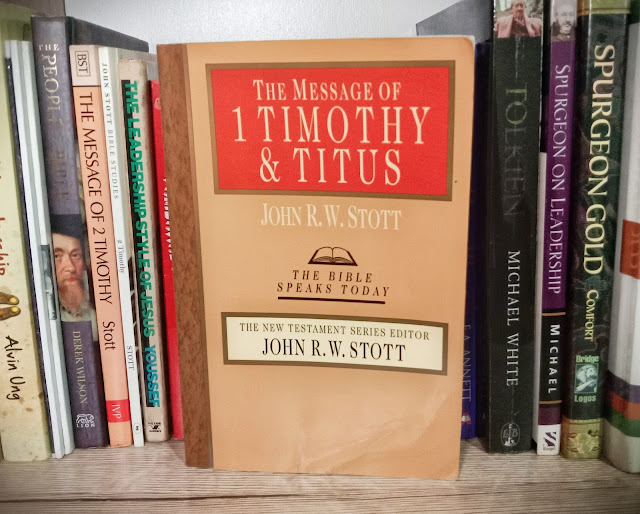
The Message of 1 Timothy & Titus: Guard the Truth (1996) by John R. W. Stott, Not A Review

The Message of 1 Timothy & Titus: Guard the Truth (1996) by John R. W. Stott
 
At first, I wanted to reread John Stott's excellent commentary on 2 Timothy because I thought it is a fitting book for me to end the year well. But when I realized that I haven't read commentary on 1 Timothy & Titus entirely, I should go for this one instead. This decision proved to be profitable and timely! Praise God. Why do I think reading good Bible commentaries is important? On the back cover of every J.C. Ryle's Expository Thoughts on the gospels says this gem of wisdom: "If the best way to understand the Christian Faith is to read the Gospels, then the next books in order of importance have to be those which aid in the understanding of those Gospels." I find that this is also true for the pastoral letters or epistles such as 1, 2 Timothy & Titus. The best way to know the truth is to read these sacred letters firsthand. The next best is to read good commentaries about them.

I love to read commentaries written by the late Dr. John R. W. Stott (1921-2011) especially on The Sermon on the Mount, Romans, and 2 Timothy. His books such as Basic Christianity, Your Mind Matters, and The Preacher's Portrait also plays a significant role in shaping my Christian faith, mind, and calling. I'm forever grateful for Uncle John's ministry! To come back to his commentaries, I find that Dr. Stott is clear in his expositions, balanced in his teachings, and faithful to the evangelical beliefs. They are both scholarly and yet readable. One very helpful feature that I like the most is that, when Dr. Stott comes to difficult or controversial passages of the pastoral letters (such as on slavery, sexual roles in the church, government, etc.), he will take extra care to outline and explain other major different interpretations before he proceeds to the most probable one with sound Biblical arguments* and applications. If you want to read Bible commentaries or looking for references to prepare for your sermon and Bible study, I fully recommend The Bible Speaks Today Series published by Inter-Varsity Press (IVP). Simply one of the best!

Before I end (sorry, this is NOT a book review after all), let me share how I use a Bible commentary like this one for all its worth. First, I will try to read 1 Timothy & Titus from at least 2 to 3 Bible translations. I read from the New Living Translation (NLT), the English Standard Version (ESV), and the JB Phillips New Testament (PHILLIPS is actually a paraphrase). This first step is important because you need to be familiarized with the Scriptures before you study the Scriptures. By the way, keep in mind that the new edition of The Bible Speaks Today Series is using the New International Version (NIV) as the main translation. Secondly, always bring the Bible with you as you read through the commentary. The reason being is that when you read something that sparks your interest or speaks to you, you need to 'see' it in the pages of the Bible for yourself. This is not just good for memorization but also good for your faith and trust in the written Word of God. Finally, share what you have learned with as many people as possible through your social media, during Bible studies, when you give counsel to others, etc. If you read, you learn once. If you read and teach, you will learn twice. If you read, teach and live it, it will be part of your life 😉✌💡

#ServeToLead #GrowingLeaders #LeadersAreReaders #JohnStott #BibleCommentary #LetsMakeReadingCoolAgain


To read my other
#1Book1Week book reviews, CLICK HERE

FB Page
: https://facebook.com/LEGASI.tv/                                    
Podcast: http://bit.ly/LegasiSpotify                     
YouTube: https://www.youtube.com/c/LEGASItv/                 

THINK BIG. START SMALL. GO DEEP.

Best Blogger Tips

Saturday, December 4, 2021

Timothy, Tell the Children to Take Care of Their Parents (1 Timothy 5:3-8)


 “Honor widows who are truly widows. But if a widow has children or grandchildren, let them first learn to show godliness to their own household and to make some return to their parents, for this is pleasing in the sight of God. She who is truly a widow, left all alone, has set her hope on God and continues in supplications and prayers night and day, but she who is self-indulgent is dead even while she lives. Command these things as well, so that they may be without reproach. But if anyone does not provide for his relatives, and especially for members of his household, he has denied the faith and is worst than an unbeliever.”
(1 Timothy 5:3-8, ESV)

The bottom line of 1 Timothy 5:3-16 as I understand it is this: God’s people, namely the church, is to help to supply not just spiritual needs but also material needs of other vulnerable Christians (for example here, the “widows”) if there are no other believing family members to do so. But if there are, then, they ought to provide the needs by all means. What Paul writes here concerning care for widows can be applied to any Christians in real need. But one thing we must keep in mind, however, the church is not a welfare agency. The church is not to put social work before the gospel of the grace of God. Beware of the damnable social gospel nowadays! The church is to take responsibility to care for those who are really in need only when there are no other Christian family members to do so (I’m repeating myself here to emphasize the point!). “Let the church not be burdened,” reminds Paul later, “so that it may care for those who are truly widows” (v.16). The qualifications of widows to be supported are listed in verses 9 and 10. Spiritually, they are the godly widows who set their “hope on God and continues in supplications and prayers night and day” NOT those who are “self-indulgent” or “live only for pleasure” (NLT), that is, the ungodly.

First moral responsibility is placed upon Christian relatives (“children or grandchildren” or any family members) at least because of these five reasons: 1) To show one’s “godliness”, 2) To repay or “to make some return” to one’s parents or grandparents. To “honor” is to show “respect” (the fifth commandment in Exodus 20:12), 3) To please God. “This is pleasing in the sight of God”; 4) To affirm one’s faith because if not he or she “has denied the faith and is worst than an unbeliever”, and, 5) To unburdened the church (v.16). It is sad that sometimes even Christians who have been loved and cared for by their parents or grandparents, practically turn their backs on them in their hour of need. The dramas on Malaysian TV series and films on Netflix about how the children argue with one another on who will take care of their elderly parents or the decision to send their parents to old folks' homes are the reflections of what really happened in our culture today. How come one mother can take care of ten children all by herself but her children can’t take care of their only mother? Such children - or probably YOU - need to hear these words all over again: “But if anyone does not provide for his relatives, and especially for members of his household, he has denied the faith and is worst than an unbeliever.” Strong words, yes, but the truth is always is!


To read previous short articles on 1 Timothy, CLICK HERE 

FB Page: https://facebook.com/LEGASI.tv/
Podcast: http://bit.ly/LegasiSpotify
YouTube: https://www.youtube.com/c/LEGASItv/

THINK BIG. START SMALL. GO DEEP.

Best Blogger Tips

Tuesday, April 20, 2021

Timothy, Be Respectful and Don't Show Favoritism (1 Timothy 5:1-2)

 
“Do not rebuke an older man but encourage him as you would a father, young men as brothers, older women as mothers, younger women as sisters, in all purity”
(1 Timothy 5:1-2, ESV)

Last week I saw a viral video online in Malaysia, where there was a fight at a Mamak restaurant (probably before the month of Ramadhan) between an older man with a young woman. I care less about what is the real issue but when I saw the older man hits the woman and the young woman kicked the man, my heart boil with rage! This is not an unusual scene, however. We all probably have witnessed – or experience ourselves – at least verbal abuse or even physical abuse between these two generations in social media, within our community, among family members, and even in the church. This evil behavior must not be among the believers! After Paul writes to Timothy to “keep a close watch on yourself and on the teaching” (1 Timothy 4:16) as a leader in God’s church and a teacher of God’s Word, he then reminds him of his attitude toward others: BE RESPECTFUL.

“Do not rebuke” or “Never speak harshly” (NLT) or “Don’t reprimand” (Philips) is a negative statement for a positive reminder: BE RESPECTFUL. Toward who? All people! Older men, younger men, older women, younger women. Inside and outside the church. The word “rebuke” means to “strike with blows.” It is primarily speaking of beating with words but I think we can extend that to beating with fists too. Although young Timothy was very influential and his leadership was sealed by God’s authority (see 6:20) and the apostle’s approval (see 4:11; 6:2b), he must not abuse his power but instead “set the believers an example in speech, in conduct, in love, in faith, in purity” (4:12). Having said that, the reminder to BE RESPECTFUL toward everyone also means we must NOT SHOW FAVORITISM (see James 2:1) regardless of their age, gender, and the nature of the relationship. If an older man or woman needs to be corrected, then, go to him or her in a kindly manner and speak to him or her as one would speak to a father or mother. In the same manner, reproof younger believers as brothers and sisters in Christ. Don’t sugarcoat the truth when you have to discipline them. The goal is not condemnation but repentance. Be firm, clear, and “speaking the truth in love” (Ephesians 4:15).

As for men, especially in the ministry, I would like to warn us: be extra careful when dealing with younger women. If you need to “encourage” them – as you must – do it as “sisters” in Christ and “in all purity.” In most cases, it is better to “take one or two others along with you” (Matthew 18:16) to create accountability. We all have heard the reported news about the abuse and sexual misconduct among Christian ministers. Don’t be a statistic! H.A. Ironside commented on this verse wisely: “Never to act toward any young woman in a way he would not like some other man to behave to his own sister.” Or read how J.B. Philips paraphrases it: “Treat the younger women as sisters, AND NO MORE” (emphasis mine). 

FB Page: https://facebook.com/LEGASI.tv/                   
Podcast: https://anchor.fm/LEGASI.tv/            
YouTube: http://bit.ly/LEGASItv 

THINK BIG. START SMALL. GO DEEP.

Best Blogger Tips

Saturday, January 30, 2021

Timothy, Keep A Close Watch on Yourself and on the Doctrine (1 Timothy 4:16)


“Keep a close watch on yourself and on the teaching. Persist in this, for by doing so you will save both yourself and your hearers” (1 Timothy 4:16, ESV)

This last verse of chapter 4 is a very powerful reminder for us today – preachers and teachers, especially and all Christians, generally. Previously, the apostle Paul tells Timothy to “devote [himself] to the public reading of Scripture, to exhortation, to teaching” (v.13, bracket mine) and do “not neglect the gift” (v.14) that God has given to him. And now, Paul wants him to “keep a close watch” or “take heed” (NKJV) these two things:

1) His Life, and
2) His Teaching or Doctrine

Nowadays, people are so fearful of the word ‘doctrine.’ Currently, I’m reading Charles C. Ryrie’s A Survey of Bible Doctrine, and one of my friends who saw the book asked me during our coffee hang out if I’m thinking of applying for a pastoral position. I said no and he replied, “Then why are you reading on Bible doctrine?” Once I heard a preacher said to the congregations that he just wants to share ‘practical’ lessons from the Bible and not about ‘theology’ or ‘doctrine.’ Again, during Bible Study, a student shared in the big group that she doesn’t like to study Bible doctrine because “I’m just a regular Christian, not a preacher.” You can find these examples everywhere in Christendom. To most people, the word ‘doctrine’ conjures up visions of technicality, difficulty, and dogmatism. Maybe it’s our fault – preachers and teachers – that give people bad or negative impressions about the word in the pulpit, writings, or social media.

“Far from being dry and abstract,” explains Millard J. Erickson in his well-known book Introduction to Christian Doctrine, “Christian doctrine deals with the most fundamental issues of life: who am I, what is the ultimate meaning of the universe, where am I going?” As such, good doctrine is very essential, critical, and important because it will influence how we answer these fundamental questions. Christian doctrine “deals with general or timeless truths about God and the rest of reality” added Millard. Where to get a sound, healthy and life-giving doctrine? Only in one chief place: The Holy Scripture, the perfect written Word of God. It is God’s special revelation of Himself and the reality of everything in life. Elsewhere Paul wrote: “All Scripture is breathed out by God and profitable for teaching, for reproof, for correction, and for training in righteousness, that the man of God may be complete, equipped for every good work” (2 Timothy 3:16). What happened if we don’t “keep a close watch” on the doctrine? It may cause us and our hearers to “depart from the faith” (4:1a). Instead of devoting ourselves to reading and teaching the Scripture (4:13), we may unintentionally devote ourselves to “deceitful spirits and teachings (or doctrines) of demons” (4:1b).

But don’t forget this: “Keep a close watch on yourself” too. If Timothy only keeps a close watch on the doctrine and not himself, he is a hypocrite. And there were a lot of religious hypocrites during Paul’s time… not to mention ours’ too. Our doctrine can be God-centred, Christ-exalted, and Spirit-filled but if it doesn’t match with our actions, we are deceiving ourselves, being deceived and a stumbling block to others. Preacher’s Homiletical Commentary puts it this way: “1. Actions are more intelligible than words; 2. The language of life is more convincing than the language of the lip; 3. The teaching of the life is available in many cases in which the teaching of the lip cannot or ought not to be attempted.” So, take heed of these two things, don’t separate the two, “persist” or “continue in them” (KJV), for “by so doing you will save both yourself and your hearers.” It’s not just about you.

FB Page: https://facebook.com/LEGASI.tv/                   
Podcast: https://anchor.fm/LEGASI.tv/            
YouTube: http://bit.ly/LEGASItv 

THINK BIG. START SMALL. GO DEEP.

Best Blogger Tips

Thursday, January 14, 2021

Timothy, First, Read the Word; Then, Expound the Word (1 Timothy 4:13-15)


“Until I get there, focus on reading the Scriptures to the church, encouraging the believers, and teaching them. Do not neglect the spiritual gift you received through the prophecy spoken over you when the elders of the church laid their hands on you. Give complete attention to these matters. Throw yourself into your tasks so that everyone will see your progress”
(1 Timothy 4:13-15,
NLT)

My last article on 1 Timothy was written on 9th September 2018 (CLICK HERE)… let me continue where I left off. The apostle Paul was still in prison when he wrote this letter and with pastoral heart, he reminds Timothy to give attention or devote himself to reading, encouraging, and teaching (v.13). The context is undoubtedly referred to the public worship service. Mind you, Paul doesn’t say worship as in singing first but worship as in “public reading of Scripture” (ESV) first. Scripture – most probably the Old Testament – was read aloud in such services and should have its proper place in our services today. The written Word of God must have its central place in the church. I always grief whenever I hear preachers read a few verses here and there and using them as preconceived doctrinal supports or to launch themselves into storytelling. First, read the Word. Then, expound the Word. Don’t you know that on its own “the word of God is alive and powerful. It is sharper than the sharpest two-edged sword, cutting between soul and spirit, between joint and marrow. It exposes our innermost thoughts and desires” (Hebrews 4:12)?

And then, Timothy ought to encourage the believers. The word “encouraging” here can also mean exhorting or comforting. How he ought to do that? Well, again, through the Scripture. I used to be obsessed with positive thinking stuff and giving motivational speeches. Now I realize that although I can help people to be (presumably) more positive, I cannot change them to be godly. But God through His words can! All encouragement must be based on Scripture. This, however, requires someone to teach it. Maybe that’s the main reason why Paul also told Timothy to teach the Scripture or “give attendance to… doctrine” (KJV). Ellicott's Commentary for English Readers puts it like this: “The word ‘doctrine’ suggests public teaching directed rather to the understanding of the hearers. The idea of exposition, or even of dogmatic teaching, seems here included.” Like I said, first, read the Word. Then, expound (teach) the Word.

To do these things – reading the Scripture, encouraging the believers, and teaching the church – were a great responsibility for the young man Timothy. However, he was not asked to do these tasks in his strength. God has given him the necessary “spiritual gift” (v.14) for his calling. It is so with every child of God called to do His work. My testimony in the ministry is this: if God calls me, then He will also enable and equip me. For Timothy, Paul reminds him to “not neglect the spiritual gift”, “give your complete attention” and “throw yourself into the task so that everyone will see your progress” (v.15). At the end of the day, our talk and walk as Christ-followers – especially as ministers of God – must consistently grow in knowledge, wisdom, and usefulness. “If a man really makes progress,” writes Albert Barnes, in his Notes on the Bible, “it will be seen and appreciated by others; if he does not, that will be as well understood by his hearers.” 

FB Page: https://facebook.com/LEGASI.tv/                 
Podcast: https://anchor.fm/LEGASI.tv/            
YouTube: http://bit.ly/LEGASItv 

THINK BIG. START SMALL. GO DEEP.

Best Blogger Tips

Sunday, December 20, 2020

1 and 2 Timothy, Titus and Philemon (Originally published in 1947) by H.A. Ironside, BOOK REVIEW


1 and 2 Timothy, Titus and Philemon (Originally published in 1947)
by H.A. Ironside

I love reading good Bible commentaries. I believe that the best way (the only way) to understand the Christian faith is to read and study the Bible, then the next best books in order of importance have to be those which help in the understanding of the written Word of God, namely, Bible commentaries. Although there is a place for technical and scholarly commentaries, especially when you want to use it for Bible Study or sermon preparations; for leisure reading and reflections, I suggest reading expository commentary (like this one) and devotional commentary (like those by J.C. Ryle's). Reading Ironside's expository commentary is like reading his sermons - plain and pointed, simple and systematic, challenging, and life-changing. On the back cover: "[This commentary series] offers concise outlines of the biblical text along with insightful and practical comments that bring out the essential truths of God's Word." Ah, this is not a mere marketing wordings but an accurate statement.

Like me but way better than me, Henry Allan Ironside never formally ordained (C.H. Spurgeon said, "God ordained me, not men." Amen!). Nevertheless, he is considered one of the leading biblical scholars of his generation. Ironside’s teaching left a long-lasting mark on evangelicalism. Along with others such as Cyrus Scofield, he was influential in popularizing dispensationalism and fundamentalism among Protestants. With that understanding, if you don't agree with these sub theologies, read this commentary anyway - or any of his books and commentaries - with discernment but also with the assurance of knowing that this man is biblically sound (have errors but not heresy) and godly (but not perfect). He convinces that teaching the Bible and living the Bible are interconnected. "If lips and life do not agree, the testimony will not amount to much," he writes to himself and us. All credit to his God and Saviour, the Lord Jesus Christ 😊⚡📖

#1Book1Week #LeadersAreReaders #LetsMakeReadingCoolAgain #ExpositoryCommentary #HAIronside

Ps: One of my favorite books in the Bible is 2 Timothy. I'm inspired by chapters on Not Ashamed, Rightly Dividing the Word of Truth, and The Authority of the Holy Scriptures. Very timely and timeless reminders ⚡

FB Page
: https://facebook.com/LEGASI.tv/              
Podcast: https://anchor.fm/LEGASI.tv/           
YouTube: http://bit.ly/LEGASItv

THINK BIG. START SMALL. GO DEEP.

Best Blogger Tips

Sunday, September 9, 2018

Timothy, Don't Let Anyone Think Less of You! (1 Timothy 4:12, No Inferiority Complex Please)


"Don't let anyone think less of you because you are young. Be an example to all believers in what you teach, in the way you live, in your love, your faith, and your purity"
(1 Timothy 4:12, NLT)

"[Don't] let anyone put you down because you're young. Teach believers with your life: by word, by demeanor, by love, by faith, by integrity."
(The Message)

Today I preached the Word of God on manhood at the church. Although I've preached many times before to the youth and students, I never failed to feel nervous as if I'm going to do it the first time. Today particularly, I feel an extra boost of nervousness. I'm nervous not because I'm not prepared or because I fear the crowd, but because I'm going to preach on manhood to men who are older than me that were in the church just now. Nervous is good because it leads me to rely on God and be prayerful; fear is not because fear assumes that the Message is yours and not God's. So what did I do? I preached to myself this verse, God's assurance: "Richard, don't let anyone think less of you because you are young!" I repeated it many times and prayed to God with all my heart until God's Word become a reality to me. When the nervousness and the fear were gone, I preached the Word of God as it is – challenged the men (including the fathers), warned them, and plead for their needs for God to become their Father. I was bold and straight to the point! After I'm done, I became nervous again but with a sigh of relief. An older man came to me afterward and asked, "Can you come again next month?"

Timothy was a young man. Perhaps by this time, he may have been about 40 years old. A man of 40 was comparatively young compared with the Apostle Paul who perhaps at this time was close to 70. Kenneth S. Wuest, a Bible teacher, points out that "many of the elders at Ephesus may have been older than Timothy." Look at it this way: 40 years-old is considered old for an athlete (Lee Chong Wei, now 36, thought that he should be retired), young for minister (Syed Saddiq Syed, Youth and Sport Minister, turn 26 on 6th December 2018), and very young for Prime Minister (Mahathir Mohamad, now 93, the oldest PM in the history of Malaysia. The real Optimus Prime!).

When Paul told Timothy to "don't let anyone put you down because you're young," what he meant was: Do not develop an inferiority complex because you are younger than some of those to whom you minister. Do not be concerned if they do not understand that God has called you to this leadership position as pastor or teacher or preacher. Do not worry if they seek to ignore you because of your comparative immaturity. "Be an example to all believers in what you teach, in the way you live, in your love, your faith, and your purity." A young man (my age is near to Timothy's) may be very immature in some respects (I admit), but if he is characterized by these things: careful as to his words, particular as to his behavior, manifesting the love of God, a man of faith and is careful as to purity of life – he will earn the respect and recognition from others, even the older ones. In short, Paul said to us to first "teach believers with your life." If these characters are in you, the people "will realize that though a young man there is something about him that marks him out as a man of God, and not one who is careless in his walk and slack in his service, or who are seeking an easy-going life as a professional cleric," said H.A. Ironside.

Don't let anyone think less of you and put you down because you are young.
Be an example to all believers and teach them with your life (too).

THINK BIG. START SMALL. GO DEEP.
Best Blogger Tips

Sunday, September 2, 2018

Timothy, Work Hard Even at the Point of Suffering - It Is Worth it (1 Timothy 4:10-11)


"This is why we work hard and continue to struggle [or to suffer], for our hope is in the living God, who is the Saviour of all people and particularly of all believers. Teach these things and insist that everyone learn them"
(1 Timothy 4:10-11, NLT)

Every bit of suffering Paul the Apostle experienced and all the agony he went through for the sake of "the glorious Good News entrusted to [him] by our blessed God" (1 Timothy 1:11) was worth it because his trust was in the living God who "is the Saviour of all people and particularly of all believers" – and that God is worth trusting and will never let us down. Therefore, "work hard" on yourself and for the Lord! "Thrown ourselves into this venture so totally," said Eugene Peterson, "We're banking on the living God." If you work hard to warn others about apostasy and false teachings (read 1 Timothy 4:1-6) and work hard to "train yourself to be godly" (1 Timothy 4:7), you'll suffer but it will be worth it! Paul said in 2 Timothy 3:12 that "Everyone who wants to live a godly life in Christ Jesus will suffer persecution" but it will be worth it! Why? Because if you warn others about their wicked schemes, you'll be hated; and if you be godly in the world where sins are praised, you'll be persecuted. Take heart! Our hope is in the living God, not the imaginary one! It is worth it!

Now, let us come to one of the most controversial verses in the Scripture, "the Saviour of all people." Does Paul teach universalism, that all men will eventually be saved? I say NO because how then could He be the special or particular Saviour "of all believers"? Paul once addressed the Athenians saying that "in [God] we live and move and exist" (Acts 17:28). This text tells me that even the very life and breath of unbelievers who may blaspheme God is a gift from God. Even now God is "saving" them from going to hell and giving them physical life and opportunity to be saved. In a way, God is the Saviour of all people. During Paul's time, the emperor of Rome was called "the Saviour of the world" by reason of the fact that he was the preserver of mankind by his ‘benevolent' reign. Then how much more is our God "the Saviour of all people" in the sense that everything good and gracious comes from His hand, even life itself. However, God is the Saviour "particularly of all believers" in Christ. I like how Life Application Bible Study interprets this verse: "Christ is the Saviour of all, but His salvation becomes effective only for those who trust Him." Amen and hallelujah!

The importance of what Paul has just been saying is emphasized by him when he admonishes Timothy to "teach these things and insist that everyone learn them."  Albert Barnes commentary on 1 Timothy 4:11 notes: "It follows from this, that a minister of the gospel is solemnly bound to teach that there is a sense in which God is the Saviour of all people. He is just as much bound to teach this, as he is that only those will be saved who believe. It is a glorious truth - and it is a thing for which a man should unceasingly give thanks to God that he may go and proclaim that He has provided salvation for all, and is willing that all should come and live." Do it Timothys – it is worth it!


THINK BIG. START SMALL. GO DEEP.
Best Blogger Tips

Friday, August 31, 2018

Timothy, Workout in the Gym is Okay Lah, but a Godly Life is Fuyooh! (1 Timothy 4:7-9)


"Do not waste time arguing over godless ideas and old wives' tales. Instead, train yourself to be godly. Physical training is good, but training for godliness is much better, promising benefits in this life and in the life to come. This is a trustworthy saying, and everyone should accept it."
(1 Timothy 4:7-9, NLT)

There are some things that we as Christians shouldn't waste our time with. "Godless ideas and old wives' tales" mentioned here – or as Eugene Peterson paraphrased it, "Silly stories that get dressed up as religion" – are some of them. This reminder is similar to what Paul wrote earlier: "[Don't waste your] time in endless discussion of myths and spiritual pedigrees." Why? Because "these things only lead to meaningless speculations, which don't help people live a life of faith in God" (1 Timothy 1:4). Once a fellow Christian told me about the world's government's‘ secret' to cover up the ‘fact' that the earth is flat! Then, a few days ago two of my friends talked with each other about The Illuminati and Freemasonry for hours. And have you received an SMS or WhatsApp text that says something like this, "[Religious message] Forward this to 10 people and good things will happen to you"? All of these are silly and unprofitable conversations!

"Instead," reminds Paul to Timothy and every Christian who read this, "train yourself to be godly" or "exercise yourself toward godliness" (NKJV). The Greek word for "exercise" here is gumnazo, from which we get the English word gymnasium. This is the place nowadays where people go for exercise and to get the body muscles in tone (although I prefer outdoor exercise. The world is my gym!). Paul continues to say that "physical training is good…" It is good! In my opinion, most Christian workers such as pastors and preachers today are often guilty of neglecting their physical health. Of course, there are those who, on the other hand, may overindulge in exercise until it also becomes a waste of time! What we need is discipline, balance, and moderation. If our bodies belong to God (read 1 Corinthians 6:19-20), then we are responsible to keep them in good shape and make the best use of them. A healthy body will produce a healthy mind; a healthy mind produces a healthy spirit.

Now, as important as bodily exercise is, there is something vastly more important. "…But training for godliness is much better, promising benefits in this life and the life to come." The reason "exercise" toward godliness is so much more profitable than physical exercise is that the results are so much more lasting. Bodily exercise is profitable only for a short time or is of little extent when compared to spiritual exercise. Bodily exercise has a life-time value but spiritual exercise has an eternal value! Godliness not only will (surely) affects our lives here and now on earth but we shall reap the result of it in the rewards of eternity. H. A. Ironside notes, "No one will live a truly pious life who neglects the means which God has given to us for this purpose. We have the Word of God; we need to study our Bibles. And we need to take much time for prayer. Then we must be faithful in testifying to those who are unsaved. To honor God in these things is to be exercised unto godliness." To be godly is to be God-like; to be God-like is to be like Christ. This you must "exercise" daily!

Paul concludes his encouragement by emphasizing its trustworthiness and it should be received and considered by Timothy – by us - seriously. "This is a trustworthy saying, and everyone should accept it." What Paul had just said is very important and either Timothy (or you) received it or not, it IS true and worth accepting. It is like Jesus when He said, "Anyone with ears to hear should listen and understand." Amen.

You may exercise at least three times a week,
or at least you know that it is important for your health.
But do you exercise spiritually regularly?
Do you see it as more important?

THINK BIG. START SMALL. GO DEEP.
Best Blogger Tips

Tuesday, August 28, 2018

Timothy, Be Continuously Nourished in God's Word (1 Timothy 4:6)


"If you explain these things to the brothers and sisters, Timothy, you will be a worthy servant of Christ Jesus, one who is nourished by the message of faith and the good teaching you have followed"
(1 Timothy 4:6, NLT)

All commentary that I read agree that the phrase "if you explain these things to the brothers" is a mild term. Modern King James Version (MKJV) puts it this way, "Having suggested these things to the brothers…” and New King James Version (NKJV) says, "If you instruct the brethren in these things…" Explain, suggest, instruct. I wonder, why Paul did not write to Timothy to ‘command' these things to the brothers? I think, since Timothy was quite a young man, it probably not good for him to exercise authority by giving orders to the believers at Ephesus. He might be resented and rejected by them. Paul counseled a suggestion rather than a command. Paul already does the hard part, Timothy only needs to explain it to them. Paul warned them, Timothy only need to deliver the warning. Paul wrote the letter, Timothy only needs to read it to them. What Paul wants Timothy to explain? Read the previous article or read 1 Timothy 4:1-5:

"The Spirit makes it clear that as time goes on, some are going to give up on the faith and chase after demonic illusions put forth by professional liars. These liars have lied so well and for so long that they've lost their capacity for truth. They will tell you not to get married. They'll tell you not to eat this or that food – perfectly good food God created to be eaten heartily and with thanksgiving by Christians! Everything God created is good, and to be received with thanks. Nothing is to be sneered at and thrown out. God's Word and our prayers make every item in creation holy"
(
The Message).

If Timothy explains this, he would be "a worthy servant of Christ Jesus." Paul wanted Timothy to warn the Ephesian-Christians of false teachings and apostasy, and to faithfully teach sound doctrine. H. A. Ironside commented, "The minister of Christ is responsible to bring these things to bear upon the hearts and conscious of the people of God so that He may be honored and they may be preserved from the unholy teachings which Satan uses to lead many astray." But you see, the best defense is a good offense. The best antidote to false teaching and apostasy is to know and preach the truth of God. We "know the truth"! (see 1 Timothy 4:3) Even so, as Paul tells Timothy, we must be continuously "nourished" in the truth, namely, God's Word or "the message of faith and the good teaching." Actually, the verb here means "constantly nourishing up." Just as we need daily food to keep us going physically, so it is, as God's people, we need daily spiritual food if we are to remain strong and grow spiritually. Why people are easily "turn away from the true faith" and "follow deceptive spirits and teachings" (1 Timothy 4:1)? Because they have become weak spiritually and failed to continuously nourish in God's Word.

Maybe that's why Paul in his second letter to Timothy reminded him to "work hard so you can present yourself to God and receive his approval. Be a good worker, one who does not need to be ashamed and who correctly explains the word of truth" (2 Timothy 2:15). If Timothy is faithful in his responsibility to warn others about "these things" (4:6), he will continue on the right path because this is the one which he "has followed" up to now. Great teacher and Bible commentator, Matthew Henry, said this to ministers like Timothy (no excuse, to us too!): "Even ministers themselves have to need to be growing and increasing in the knowledge of Christ and his doctrine: they must be nourished up in the words of faith" [and] "the best way for ministers to grow in knowledge and faith is to put the brethren in remembrance; while we teach others, we teach ourselves." I'm encouraged!


THINK BIG. START SMALL. GO DEEP.
Best Blogger Tips

Thursday, August 23, 2018

Timothy, Some Will Turn Away from the True Faith a.k.a. Apostate (1 Timothy 4:1-5)


"Now the Holy Spirit tells us clearly that in the last times some will turn away from the true faith; they will follow deceptive spirits and teachings that come from demons. These people are hypocrites and liars, and their consciences are dead. They will say it is wrong to be married and wrong to eat certain foods. But God created those foods to be eaten with thanks by faithful people who know the truth. Since everything God created is good, we should not reject any of it but receive it with thanks. For we know it is made acceptable by the word of God and prayer"
(1 Timothy 4:1-5, NLT)

The New Testament warns and church history demonstrates that holding the truth and maintaining the purity of the Gospel is not easy. As H.A. Ironside, Bible teacher, once commented: "Men would accept antichrist instead of the Christ of God." This is true then as it is today. The apostle Paul now instructs Timothy – now instructs us – to be on guard of what is ahead. Paul begins by writing that "Now the Holy Spirit tells us clearly…" (“expressly" or "explicitly"). They have been warned! The Holy Spirit has made it clear that in "the last times" (this term is different from the "last days" or "last hour") – during Paul's times – "some will turn away from the true faith" or apostate. This is sad. You and I know those who have been departed from the true faith in Jesus Christ either by choice, force, desperation, marriage, and lack of Christian witness on our part. But there is more…

The influence of evil spirits. "They will follow deceptive spirits and teachings that come from demons." These evil spirits are ever active in seeking to turn many away from the faith "that God has entrusted once for all time to his holy people" (Jude 3). It is interesting that whenever someone departs from the faith, he will give heed to deceptive or seductive spirits and the doctrine of demons. This shows the real source of false doctrine. Paul wrote in Ephesians 6:12 that "we are not fighting against flesh-and-blood enemies, but… against evil spirits in the heavenly places." The Devil (and his evil spirits) "is a liar and the father of lies" (John 8:44) and is actively engaged in combating the faith of Christ. Behind Islam, one of the main religions that act against Christianity, for example, is not men of intellect or ‘holy' religious leaders, but the Devil who "always hated the truth" (John 8:44). We are not at war with the Muslims ("we are not fighting against flesh-and-blood") but with the Devil and his armies. This is not a Christian vs. Islam, this is Truth vs. Lie! Focus on the real enemies!

First, the departure from the truth. Then, the Deceiver deceives them to follow false doctrines and in turn, they deceived others. By doing this they being deceived themselves. And so it makes sense that "these people are hypocrites and liars, and their consciences are dead." They reached the place where conscience no longer responded to the voice of God. Paul told Timothy earlier that Christ-followers must "live with a clear conscience" (1 Timothy 3:9). Have you ever meet someone who has known the truth, witnessed God's miracle and healing power performed in the name of Jesus, and saw much evidence of Christ's Lordship and divinity in the Scripture and still don't believe? Don't be surprised because "their consciences are dead"! Due to inner spiritual emptiness, they turn to outer laws. "It is wrong to be married and wrong to eat certain foods," they said. Nowadays, nuns, monks, and priests had to take a vow not to marry, is this what Paul was referring to here? Not eating certain foods on certain days, is this not the teaching of demons too? Beware!

Nothing that God has created is to be rejected as being evil. Marriage is good (see Hebrews 13:4) and nothing God made for food is to be rejected (see Matthew 15:11). You may throw something away because you don't like it, but not because it is evil. These things used for food are "made acceptable by the word of God and prayer" in a sense that they are recognized by Christ's followers as being "made holy" or "sanctified" for our good by God. Of course, this comes through proper instruction from His Word and from our receiving them from His hand through prayer. Jesus set the example in this when He returned thanks before feeding the multitude and on other occasions.

Kevin Pier, a fellow blogger in kevinpierpoint.com, ends his article on 1 Timothy 4:1-6 this way, I quote: “There is a lot of gift-wrapped garbage in these days. We need to be on our guard that false teaching does not take place in God’s church. If you are a follower of Jesus Christ you need to take care that you have not been led astray and deceived by those who are teaching things contrary to the Word of God. You need to be sure you aren’t hypocritical in your own life. The only way we can stand firm is to be students of God’s Word.” And then he ends with this question, “Are you a student of God’s Word?”

The same Holy Spirit (4:1) that warns us about these things is also able to keep us faithful.
Ask and pray for guidance and strength from Him.
“He is the Holy Spirit, who leads into all truth” (John 14:17). Amen.
THINK BIG. START SMALL. GO DEEP.


Best Blogger Tips

Monday, June 18, 2018

Timothy, This Is the Great Mystery of Our Faith (Six-Fold Descriptions about Christ in 1 Timothy 3:16)


"Without question, this is the great mystery of our faith:
Christ was revealed in a human body
and vindicated by the Spirit.
He was seen by angels
and announced to the nations.
He was believed in throughout the world
and taken to heaven in glory"
(1 Timothy 3:16, NLT)

After Paul wrote about "how people must conduct themselves in the household of God" (v.15), he now focuses on what is at stake and why it is important to do so (v.16). He begins by saying "without question" or contradiction. It gives the thought of something that cannot be denied, "…this is the great mystery of our faith." Mystery? This is not like a mystery novel, unknown or secret truth. Rather, as H. A. Ironside, a Bible teacher, and preacher, said that it is "a secret revealed only to initiates." He continues, "This mystery is that of the incarnation – that God came down to earth, taking into union with His Deity a human body, a human spirit, and a human soul so that He was both God and Man in one blessed, adorable Person." This is the great mystery of our faith; this is the foundation on which our faith stands; this is the foundation of the truth (v.15) – Jesus Christ, our Lord, and Saviour! He is the One in whom is centered the "mystery of our faith." Here are six-fold descriptions about Christ:

#1 Jesus is Fully Human: "Christ was revealed in a human body..." If anyone wants to know what God is like, they can look at Jesus. "No one has ever seen God. But the unique One, who is himself God, is near to the Father's heart. He has revealed God to us" (John 1:18). Again, in John 1:14, "[The Word] became human and made his home among us. He was full of unfailing love and faithfulness. And we have seen his glory, the glory of the Father's one and only Son." And so, "God was in Christ" revealed in a human body.

#2 Jesus is Fully God: "…and vindicated by the Spirit." Jesus was God manifest in the flesh or revealed in a human body by the revelations of the Holy Spirit on several occasions in His earthly life such as during His baptism, transfiguration, and so forth. During His baptism, for example, God the Father opened the heavens above Him, the Holy Spirit descended upon Him, and the Father's voice was heard declaring, "This is my dearly loved Son, who brings me great joy" (Matthew 3:17). Thus, Jesus was vindicated by the Spirit. As you read the gospel stories, you can see that behind His humanity there lies His divinity. He healed, He preached, and He forgives sin all by "the Holy Spirit's power" (Luke 4:14).

#3 Jesus is Greater than Angels: "He was seen by angels…" Do you know that angels – these mighty creatures – were present at the very high points of Jesus' early life and ministries such as His birth, temptation, agony in the garden, resurrection, and ascension? If you read Hebrews 1-2, the angels were there when God the Son was with the Father and the Holy Spirit in heaven. H. A. Ironside puts it this way, "Before God became incarnate in Jesus Christ He was invisible to created eyes. God the Father was invisible; God the Son was invisible; God the Holy Spirit was invisible. Angels could look only upon the glory of God but could not see the invisible One. But when the Lord Jesus Christ came down to earth… they knew they were looking into the face of the God who had created them. As He walked on earth angels were beholding the wondrous works wrought by God manifest in flesh." Angels are created beings, God is the Creator. Therefore, Jesus is greater!

#4 Jesus is the Message of Salvation for All: "…and announced to the nations." Because of Jesus the Son, God was no longer to have one people (the Jews) separated from the rest of the nations (the Gentiles) but His love could go out to all mankind. "Call him [Jesus] Immanuel, which means ‘God is with us'" (Matthew 1:23). This is the message to the nations, "In Jesus Christ, God is with us! Not against us!" All may be saved who turn to Him in faith.

#5 Jesus is the Saviour of the World: "He was believed in throughout the world…" This is a missionary statement. Soon and very soon, the whole world will believe Him. I don't mean that all will believe in Him and be saved. What I mean is that the world will know that Jesus is the Saviour of the world. Jesus prayed for His disciples to the Father that "they will all be one, just as you and I are one – as you are in me, Father, and I am in you. And may they be in us so that the world will believe you sent me" (John 17:21). Either the world will believe in Him in faith or rebellion, the Bible is clear all will: "At the name of Jesus every knee should bow, in heaven and on earth and under the earth, and every tongue declare that Jesus Christ is Lord, to the glory of God the Father" (Philippians 2:10-11).

#6 Jesus Came to Be Rejected but He Returned in Glory: "…and taken to heaven in glory." Jesus Christ, the Man-God is now in heaven or as Paul says "in glory." What Paul wanted to emphasize here is not so much about where He went but how He went "…in glory." For about 30 years, Jesus walked humbly on earth like one of His own creations. He never did anything but good. He healed people, raised the dead, and loved the sinners. Yet He was despised and rejected. Finally, He bore the ultimate rejection through suffering, pain, and death. But as you and I know that was not the end of the story. This is the redemption story: Jesus was raised back to life! He has risen! He appeared in splendor and glorious body! He was lifted in glory!

It took me about 2 hours to finished writing this article. Every description of Christ in this one verse in 1 Timothy 3:16 is precious and worth to consider and meditate upon. Take your time today to praise and thank Him for who He is and for what He had done for you and me. Amen.

THINK BIG. START SMALL. GO DEEP.

Best Blogger Tips

They Click it A lot. [Top 7 last 7 Days]