Showing posts with label Humanity. Show all posts

Tuesday, November 28, 2023

How To Become A People Magnet: 62 Life-Changing Tips To Attract Everyone You Meet (2019) by Marc Reklau, Book Review

 How To Become A People Magnet: 62 Life-Changing Tips To Attract Everyone You Meet (2019) by Marc Reklau

Bad news: I've not become a people magnet after I finished reading it. Good news: This book reminds me to at least try to increase my magnet-ism or be a less annoying person (or don't make it worse! It is hard to be one if one of my heroes of faith is John the Baptist). Hey, these are "tips" not a book of spells, and reading alone will not make any difference in anyone's social lives if not practiced. It is application, not knowledge, that transforms people. For sure, salespeople need to read this book! But it is also good for anyone who wants to improve their social skills and relationships. The author writes, "The most successful people are usually the ones who best get along with people. (Of course, there are always exceptions to the rule). Science tells us that the number one predictor of success and lasting happiness is our social relationships. People with a strong social network even live longer!"

I've observed how tactless young people are today when they try to communicate with others. I've seen how insensitive people are when interacting with those who are younger than them. I've witnessed many awkward communications between students and coworkers. Some people say technologies and gadgets are the enemy, but it's not entirely true. I think it's our personal belief that says (at its core), "People are not important; I am!" Ryan Holiday's book title summed it up well: "Ego is the enemy.” Even if egoistic people seem interested in building relationships, their main goal is not to serve but to use others, not to build but to manipulate others. Thus, these tips can be used for both good and evil, but as the Scripture says, "There is nothing concealed that it will not be revealed, nor so hidden that it will not be made known."

This short book is divided into seven (7) parts. Some tips are very common sense ("Be friendly"), too positive ("Don't criticize"), and probably not suitable for certain types of people ("Praise and praise a lot!"). Most tips are good reminders ("Listen to people actively"), practical ("How to make a good impression"), and humbling ("Talk about your own mistakes first"). There are a few tips that I know I need to practice, but I just can't imagine myself doing them. My excuse is my personality, but in high probability, it's my ego. Lord, help me, a sinner. By the way, on a related topic, I want to recommend these books:

• Winning With People and 25 Ways to Win With People by John C. Maxwell

• How To Win Friends & Influence People by Dale Carnegie

• The Rules of People by Richard Templar

• The Laws of Human Nature by Robert Greene

 #ServeToLead #LeadersAreReaders #HowToBecomeAPeopleMagnet #MarcReklau #PeopleSkills #Relationships #LetsMakeReadingCoolAgain

To read my other book reviews/summaries, CLICK HERE

THINK BIG. START SMALL. GO DEEP.

Best Blogger Tips

Sunday, September 4, 2022

Reading Can Activates Your Potential #LeadersAreReaders August 2022


Without reading and writing, there will be no progress to speak of. Without reading and writing, we'd be stuck in the Stone Age. Without reading and writing, there will be no civilization as we know it. These gifts of God to humankind are keys to unlocking our hidden potential. These gifts, writes Burke Hedges, author of Read & Get Rich, "liberates us and activates our dormant minds, much like a catalyst activates an inert chemical solution. Without the catalyst, the chemical just sits there. Add the catalyst and - boom! - there's an explosion of activity."

This reminds me of an old, true story. A young Italian sculptor named Agostino had a huge block of marble delivered to his studio. He had great plans to sculpt the block into a marvelous statue but unfortunately, he found the marble hard to work with. Frustrated, he had the marble removed to make room for a different project. About 40 years later, another Italian sculptor named Michaelangelo spotted the marble block hidden in an abandoned garbage heap. When he saw it, he ordered it sent to his studio. You know what happened next, right?

In case you don't... For many years, he studied the marble block, sizing up its potential, measuring it over and over again, testing its hardness with his chisels, making endless sketches, etc. Slowly but surely he gently smoothed his completed status with his chisels. The result was a masterpiece, the famous statue of David! You see, my fellow social media friends, Michaelangelo did what Agostino failed to do:
he saw the full potential of the marble block and released that potential with his talent, patience, genius - and his chisels. Like that marble block, we are rough and unrefined at first (otak pun keras!) but we have such great potential! Reading (and writing) is the chisel that releases our potential and reveals the work of art within.

Ernest Carr puts it this way,
"Not to be able to read is like one world with one door to enter and nothing is there... Because of literacy, I have been freed from this dark world. Because of literacy, I have 1,000 doors that I can enter now." So you see, reading not only activates your POTENTIAL but also POSSIBILITIES. Read! #ServeToLead #LeadersAreReaders #LetsMakeReadingCoolAgain

To read other articles on reading and book reviews,
CLICK HERE

THINK BIG. START SMALL. GO DEEP.

Best Blogger Tips

Tuesday, July 26, 2022

Gay Girl, Good God: The Story of Who I Was, and Who God Has Always Been (2018) by Jackie Hill Perry, Audiobook Review


Regardless of who she is becoming or her theology may have been shifted a bit today, objectively speaking, judged by this book alone, I love it! Jackie Hill Perry writes in a very poetic way. It is not just beautiful but also truthful too. With compassion and conviction. Lots of vulnerability and yet not self-centered. As a poet and rapper, Jackie is no doubt an expert storyteller. Although a bit preachy in the end and in between, as a reader, I know her origin story as an ex-gay girl a.k.a. lesbian but above all, I know the good God that she is writing about, "To tell you about what God has done for my soul is to invite you into my worship."

Jackie grew up fatherless, a marijuana user, a pornography addict, and experienced gender confusion. The back cover states:
"She embraced masculinity and homosexuality with every fiber of her being. She knew that Christians had a lot to say about all of the above. But was she supposed to change herself? How was she supposed to stop loving women, when homosexuality felt more natural to her than heterosexuality ever could?" This book tells her journey toward change and wholeness. I can imagine what the LGBTQ+ people might think about this book: it's a cliche. A gay girl found a good God, let go of her old lifestyle and married a man, etc. But it's more than that. For one, Jackie admits that temptation does come and go. Yet "I don’t believe it is wise or truthful to the power of the gospel to identify oneself by the sins of one’s past or the temptations of one’s present but rather to only be defined by the Christ who’s overcome both for those He calls His own." Amen!

I have a few unresolved issues about the book though: What happened to her girlfriend after she ended the relationship? After a few years of marriage with Preston, does same-sex attraction (SSA) occur again? How about non-practice SSA who wish to be celibate, any words for them? (or maybe I missed it). Overall, it is a good book to understand how one person can be changed by the good God.
"Because a good God made the woman, then being a woman is a good thing." For sure, Jackie writes from the 'tradition' view, not from the 'progressive' view. Some people might disagree with her interpretations, and some will affirm her Biblical view (I'm one of them). This is a story of one person, so, don't use this book to be the standard to measure and judge all SSA or LGBTQ+ people. There is no one size fit when it comes to the sexual issue. It's messy. Continue to listen, learn and explore - and read the Scripture, that is, the Word of God, rightly.

#ServeToLead #LeadersAreReaders #GayGirlGoodGod #JackieHillPerry #LetsMakeReadingCoolAgain

To read my other
BOOK REVIEWS, go to: https://legasitv.blogspot.com/search/label/Book%20Review?m=1 

All things media
: https://linktr.ee/LEGASI.tv    

THINK BIG. START SMALL. GO DEEP.

Best Blogger Tips

Monday, March 7, 2022

Read Books and Beat the Goldfish! #LeadersAreReaders February 2022

Currently, I’m rereading Chris Bailey’s Hyperfocus (2018). When I went to MPH Bookstore the other day, I saw a new book that interest me by Johann Hari entitled Stolen Focus (2022). But the price is so expensive, RM89.90! I understand the book business is having a hard time nowadays and in the same way, owning physical books and encouraging people to be readers is getting hard too (state libraries and discount bookstores like BookXcess are saviors for bibliophiles). Not that I cannot afford to buy the book but as I browse through the contents - besides having newer research and the author’s unique perspectives - I realize that the challenge of managing attention and focus today is the same as yesterday. No new book can claim that this is a new phenomenon. Thus, I reread Hyperfocus and settle with just listening and watching interviews of Johann Hari online… hoping that soon the State Library will have it available. Lord, have mercy.

“Reading a book requires a good deal of attention,” writes Chris Bailey, “and with attention becoming a rare commodity, fewer people can devote themselves to reading without distraction.” Attention is our most limited and constrained resource. According to Microsoft Attention Spans Research Report*, the average human attention span in 2000 is 12 seconds and in 2013, it decreased drastically to 8 seconds (I don’t know how they measure this, but the goldfish have an average attention span of 9 seconds. 1 second longer than the average human!). In today’s fast-paced world of information overload, we’re constantly flooded with social media notifications, text messages, and games. Smartphone users, like you and me, check our devices about 80 to 90 times a day. No wonder we are so distracted. This is one of the reasons for the decline of book-reading culture in Malaysia and the world in general.  We still read but read bits and pieces of information. We have amassed lots of random information but lack actual knowledge, depth, and wisdom. This is not just affecting the overall quality of our work-life (or study-life, if you’re a student) but also the state of our mental health and spirituality.

Therefore, you must cultivate a love for reading books. It helps to train you (or force you, at the beginning) to increase your attention spans. It requires attention and it improves your attention. Jessalyn Lau, from the neuroscience perspective, says: “Reading has been proven to increase your focus, attention span, concentration, and to improve memory.” Perhaps you say you don’t have time to read books. I get what you mean. You have works to do, family to care for, products to promote, etc. But “no time” is a myth. Unless you move at the speed of light and the theory of special relativity applied to you, we all have the same amount of time. It's not about you don’t have time but it's about you MAKE time. We have no problem carving out time for things we want to do. So, take or buy a book that interest you, set an uninterrupted time (10 to 15 minutes for a start) today, turn off or switch your smartphone to silent mode and put it away from your reach, make a cup of hot coffee or tea or chocolate and start reading! Start small but do it frequently. At first, you will still be easily distracted. However, over time it will become a habit. And soon, you will be proud of yourself because you have beat the goldfish attention span record! Congratulation!

*https://www.scribd.com/document/265348695/Microsoft-Attention-Spans-Research-Report  

#ServeToLead #Hyperfocus #AttentionSpans #BeatTheGoldfish #LetsMakeReadingCoolAgain

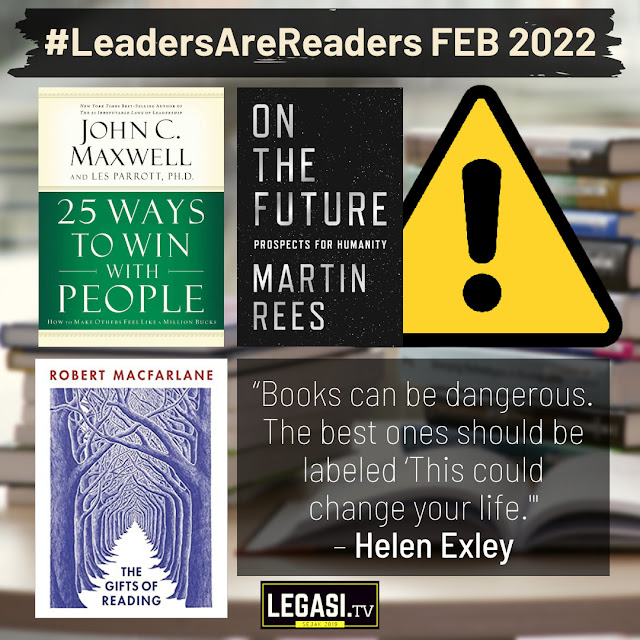
To read my book reviews of #LeadersAreReaders FEBRUARY 2022, CLICK LINKS below:

1) On the Future: Prospects for Humanity (2018) by Martin Rees https://bit.ly/OnTheFuture

2) The Gift of Reading (2016) by Robert Macfarlane https://bit.ly/MacfarlaneReading 

3) 25 Ways to Win With People (2005) by John C. Maxwell https://bit.ly/25WaysPeople 

4) The Previous book reviews https://bit.ly/1Book1Week 


FB Page: https://facebook.com/LEGASI.tv/                             
Podcast: http://bit.ly/LegasiSpotify                            
YouTube: https://www.youtube.com/c/LEGASItv/                        

THINK BIG. START SMALL. GO DEEP.

Best Blogger Tips

Tuesday, February 22, 2022

On the Future: Prospects for Humanity (2018) by Martin Rees, Book Review

 On the Future: Prospects for Humanity (2018) by Martin Rees

I enjoy watching the YouTube Originals series on The Age of A.I. eight science-documentary episodes covering the ways how Artificial Intelligence is and will change the world in various fields such as robotics, health, food, space travel, relationships, and others. It is narrated and hosted by Robert Downey Jr. with the vibe of Tony Stark’s coolness and humor (actually it is more interesting if J.A.R.V.I.S. or F.R.I.D.A.Y. be the one who narrated the series). I’m always fascinated by how fast we humans have progressed in terms of knowledge, science, and technology. It is both creates excitement and anxiety. When I watched the series, I realize that the producers want to highlight the wonderful positive aspect of A.I. implementations in many areas of our human experiences, but I still can’t help to think realistically (with a mix of negative thinking), of “what if” this or that happened. What if we create evil Ultron with the good intention to protect ourselves? What if there are powerful but bitter people like Magneto who decided to choose only special people like them to survive? What if there are people with the Thanos ideology that in order to bring peace and order there must be wars and necessary sacrifices needed to be made?

These existential questions and more leads me to this book. Martin Rees, an Astronomer Royal, renowned scientist, and futurist, examines the critical issues that will define the future of humanity on earth and beyond. His insights into cutting-edge science and technology and global trends are very helpful. His main argument is that if we approach the future with short-term thinking, polarizing debates, alarmist rhetoric, and pessimism, we are doomed to extinction (my language). But if we take responsibility for the future NOW with long-term thinking, rational discussions, solution-oriented partnership, globally, collectively, and optimistically, we can flourish.
“This book offers some hopes, fears, and conjectures about what lies ahead,” said Martin who doesn’t claim to be a prophet of the future but trying to act like one anyway due to the urgency of the subject at hand. “Surviving this century, and sustaining the long-term future of our ever more vulnerable world, depends on accelerating some technologies, but responsibly restraining others. The governance challenges are huge and daunting.” I agree. As a Christ-follower, I wholeheartedly believe that the future is in the hand of the sovereign God. But from the humanistic perspective, as the author seems to be one (he said he is a ‘cultural Christian.’ It doesn’t matter what he meant, for this book is not a Christian book anyway), the future is in our hands.

Overall,
On the Future is an excellent read. The author’s careful and brief treatments on the issues like nuclear threats, eco-threats, climate change, biotech, cyber technology, human consciousness, robotics, A.I., and spaceflight are both encouraging and alarming for obvious reasons. Of course, a book like this is not without speculations such as the possibilities of our dominion outside our planet (for example, colonization of Mars), and the ongoing search for extraterrestrial intelligence. I find that it is interesting when Martin also discusses the limits and future of science. By the way, I want to share one thing that probably going to spark your interest. This book is published in 2018 and about two years after that, in March 2020, the WHO declared COVID-19 a global pandemic. This is a glimpse of one of Martin’s worst nightmares coming true when he wrote: “Pandemics are an ever-present natural threat, but is it just scaremongering to raise concerns about human-induced risks from bio error or bio terror? Sadly, I don’t think it is. We all know too well that technical expertise doesn’t guarantee balanced rationality. The global village will have its village idiots and they’ll have a global range… Bio error and bio terror are possible in the near term - within ten or fifteen years. And in the longer term, they will be aggravated as it becomes possible to ‘design’ and syntheses viruses - the ‘ultimate’ weapon would combine high lethality with the transmissibility of the common cold.” 10 to 15 years, huh? How about 1-2 years?!

After I finished reading this book, I still have the “what if” questions about the future of humanity from the humanistic perspective. The difference is that I have moved from some (Oh, there are many!) of my ignorance to more informed “what if” question
s.

#ServeToLead #LeadersAreReaders #OnTheFuture #ScienceAndTechnology #LetsMakeReadingCoolAgain

[P. 
s: Two other issues/topics that are important, in my opinion, that should be covered in a book on the future like this one are cryptocurrency and the metaverse. Check it out!]

To read my other book reviews (and articles) based on science, CLICK HERE 


FB Page
: https://facebook.com/LEGASI.tv/                          
Podcast: http://bit.ly/LegasiSpotify                          
YouTube: https://www.youtube.com/c/LEGASItv/                      

THINK BIG. START SMALL. GO DEEP.

Best Blogger Tips

Thursday, November 18, 2021

Payoff: The Hidden Logic That Shapes Our Motivations (2016) by Dan Ariely, Book Review


Dan Ariely is one of my favorite authors and speakers on behavioral economics, namely, someone who studies the combination of economics and psychology to understand how people decide and why they behave the way they do. I’m an observer. I love to predict people’s behavior and so, this is a fascinating subject to me. I’ve read Predictably Irrational and listened to The Upside of Irrationality and (Dis)Honesty audiobooks - I recommend it all. This short book (just 103 pages) is part of the TED Books series which is a compliment and extension of Ariely’s TED Talks on this subject.

“Human motivation is not simple,” writes Ariely, “but as we understand it more, we’ll better be able to handle ourselves, our work, our relationships, our employers, and our employees. Knowing what drives us and others is an essential step toward enhancing the inherent joy - and minimizing confusion - in our lives.” Every day we try to motivate ourselves. How to create meaning in my current work now? Why I should or shouldn’t quit? What is my end goal? If you’re in the people business or any kind of relationship, surely you spend lots of time trying to motivate others too. How to makes this partnership works? Why does this or that person enjoy life more than others? What are the determining factors of our organization's productivity? These questions and more - if you care enough - are part of our everyday life. As the author puts it: “We are all part-time motivators.” But the problem is that motivations for each person are complex, variant, and subjective. Some are driven by money or achievement or happiness or purpose or a sense of progress or as often the case, a mix of all of these and more. Plus, although Ariely shares valuable insights from the psychological experiments (Bionicles, Origami, and Intel experiments are particularly interesting) that he outlines in the book, we need to keep in mind that real life is not like a lab that we can easily predict but it is both an ugly and beautiful, messy and orderly world. Ariely can be too general and simplistic in his assessments. Keep this in mind as you explore the subject.

Having said that, there are universal and essential motivations that drive human behaviors. For example, a sense of meaning, connection, identity, and individuality. Something simple like giving a compliment or acknowledgment for a job well done can be a strong drive of motivation for most people (on the other hand, it takes a little thing like negative-aggressive feedback can kill even the tiniest motivation!). Some of our conventional wisdom about motivation are also challenged in this book. For example, the idea that giving a large amount of money or bonuses as an incentive, in the long-term, “can backfire and make people less driven.” To know more, read the book or/and watch his TED Talks on YouTube. I also recommend listening to his podcast interviews on Spotify.

#ServeToLead #LeadersAreReaders #GrowingLeaders #MotivationMatters #DanAriely #Psychology #TEDBooks #LetsMakeReadingCoolAgain

To read my other #1Book1Week book reviews, CLICK HERE

FB Page
: https://facebook.com/LEGASI.tv/                                
Podcast: http://bit.ly/LegasiSpotify                 
YouTube: https://www.youtube.com/c/LEGASItv/             

THINK BIG. START SMALL. GO DEEP.

Best Blogger Tips

Wednesday, September 8, 2021

Romans 1:28-32 The Breakdown of Human Society (#LetterToTheRomans)

As I observe the current world events and study the Word of God, especially Romans 1, I see the inevitable breakdown of human society. As we move further away from God, we move nearer to our self-destruction. More than ever, the wrath of God is revealed from heaven against all ungodliness and unrighteousness of men (see Romans 1:18). The question is, WHY? And is there any hope amidst all of this?

To watch my previous short studies of #LetterToTheRomans, CLICK HERE http://bit.ly/LegasiRomans 


FB Page
: https://facebook.com/LEGASI.tv/                        
Podcast: http://bit.ly/LegasiSpotify          
YouTube: https://www.youtube.com/c/LEGASItv/      

THINK BIG. START SMALL. GO DEEP.


Best Blogger Tips

Romans 1:26-27 The Reason for Homosexual Behaviour (#LetterToTheRomans)

"For their women exchanged natural relations for those that are contrary to nature," writes Paul the Apostle in Romans 1:26-27 and, "the men likewise gave up natural relations with women and were consumed with passion for one another, men committing shameless acts with men..." These are the consequences of something MORE important ⚡What is the reason for homosexual behavior? What is the context of these verses? Where it should lead them - and every one of us - to? #ServeToLead #PreachTheWord #SinIsSin #ThePowerOfTheGospel

To watch previous short studies of #LetterToTheRomans CLICK HERE http://bit.ly/LegasiRomans 


FB Page
: https://facebook.com/LEGASI.tv/                        
Podcast: http://bit.ly/LegasiSpotify          
YouTube: https://www.youtube.com/c/LEGASItv/      

THINK BIG. START SMALL. GO DEEP.


Best Blogger Tips

Wednesday, June 23, 2021

Romans 1:3-4 Jesus Is Truly Man, Truly God (#LetterToTheRomans​)

[The Gospel] "concerning his Son, who was descended from David according to the flesh and was declared to be the Son of God in power according to the Spirit of holiness by his resurrection from the dead, Jesus Christ our Lord" (Romans 1:3-4) There are six (6) things that we need to know about Jesus in these verses ���️‍♀️���✍ #ServeToLead #PreachTheWord #TrulyManTrulyGod  

To watch previous short studies of #LetterToTheRomans CLICK HERE ��� http://bit.ly/LegasiRomans 

FB Page: https://facebook.com/LEGASI.tv/                       
Podcast: http://bit.ly/LegasiSpotify         
YouTube: https://www.youtube.com/c/LEGASItv/     

THINK BIG. START SMALL. GO DEEP.

Best Blogger Tips

Sunday, December 20, 2020

Angelus' Quote: The Triune God Is Uncomprehend


This is a good read 😊 Augustine (of Hippo) was once walking by the seashore pondering the doctrine of the Trinity. He came upon a little boy who dipping water from the ocean with a shell and pouring the water into a hole of sand. "What are you doing?" Augustine asked the child. "I'm going to put the ocean in this hole," the boy replied.

Augustine went his way. But, he confided to his friends later that he was struck with the thought: "And are you doing the like in thinking to comprehend the depths of God in the limits of your finite mind?" If you try to understand the Trinity, you will lose your mind. But if you deny the Trinity, you will lose your soul ⚡📖👈 #ServeToLead #GodTheTrinity

FB Page: https://facebook.com/LEGASI.tv/              
Podcast: https://anchor.fm/LEGASI.tv/           
YouTube: http://bit.ly/LEGASItv

THINK BIG. START SMALL. GO DEEP.

Best Blogger Tips

Friday, September 18, 2020

Altar of Eden (2010) by James Rollins, Somewhat Review


Altar of Eden (2010) by James Czajkowski a.k.a. James Rollins

 Rollins is one of my favorite novelists. He is brilliant! The Order of Sanguines Series, a trilogy, his collaboration with Rebecca Cantrell, and SIGMA Force Series, are among my top three novel series.  In the past, whenever I feel like I want to read fiction, I used to entertain myself with Nicolas Sparks’ heart-melting romanticism (author of A Walk to Remember) and Arthur Conan Doyle’s mystery genius (author of Sherlock Holmes Series). But as my interests grow wider, I stick with Rollins. His ability to mixing cutting-edge science and theories, advanced technology, and ancient history, romance, and action, is one of the kinds. He is very good with frictional stories like Eminem in the rap industry. “His books have everything…” one of the praises says, “Yet it works, because Rollins is a master of controlled chaos.” I couldn’t agree more.

Altar of Eden, a stand-alone novel, is a good read. Probably because the characters are new and fresh to me (I mean, different from SIGMA Force Series characters) and the story includes something that I’ve done some personal research about. Not much, but at least I can keep up with the basic arguments. Without going into spoiler alert, I must say, if you have pondered about our scientific discoveries and technologies of the 21st century and the mystery of our DNA – or the creation, in general – you’ll be thrill by this novel. Plus, most of the facts that go into his book(s) are true. At the end of every novel, he will outline “Author’s Note to Readers: Truth or Fiction.” Of course, the characters, conclusions, and implications are made-up. It doesn’t claim “historical accuracy” like Dan Brown does to The Da Vinci Code.

 #ServeToLead #1Book1Week #LetsMakeReadingCoolAgain #LeadersAreReaders #JamesRollins #ThrillerNovel #AltarOfEden

 To read my other novel-book reviews, CLICK HERE: https://www.richardangelus.me/search/label/Novel

FB Page: https://facebook.com/LEGASI.tv/         
Podcast: https://anchor.fm/LEGASI.tv/        
YouTube: http://bit.ly/LEGASItv        

THINK BIG. START SMALL. GO DEEP.


Best Blogger Tips

Tuesday, September 1, 2020

The Art of Thinking Clearly (2013) by Rolf Dobelli, 2nd Book Review


The Art of Thinking Clearly (2013) by Rolf Dobelli, 2nd Book Review

I have read this book twice. The first was 4 years ago in 2016 (to read my first review, CLICK HERE). I love this book so much for three main reasons: 1) It’s about thinking; 2) I’m very interested in social psychology and decision-making; and 3) Each chapter is short, concise, and easy to read. It is about cognitive biases, namely, systematic errors in thinking that occur when people are processing and interpreting information in the world around them and affects the decisions and judgments that they make. The bad news is that all of us - even the most self-aware people - cannot avoid all of these biases. But the good news is that we can begin to understand why we do what we do and by deliberate practice - we can make better (not perfect) choices. Dobelli outlines 99 cognitive biases, let me share the top 3 biases, in my opinion, that we always make in our day-to-day thinking:

#1 Confirmation Bias. It is the idea that people seek out information and data that confirms their pre-existing ideas. They tend to ignore contrary information. This can be a very dangerous cognitive bias in business and especially, religion. Let say you just started a business selling Faith Fleur hair serum because your friend says it’s an excellent and the best serum in Malaysia. You post some testimonial pictures on your social media and then a few hours later, you observe (due to the algorithm) that others in your circle of social media also sell the product with very positive testimonies. You thought, “This product is the best!” Is it the best? No. There are other products in the market. Faith Fleur hair serum is a popular, safe, and good product but not the very best there is. Your friend says it’s the best, you believe her, and so you interpret everything based on that existing belief or conviction. As you can see, if you apply that bias in religion, it can be misleading, even dangerous. “The confirmation bias,” writes Dobelli, “is the mother of all misconceptions.”

#2 Groupthink. It is a phenomenon that occurs when a group of individuals reaches a consensus without critical reasoning or evaluation of the consequences or alternatives. Let me give an example in a Christian setting: during a Bible Study on the Book of Romans, the leader expounds the Scripture and concludes that Calvinist doctrines of predestination and election are the most biblical and faithful to the Scripture. When you heard it, you’re skeptical and doubtful. You wanted to respond and ask questions but since almost everyone nodded in agreement, you keep silent. Not wanting you cause division, you suppressed your opinions, and say to yourself, “Oh well, since nobody disagree with him, maybe I’m wrong.” And you say “Amen” all the way. If you want to decide with your friends where to eat for supper (Malaysian culture ma), then subjecting yourself to groupthink is harmless. But when it involves ethics or morals (and eternal consequences), groupthink can be disastrous.   

#3 Halo Effect. Simply put: it is when one trait of a person or thing is used to make an overall judgment of that person or thing. It is also known as the "physical attractiveness stereotype" or the "what is beautiful is a 'good' principle." I love this example by Dobelli: “Dozens of studies have shown that we automatically regard good-looking people are more pleasant, honest, and intelligent. Attractive people also have it easier in their professional lives - and that has nothing to do with the myth of women ‘sleeping their way to the top.’ The effect can even be detected in schools, where teachers unconsciously give good-looking students better grades.” Men, do you accept Facebook friend requests by a stunningly beautiful girl right away even though you never knew her before? Woman, do you think all the BTS members are angels from heaven? (Okay, maybe not all men or women like that). We love to think that we are fair and just, not stereotyping and anti-racism, very kind, and ‘never judge a book by its cover’ but on a subconscious level, we do. We are irrational. Why do anime fans think that Son Goku is the good guy? Because when he died, he has a halo and angel’s wings. Oh, the halo effect dies hard.

I recommend this book for beginners and for those who want to get the big picture of cognitive biases or fallacies. If you want to study deeper, I recommend reading books by Daniel Kahneman’s Thinking, Fast and Slow (haven’t finished it, so no book review yet), Nassim Nicholas Taleb’s The Black Swan (use it as reference), Robert Cialdini’s Influence (my review, CLICK HERE), Dan Ariely’s Predictably Irrational & The Upside of Irrationality (my review, CLICK HERE), and Steven D. Levitt’s Think Like a Freak (my review, CLICK HERE). But before I finished, I’m fully aware of the controversy that Rolf Dobelli is accused of - or actually, showing that - plagiarizing other authors especially his once a good friend, Nassim Nicholas Taleb... I think it’s true.

#1Book1Week #ServeToLead #LeadersAreReaders #LetsMakeReadingCoolAgain #TheArtOfThinkingClearly #SocialPsychology #CognitiveBiases

FB Page: https://facebook.com/LEGASI.tv/         
Podcast: https://anchor.fm/LEGASI.tv/        
Instagram: https://instagram.com/legasi.tv/        
YouTube: http://bit.ly/LEGASItv        

THINK BIG. START SMALL. GO DEEP.


Best Blogger Tips

Wednesday, September 25, 2019

Angelus' Quote: Everybody Needs Encouragement!


After I finished reading a book on leadership, I wrote on the last empty page, something that struck my mind when I read about how Paul encouraged Timothy to stay faithful to his call. I wrote in big letters: "Everybody needs encouragement!"

"I have yet to find the man," said Charles Schwab, "however exalted his station, who did not do better work and put forth greater effort under a spirit of approval than under a spirit of criticism" 😘 Appreciate other, encourage one today #GrowingLeader #ServeToLead

THINK BIG. START SMALL. GO DEEP.


Best Blogger Tips

Monday, May 13, 2019

3 Predetermined Things about Jesus from Luke 2:21-24 (Short Bible Study)


Read Luke 2:21-24 (NLT):

Eight days later, when the baby was circumcised, he was named Jesus, the name given to him by the angel even before he was conceived. Then it was time for their purification offering, as required by the law of Moses after the birth of a child; so his parents took him to Jerusalem to present him to the Lord. The law of the Lord says, "If a woman’s first child is a boy, he must be dedicated to the Lord." So they offered the sacrifice required in the law of the Lord — “either a pair of turtledoves or two young pigeons."

3 Predetermined Things about Jesus:

#1 The Name of Jesus - WHO He Is
#2 The Dedication of Jesus - WHY He Came
#3 The Humility of Jesus - HOW He Came

Want to Watch Previous Videos?


THINK BIG. START SMALL. GO DEEP.

Best Blogger Tips

Tuesday, February 19, 2019

7 Quote-Lessons from Alita: Battle Angel

Here are Seven (7) Lessons I Learned from watching Alita: Battle Angel. Don't waste RM10.00+ and not learning something, right? For explanations for each quote, CLICK [AT YOUR OWN RISK] HERE


THINK BIG. START SMALL. GO DEEP.
Best Blogger Tips

Sunday, October 21, 2018

The Upside of Irrationality (2010) by Dan Ariely, A Book Review


The Upside of Irrationality: The Unexpected Benefits of Defying Logic at Work and at Home (2010)
by Dan Ariely

"Human beings are irrational," said the author. We thought (mostly unconscious) that we are objective, rational, and logical. We take pride in the ‘fact' that we make decisions based on reason. When we decide to invest our money, buy a home or books, choose restaurants for dinner, or pick a medical treatment, we usually assume that the choices we make are the right ones. Ariely observes, "We are all susceptible to a formidable array of decision biases. There are more of them than we realize, and they come to visit us more often than we like to admit." This book attempts to show us the many ways in which we act irrationally while thinking what we're doing makes perfect sense, and how this irrational behavior can actually be beneficial as long as we use it the right way.

You see, sometimes being irrational has its advantages (as the author keeps on emphasizing throughout the book). In our optimized world trying to make 100%, rational decisions all of the time seems tempting, and most people would probably adopt a robot-like decision-making ability in a heartbeat if they could. Ariely argues that this isn't the best solution, for much of what makes us irrational is also what makes us human and allows us to connect with one another. "Rather than strive for perfect rationality, we need to appreciate those imperfections that benefit us, recognize the ones we would like to overcome, and design the world around us in a way that takes advantage of our incredible abilities while overcoming some of our limitations," said Ariely.

In this book, he asked rational-vs-irrational-based questions such as: Why do large bonuses actually make us less productive? Why is revenge so important for us? Why there is such a big difference between what we 'think' will make us happy and what 'really' makes us happy? How to enjoy your work? Why do we overvalue what we make? Why 'my' ideas are better than 'yours' regardless of their quality and brilliance?  Why do we get used to things even though it is sometimes irrational to do so? Why does online dating fail? Why we shouldn't act on our negative feelings? Why do we respond to one person who needs help but not too many? And many more. Some questions are common sense, but sometimes we don't really know what's the thinking and motives behind those actions and responses. Here, Ariely, professor of psychology and behavioral economics, social scientist, answered these questions based on his (and partners') researches and experiments. These may sound technical and somewhat boring to some – but not so. If Ariely wrote it, he wrote it with clarity, easy to understand, and fun. It's not overrated if I say that this book is FUN to read.

I want to write a chapter by chapter summary of this book, but I found that a responder, Poonam @goodreads.com had done a great job doing it. So I would like to refer you to Poonam's review [CLICK HERE]. Dan Ariely's first book Predictably Irrational (2008) was a success but I haven't read it. I bet it is as good as this one. I plan to read The Honest Truth About Dishonesty (2012) on the subject of lying in the near future. If you like Malcolm Gladwell's or Adam Grant's books, you will surely like Dan Ariely's… Perhaps you'll love Ariely more. Like I do.  

[P.S: If you want to have a ‘taste’ of Dan Ariely, watch him on YouTube and TED Talks videos.]


THINK BIG. START SMALL. GO DEEP.
Best Blogger Tips

They Click it A lot. [Top 7 last 7 Days]