Showing posts with label Spiritual Health. Show all posts

Sunday, June 18, 2023

Freedom of Simplicity: Finding Harmony In a Complex World (1981, 2005) by Richard J. Foster, Book Review

Freedom of Simplicity: Finding Harmony In a Complex World (1981, 2005) by Richard J. Foster
 
I was first introduced to Christian spiritual disciplines through Richard Foster's classic Celebration of Discipline many years ago. I learned so much from that book, and I've practiced some of it until today, such as the disciplines of study, service, solitude, celebration - and simplicity. But then, I read and heard other authors criticize this book as being very influenced by ancient Catholic mystics, Eastern practices, and extrabiblical advice. In my opinion, some of the critics are valid (such as contemplative prayer, Lectio Divina, etc., which I'm very uncomfortable with), and some simply disagree on methods and traditional streams of Christianity, which are very subjective. This is a good reminder - for me and you - to read any books, even so-called Christian books with spiritual discernment, and holy skepticism, and get the most out of them (perhaps Philippians 4:8 is applicable here).

With this in mind, I reread Richard Foster's
Freedom of Simplicity, an extension of one of the disciplines in his classic book as mentioned above. The idea of Christian simplicity is similar to secular minimalism but with one major difference: the main focus of simplicity is on God first, not the self. It is about intentionally getting rid of the things and reordering our lives that hinder our walk with God. Or, to put it positively, to enable us to walk with God with joy and freedom. God is calling us to live a simple life as Jesus lived simply. It allows us to create more space and the mental capacity for the Holy Spirit to move in all areas of our lives. This book reminds me of Proverbs 30:8b-9, "Give me neither poverty nor riches! Give me just enough to satisfy my needs. For if I grow rich, I may deny you and say, 'Who is the Lord?' And if I am too poor, I may steal and thus insult God’s holy name." Give me Jesus!

Foster divided the book into two parts:
the foundation and the practice. He first argues why the discipline of simplicity is urgent, challenging, complex, and yet necessary. He also shows that it is rooted in the Old Covenant (Testament), the New Covenant, and church history among the saints. Based on his survey of Biblical texts, witnesses and practices, he concludes that inward simplicity must consist of 1) The Divine Center and, 2) Holy Obedience. From these, outward and corporate simplicity will overflow from our lives to affect our community and the world around us. Foster ends this book with encouragement, namely, the simplicity of simplicity: "There are not many things we have to keep in mind - in fact, only one: to be attentive to the voice of the true Shepherd. There are not many decisions we have to make - in fact, only one: to seek first his kingdom and his righteousness. There are not many tasks we have to do - in fact, only one: to obey him in all things." Come to think about it, the discipline of simplicity IS indeed simple because it is by God's grace. How do I get there? Well, hard work! A paradox.

#LeadersAreReaders #FreedomOfSimplicity #RichardFoster #SpiritualDiscipline #GraceAndWork #ChristianLifestyle #ServeToLead #LetsMakeReadingCoolAgain

To read my other book reviews/summaries, CLICK HERE

THINK BIG. START SMALL. GO DEEP.

Best Blogger Tips

Tuesday, May 10, 2022

Three (3) Categories of Books To Avoid #LeadersAreReaders April 2022

In his highly recommended book, Lit! A Christian Guide To Reading Books (2011), Tony S. Reinke shares three categories of books to avoid:

1) AVOID CERTAIN BOOKS BECAUSE OF TIMING. "Choosing what books to read is often not a yes/no decision but a now/later decision," writes Reinke. "The same is true for young Christians who are new to the faith. Be cautious of reading literature that you are ill-equipped to read with discernment. Sometimes the proper Christian approach to literature is humble postponement." I agree. One day, a student saw me reading Richard Dawkins' The God Delusion, a passionate atheist who states that it is irrational to believe in God and why religion is harmful to mankind. After he noticed that I'd written the review, he wanted to borrow the book because he was interested too. I'm all out for reading widely and books that I don't agree but he was not equipped to read this kind of book with discernment (Dawkins, although a brilliant scientist, is such a lousy layperson theologian). I know because I've observed his knowledge of the Scripture is still under development. So I refuse kindly, explained to him patiently, and encourage him to study the Scripture first. I love that he wants to read books at all but at this rate, he needs to practice "humble postponement."

2)
AVOID CERTAIN BOOKS THAT GLORIFY EVIL. This does not mean avoiding books that mention evil or give descriptions of evil or capture the dark realities of life. The Scripture doesn't even avoid the topic of evil explains Reinke. "The more important questions are these: How are the violence, sexual sin, and skepticism presented? Is it presented as evil? Is fornication celebrated, or are the consequences of sin made obvious? Does the book celebrate sin, or leave evil unresolved?" These are good questions to think about. This is why I'm very concerned with the rise of open occultism and the glorification of witchcraft in the Marvel Cinematic Universe. Books such as The Harry Potter and the likes should be avoided. As the Scripture says, "Woe to those who call evil good and good evil, who put darkness for light and light for darkness, who put bitter for sweet and sweet for bitter" (Isaiah 5:20). Books that expose evil, yes; books that glorify evil, no.

3)
AVOID CERTAIN BOOKS FOR CONSCIENCE'S SAKE. Reinke asserts, "While there are no rigid rules for what Christians should or should not read, we must be sensitive to our own consciences and the consciences of those around us. As we establish our own understanding of what books we will and will not read ourselves, we must respect the parameters that other Christians have chosen to set for themselves and their children." For me, as an example, I have no problem reading books on Islam and from Muslim writers although I don't believe in their core teachings. I enjoy especially the writings of the liberal Muslim modern-day intellectuals. But I find myself couldn't even read a page or two of Anton S. Lavey's The Satanic Bible. Both are false religions (respectfully honest), yet, I couldn't consciously endure the other. It's a matter of conscience, a level of tolerance, and a mass amount of discernment. On this, Reinke has a good reminder: "A firm grasp of the biblical worldview learned directly from the study of Scripture is essential for a Christian book reader because distortions to the biblical worldview can be found on every shelf in the bookstore." Yes!

#ServeToLead #BooksToAvoid #LetsMakeReadingCoolAgain

CLICK THE LINKS
 to read my book reviews of #LeadersAreReaders for April 2022

1)
The Science of Self-Learning (2018) by Peter Hollins, CLICK HERE
2) The Spirit-Filled Life (1895, 2019) by John MacNeil, CLICK HERE
3) The Message of Matthew: The Kingdom of Heaven (1988, 2000) by Michael Green, CLICK HERE
4) Matthew: The College Press NIV Commentary (1997) by Larry Chouinard, CLICK HERE


LEGASI.tv Media: https://linktr.ee/LEGASI.tv  

THINK BIG. START SMALL. GO DEEP.

Best Blogger Tips

Tuesday, April 12, 2022

The Spirit-Filled Life: Restoring A Biblical Understanding and Experience of the Holy Spirit (1895, 2019) by John MacNeil, Book Review

To listen to the audiobook of this book, go to Aneko Press YouTube Channel


 The Spirit-Filled Life: Restoring A Biblical Understanding 
and Experience of the Holy Spirit (1895, 2019) by John MacNeil

If I want to listen to or read Bible-saturated Christian classics, the first place I go is the Aneko Press website and YouTube. So many good titles, sound authors, and the best is - it’s free! Although it's an old book, the heart of MacNeil’s message is timeless. Aneko Press has done a good job of updating and revising it. This book can be scary to read because it sometimes emphasized heavily the teaching of ‘inner life’ like that of Andrew Murray’s books. In fact, he, Murray, and others were parts of the controversial Higher Life Movement. If not careful, it will make you feel spiritually inferior. But with prayerful reading and Scripture meditating, your eyes will be open to how much God desire for His children to be filled with the Holy Spirit - and to know Him. “The fullness of the Holy Spirit,” writes MacNeil, “is the birthright of every believer.”

The author begins this book by quoting Acts 19:1-2, “Now it happened that while Apollos was in Corinth, Paul passed through the upper country and came to Ephesus, and found some disciples. He said to them, ‘Did you receive the Holy Spirit when you believed?’ And they said to him, ‘On the contrary, we have not even heard if there is a Holy Spirit.’” MacNeil comments on this situation, “Many - oh, so many - of God’s dear children are living on the wrong side of Pentecost, living on the same plane as that on which the disciples were living before they were filled with the Holy Spirit, and thus by their lives they practically make the sad confession, ‘We did not so much as hear whether the Holy Spirit was given or whether there is any Holy Spirit.’” Indeed, this is a sad confession. I have said it before too. Chapter 3: A Command to Be Obeyed; Chapter 4: Something Different from the New Birth; Chapter 7: The Time Between Regenerating and Filling; and Chapter 8: Other Words for Being Filled With the Spirit; are very helpful chapters to understand the distinction between being filled with the Spirit from being born (again) of the Spirit. The Scripture examples and passages that MacNeil used to support his writings are very persuasive. Don’t take it all at face value, of course, but do consider it seriously.

We need to continually be filled with the Holy Spirit (Ephesians 5:18). I find that if I don’t, my spiritual life will be dry. There were times when I preached the Word of God, it was all rhetoric but no power. Bones with no skins. iPhone 13 software with short battery life. At one-third of the book, MacNeil gave a very valuable reminder: “[Be] on guard against desiring such an important blessing from wrong motives. We must seek it for the one supreme reason - the glory of God. If self is at the root of our motives at all, God will most surely block our way to fullness of blessing... there is a need for the refining fire to go through our hearts. God must be Alpha and Omega in the matter. ‘For God’s glory, and for God’s glory alone’ must be our motto as we proceed with our search for the fullness of the Spirit.” Amen. Read it!

#ServeToLead #LeadersAreReaders #TheSpiritFilledLife #TheHolySpirit #LetsMakeReadingCoolAgain

 To read my other - a hundred plus - book reviews, CLICK HERE and all things media https://linktr.ee/LEGASI.tv 


THINK BIG. START SMALL. GO DEEP.

Best Blogger Tips

Monday, March 7, 2022

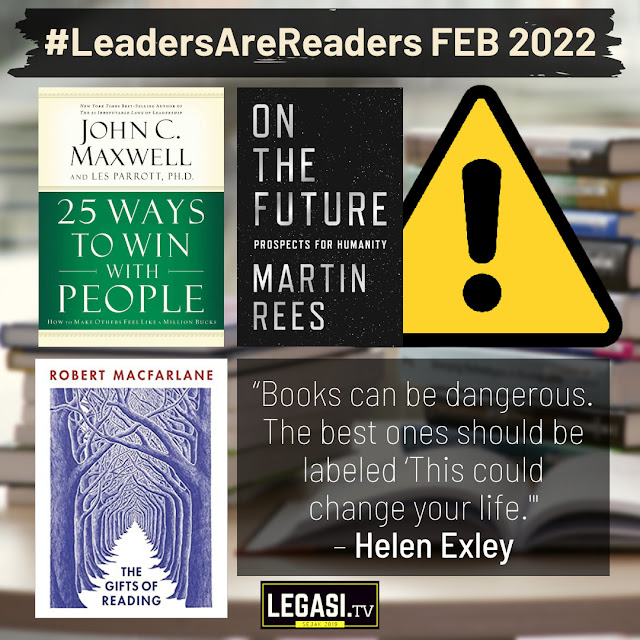
Read Books and Beat the Goldfish! #LeadersAreReaders February 2022

Currently, I’m rereading Chris Bailey’s Hyperfocus (2018). When I went to MPH Bookstore the other day, I saw a new book that interest me by Johann Hari entitled Stolen Focus (2022). But the price is so expensive, RM89.90! I understand the book business is having a hard time nowadays and in the same way, owning physical books and encouraging people to be readers is getting hard too (state libraries and discount bookstores like BookXcess are saviors for bibliophiles). Not that I cannot afford to buy the book but as I browse through the contents - besides having newer research and the author’s unique perspectives - I realize that the challenge of managing attention and focus today is the same as yesterday. No new book can claim that this is a new phenomenon. Thus, I reread Hyperfocus and settle with just listening and watching interviews of Johann Hari online… hoping that soon the State Library will have it available. Lord, have mercy.

Reading a book requires a good deal of attention,” writes Chris Bailey, “and with attention becoming a rare commodity, fewer people can devote themselves to reading without distraction.” Attention is our most limited and constrained resource. According to Microsoft Attention Spans Research Report*, the average human attention span in 2000 is 12 seconds and in 2013, it decreased drastically to 8 seconds (I don’t know how they measure this, but the goldfish have an average attention span of 9 seconds. 1 second longer than the average human!). In today’s fast-paced world of information overload, we’re constantly flooded with social media notifications, text messages, and games. Smartphone users, like you and me, check our devices about 80 to 90 times a day. No wonder we are so distracted. This is one of the reasons for the decline of book-reading culture in Malaysia and the world in general.  We still read but read bits and pieces of information. We have amassed lots of random information but lack actual knowledge, depth, and wisdom. This is not just affecting the overall quality of our work-life (or study-life, if you’re a student) but also the state of our mental health and spirituality.

Therefore, you must cultivate a love for reading books. It helps to train you (or force you, at the beginning) to increase your attention spans. It requires attention and it improves your attention. Jessalyn Lau, from the neuroscience perspective, says: “Reading has been proven to increase your focus, attention span, concentration, and to improve memory.” Perhaps you say you don’t have time to read books. I get what you mean. You have works to do, family to care for, products to promote, etc. But “no time” is a myth. Unless you move at the speed of light and the theory of special relativity applied to you, we all have the same amount of time. It's not about you don’t have time but it's about you MAKE time. We have no problem carving out time for things we want to do. So, take or buy a book that interest you, set an uninterrupted time (10 to 15 minutes for a start) today, turn off or switch your smartphone to silent mode and put it away from your reach, make a cup of hot coffee or tea or chocolate and start reading! Start small but do it frequently. At first, you will still be easily distracted. However, over time it will become a habit. And soon, you will be proud of yourself because you have beat the goldfish attention span record! Congratulation!

*https://www.scribd.com/document/265348695/Microsoft-Attention-Spans-Research-Report  

#ServeToLead #Hyperfocus #AttentionSpans #BeatTheGoldfish #LetsMakeReadingCoolAgain

To read my book reviews of #LeadersAreReaders FEBRUARY 2022, CLICK LINKS below:

1) On the Future: Prospects for Humanity (2018) by Martin Rees https://bit.ly/OnTheFuture

2) The Gift of Reading (2016) by Robert Macfarlane https://bit.ly/MacfarlaneReading 

3) 25 Ways to Win With People (2005) by John C. Maxwell https://bit.ly/25WaysPeople 

4) The Previous book reviews https://bit.ly/1Book1Week 


FB Page: https://facebook.com/LEGASI.tv/                             
Podcast: http://bit.ly/LegasiSpotify                            
YouTube: https://www.youtube.com/c/LEGASItv/                        

THINK BIG. START SMALL. GO DEEP.

Best Blogger Tips

Friday, June 4, 2021

The Ultimate Prescription: What the Medical Profession Isn't Telling You (2010) by Dr. James L. Marcum, BOOK REVIEW

The Ultimate Prescription: What the Medical Profession Isn't Telling You (2010)
by Dr. James L. Marcum, MD (with Charles Mills)

It's hard for me to ignore this: when the vaccines available for the public, I observe many people are eager to get shots for themselves and their loved ones. Try to get themselves and family members to register online and when the website jammed, they tenaciously try and try again. "Don't give up," a mantra that I read in one of my WhatsApp groups. Then when it's time for them to take the shot, people don't mind driving early in the morning, some even from miles away and very patiently queuing the long lines. There is no laziness, very few complaints, and little need for crowd control. But something is missing here: the same eagerness doesn't apply to most people's lifestyle when it comes to physical exercise, eating right, and mental health. It seems we are more concerned with which vaccines are the best but we are ignorant about how we treat our God-given bodies, minds, and spirits.

According to the World Population Review 2019, Malaysia has the highest prevalence of obesity among adults in South-East Asia at 15.6% (the 'fattest' country in Asia). According to the WHO, the top killer in Malaysia in 2014 was coronary heart disease (still is all around the world). The most recent epidemiological data, published in 2015 by the Malaysian Ministry of Health, identified that the prevalence of mental disorders among adults was 29% (that's about 3 in 10 people). Add these data with the effects of the pandemic and the stress of quarantines, we are doom if we don't take care of our health. Dr. James Marcum, in the back cover, argues that many of the diseases sending us to doctors' offices, surgical suites, and early graves are PREVENTABLE - and we don't need to be over-medicated (not anti-medicine) to cure them. "The painful truth is that we give the disease to ourselves by the choices we make over a lifetime. We create the chronic condition that brings about the acute event by placing endless stressors on our systems - stressors that eventually do us in."

Dr. James is a behavioral cardiologist, so he outlines many good scientific evidence to back up his claims, share lots of experience with his patients to authenticate his observations, and unapologetically tackle dozen of deadly misconceptions around us today. At the same time, he writes this book from a Christian perspective and believes that although modern medicines and technologies have done so much to combat the symptoms of diseases, only God, the Great Physician, through His Word (The Bible, 'owner's manual' as he called it), is the true source of healing. By gleaning truths from the Creation Story - Genesis chapter 1 to 3 - Dr. James skillfully let us see that God had already revealed His 'Health Plan' for us that is consistent with scientific findings. Perhaps I have issues with how he interprets some texts, but overall, he is theologically (but not a theologian) sound. Besides all the usual but often neglect natural ways to increase good health, he also highlights the spiritual aspect of love and worship. As cheesy as it may sound, this remains true: "Love [of God and with one another] is the solution to our global health care dilemma. Love opens the door for us to rediscover the ultimate prescription and find healing for our minds, bodies, and spirits. Love is the ultimate treatment. It's the final step to a full, long-lasting recovery"  
#LeadersAreReaders #GrowingLeaders #TheUltimatePrescription #HealthIsWealth #LetsMakeReadingCoolAgain

[P.s: In the final sections of this book, Dr. James gives very useful information about the symptoms, diagnostic testing, and treatment of cardiovascular disease. Sweet!]

To read my other #1Book1Week book reviews on health in general, click links below 

1) Happiness Is A Choice: The Symptoms, Causes, and Cures of Depression (2007, Updated Edition) by Frank Minirth, M.D. & Paul Meier, M.D. CLICK HERE
 
2) The Clever Guts Diet: How to Revolutionize Your Body from the Inside Out (2017) by Dr Michael Mosley CLICK HERE  

3) Diet Rehab: 28 Days to Finally Stop Craving the Foods That Make You Fat (2011) by Dr Mike Dow CLICK HERE  

4) Spartan Up! A Take No-Prisoners Guide to Overcoming Obstacles and Achieving Peak Performance in Life (2014) by Joe De Sena CLICK HERE   


FB Page: https://facebook.com/LEGASI.tv/                       
Podcast: https://anchor.fm/LEGASI.tv/               
YouTube: https://www.youtube.com/c/LEGASItv/     

THINK BIG. START SMALL. GO DEEP.

Best Blogger Tips

Tuesday, May 25, 2021

Happiness Is A Choice: The Symptoms, Causes, and Cures of Depression (2007) by Minirth & Meier, Book Review


Happiness Is A Choice: The Symptoms, Causes, and Cures of Depression
 
(2007, Updated Edition) by Frank Minirth, M.D. & Paul Meier, M.D.

"Most people are about as happy as they choose to be," said Abraham Lincoln. The authors agree with him. Probably Lincoln knows best. He went through many grievances in his life - the death of a loved one, lost elections, the Civil War, and other major disappointments. According to the authors, Lincoln once was so depressed that he considered suicide. But he chooses to overcome his depression and obtained inner joy and peace. Of course, eventually, he died but not because of depression but fell victim to the bullet.

Dr. Minirth and Dr. Meier have over 30 years of experience and study human psychology, physiology, anatomy, mentality, spirituality and are said to have exercised psycho-therapeutic skills on thousands of patients. According to them, with minor exceptions like a genetic bipolar disorder, "happiness is a choice." Granted that the human mind and emotions are a very complex, dynamic system, both authors are very confident that lasting inner happiness and depression at its core is "your choice." I agree and at the same time disagree with this statement. I agree because to solve a problem you need to realize that to some extent you're in control and it is within your power to make a change in your life. Free will is God's gift, not a curse. Who chooses to dwell in the misery? Who enjoys being a victim? Who reacts destructively? Who always blames you? You! This reminds me of Jim Rohn's quote: "If you don't like how things are, change it! You're not a tree." Sometimes people unintentionally 'choose' depression due to guilt, bitterness, anger and even use it as a tool for manipulation.

But, on the other hand, I disagree. Why would anyone choose unhappiness and depression? What if there is a chemical imbalance in my brain? What if I'm born this way? (Now, this can be an excuse. But what excuse are you gonna give to those who are born intersex, for example) What about a spiritual attack? Where is the 'choice' in these? I think there are no once-for-all books that can simply answer these questions. Therefore, I'm going to be very gracious with the authors and try to understand their point of view based on their experiences as practitioners and from their Biblical perspective as Christ believers. My disagreement probably due to my lack of knowledge. But this is a true statement: most (not all) clinical depression is treatable and very likely curable. The rise of depression especially during the pandemic is worrisome and it is a very helpful book to keep us informed, be empathetic and hopefully, we will choose some new, healthy-producing attitudes and behavior patterns in our lives. "There is no single cause for all depressions, even though pent-up anger is the root cause of the vast majority of depression," writes the authors in the conclusion of this book. "[And] there is no single solution, even though faith in Jesus Christ and the principles of God's Word is at the root of all the solutions (known and unknown). The solutions may sometimes be very complex, but THEY DO EXIST!" Yes, they do exist. Have hope and faith in the sovereign God. Amen! [Ps: Don't be afraid to find help ya] ���������

#LeadersAreReaders #GrowingLeaders #HappinessIsAChoice #FightAgainstDepression #LetsMakeReadingCoolAgain

To read my other #1Book1Week Book Reviews, CLICK HERE ��� https://legasitv.blogspot.com/search/label/Book%20Review?m=1 

FB Page: https://facebook.com/LEGASI.tv/                      
Podcast: https://anchor.fm/LEGASI.tv/              
YouTube: https://www.youtube.com/c/LEGASItv/    

THINK BIG. START SMALL. GO DEEP.


Best Blogger Tips

Saturday, January 23, 2021

Lima (5) Cadangan untuk Membaca Alkitab pada Tahun 2021


Dalam episod podcast kali ini, saya ingin berkongsi lima (5) cadangan untuk membaca Alkitab pada tahun 2021 📖 Tetapi sebelum itu, saya terlebih dahulu menerangkan beberapa sebab penting kenapa kita perlu membaca Alkitab, apakah cabaran-cabaran yang kita sering alami dan bagaimana untuk mengatasinya. Lima cadangan ialah seperti berikut:

1) Use Bible Reading Plan / Guna Jadual Membaca Alkitab. Dua jenis jadual yang saya sarankan: a) Kronologi seluruh Alkitab, atau sekurang-kurangnya, b) Perjanjian Baru setahun. Beberapa Bible Reading Plan yang kamu boleh guna: https://www.ligonier.org/blog/bible-reading-plans/

2) Use Suitable Translation For You / Guna Terjemahan yang Sesuai untuk Kamu. Untuk bacaan harian (bukan untuk Pengajian Alkitab), saya sarankan New Living Translation (NLT), New International Version (NIV) & Contemporary English Version (ECV). Bagi bahasa, guna Alkitab Versi Borneo (AVB) atau Terjemahan Baru Indonesia (TB).

3) Listen to Audio Bible / Dengar Alkitab Suara. Cari di YouTube, Spotify dan SoundCloud. Kegemaran saya ialah tNIV, ECV dan KJV.

4) Master ONE Book this Year / Menguasai Satu Buku atau Kitab Tahun Ini. Ini cadangan untuk advance readers yang sudah pernah membaca Alkitab secara menyeluruh beberapa kali. Kaedah ini paling berguna, efektif dan berhasil. Untuk lebih jelas, dengar episod podcast ini.

5) Share What You Have Learned Thus Far / Berkongsi Apa yang Sudah Kamu Pelajari Setakat yang Kamu Baca. Bila kamu baca, kamu belajar sekali; bila kamu berkongsi atau ajar, kamu belajar dua kali; bila kamu praktik atau aplikasikan apa yang kamu baca, kamu belajar untuk hidup.

😊⚡💪 #ServeToLead #LEGASItvPodcast #BacaAlkitab2021

Untuk mendengar 👂 episod ini, KLIK DI SINI > Open Spotify: http://bit.ly/SpotifyAlkitab2021 ATAU http://bit.ly/BacaAlkitab2021

FB Page: https://facebook.com/LEGASI.tv/                 
Podcast: https://anchor.fm/LEGASI.tv/            
YouTube: http://bit.ly/LEGASItv

THINK BIG. START SMALL. GO DEEP.

Best Blogger Tips

Thursday, August 6, 2020

Angels: God's Secret Agents (1975) by Billy Graham, Book Review


Angels: God's Secret Agents (1975) by Billy Graham

I read this book for the first time during our campus Christian Fellowship (CF) mission trip to Betong many years ago. When we encountered spiritual warfares, I was curious about what the Bible really said about angels - good and evil - Who are they? What is their purpose or mission? And why are they always appear in the Word and frequently in the world today? Late Billy Graham wrote a book on this topic when the people of his generations were getting more interested in the supernatural such as UFO, ESP, and demonic cults. With all the confusion, he wants to direct his readers to biblical truths about angels. He is faithful to the Scripture, very clear, non-speculative and his writing is easy to read.

Billy's wife, Ruth, who was born and raised in China, recalls that in her childhood days tigers lived in the mountains. One day a poor woman went up to the foothills to cut grass. To her back was tied a baby and a little child walked beside her. As she reached the top of a hill she heard a roar and then saw a mother tigress (hey, a female tiger is more frightful than a male tiger) springing at her. "This illiterate Chinese mother had never attended school or entered a church. She had never seen a Bible," writes Mr. Graham, "But a year or two earlier a missionary had told her about Jesus, 'who is able to help you when you are in trouble.' As the claws of the tigress tore her arm and shoulder, the woman cried out in frenzy, 'Oh Jesus, help me!' This ferocious beast, instead of attacking again to get an easy meal, suddenly turned and ran away." Had God sent an angel to help this poor woman?

I remember a few incidents in my life where I suspect God sent an angel(s) to protect me. A man who appeared out of nowhere helped me pulled my car out from the drain and then gone. I was so sure that a wild dog trying to bite and run very fast toward me (I mumbled some prayer, I think) but about 1 meter away, the dog suddenly stopped for no reason. During one of the mission trips, a witch doctor came to us and asked us who 'protecting' us from her spells.

I believe God when He promises us in Psalms 91:11, "He will give angels charge of you, to guard you in all your ways." Especially, when we do the works of ministry. [Good] angels are our allies. Do not worship them, but know that they - and us, in some parts - are servants of God. As Mr. Graham puts it: "While we do not place our faith directly in angels, we should place it in the God who rules the angels; then we can have peace" 😊🙏⚡ #1Book1Week #ServeToLead #LeadersAreReaders #LetsMakeReadingCoolAgain #Angels #BillyGraham

FB Page: https://facebook.com/LEGASI.tv/       
Podcast: https://anchor.fm/LEGASI.tv/      
Instagram: https://instagram.com/legasi.tv/      
YouTube: http://bit.ly/LEGASItv      

THINK BIG. START SMALL. GO DEEP.

Best Blogger Tips

Monday, February 3, 2020

Angelus' Quote: In Spiritual Leadership, Fasting Is Essential


Leadership usually means activity and busyness. Always there is something else to complete, somebody to meet, the next meeting to attend, another book to read, etc. Often what's left behind is our private, personal, intimate walk with God. Fasting is one means to redirect our attention to Him. From my-leadership to God-leading-ship.

Years ago, I read Richard Foster's The Celebration of Discipline, a classic book, he wrote: "Fasting can bring breakthroughs in the spiritual realm that will never happen in any other way. It is a means of God's grace and blessing that should not be neglected any longer." It is essential 💪😉 #ServeToLead #SpiritualLeader
_____________


THINK BIG. START SMALL. GO DEEP.

Best Blogger Tips

Monday, January 6, 2020

Seven (7) MORE Ways to Read the Entire Bible in One (1) Year


I hope you already read my previous article entitled Seven (7) Ways to Read the Entire Bible in One (1) Year. If not yet, CLICK HERE to read. God through many of His faithful scholars and servants, has produced hundreds of Bible translations. In this way, God doesn't limit His Written Word with only the original Hebrew, Greek and Aramaic languages. You and I in Malaysia (and all over the world) can read the Bible in our mother tongue or native language. God is also the God of Iban, Chinese, Indian, Malay, Dusun - all languages. With this awesome privilege to know God and His Mind, why wouldn't Christians don't want to read the Bible for his or herself?

Deep inside we know that as Jesus' followers we need to read the Bible consistently. But you and I know that most Christians have never even finished reading the New Testament, let alone the entire Bible (Matthew 26:41 says, "For the spirit is willing, but the body is weak!"). As you know too, the Bible is a BIG volume book. But do not be discouraged! By dividing the Bible into 366* daily readings, your goal of reading the Bible in a year can easily be accomplished. Get a Bible reading plan today and start where you are. It's not too late (yet). In addition to the 7 ways to read the entire Bible in 1 year that I already suggested in the previous article (again, please check it out), here I would like to add another 7 ways or tips to encourage you in this noble and profitable holy-curious-reading to know the living God through His written Word:

*year 2020 have 366 days

#8 LISTEN TO (DRAMATIZED) AUDIO BIBLE


In my opinion, reading is better than listening to the Bible in terms of memorizing, familiarizing and imagining the Scripture. But listening is as Biblical as reading the Scripture. Romans 10:17 puts it this way: "[Faith] comes by hearing, and hearing by the word of God." I love to listen to podcasts, audiobooks and dramatized audio Bible. In my office, we have a set of The Bible Experience (TNIV) audio Mp3 and I love it very much. If Mp3 is too old school for you, you can download or listen to audio Bible online such as through http://www.bible.is/ website or App (untuk Bahasa Indonesia, saya cadangkan kamu mendengar https://www.alkitabsuara.com/). By all mean, try to READ the actual, physical Bible. Use the audio Bible if you need to catch up with some of your readings or to listen to the overall ideas or themes of the book that you are read now.

#9 WRITE YOUR THOUGHTS, REFLECTIONS & QUESTIONS ON YOUR NOTEBOOK OR JOURNAL


When the apostle John was in exile in the Patmos island, he was given a vision of heaven. The Lord appeared to him and said, "Write on a scroll what you see... Write, therefore, what you have seen" (Rev. 1:11,19). Likewise, you can write what you have read and 'seen' in Scripture. If your Bible has big margins, write your responses there. If you think your Bible is too 'sacred' to write something on, then use a notebook or post-it-notes. Some people use a journal, you can, but I'm not that disciplined. As you read and meditate on the Word, some insights and observations may come to mind, so you should write it down while it is still fresh.

Most of the time, when I read the Bible, I have more questions than insights. Question is good and very important provided that you have the initiative to ask God to reveal it to you in prayer and to search for the answer(s) later. Even if God doesn't give you the answer to your question immediately, just write it down. Who knows, maybe a few years later the answer may come to you unexpectedly but divinely orchestrate. Sometimes there is no answer... and it's okay too.

#10 FIND A QUITE, COMFORTABLE & LESS DISTRACTION PLACE TO READ


I would love to say that I get up early morning every single day, pour a cup of coffee and spend two hours reading my Bible and praying on my knee. Sorry, I don't. I'm not that spiritual. I do, however, when I wake up (probably around 7-9.00am, even 11.00am, depending on what time I sleep), tidy up my bed, drink water, take a shower and then I read my Bible as I boil the water to make myself a cup of coffee. After I post a daily reminder of Bible reading for that day (if you want to receive a daily reminder of 1 Year of Chronological Bible Reading Plan, follow me on Instagram: https://instagram.com/legasi.tv/), I put my phone on airplane mode to avoid digital distraction while I’m reading. 

Since I stay alone, so, it's easy for me to find a quiet and comfortable place to read. In the past, I used to read the Bible in the toilet. For some people, this can be disguised, but for me, this was the only option I have to read peacefully and away from distractions. I also used to find that the quietest place in the morning is in my car on the way to the office. Be creative and adjust your priorities. Some people love to read the Bible at night. I don't recommend it. Reading novels or other books are okay. The psalmist says, "Your word is a lamp to my feet and a light to my path" (Psalm 119:105). As you begin to step into the day, let God's Word be the lamp and the light to your feet.

#11 ITS OKAY TO SKIP 'HARD CHAPTER', COME BACK TO IT AGAIN LATER


The Bible can be a difficult book to read when you begin, but the more you read it, the more you'll get to grips with it. If you keep going you'll learn to love it and understand it better, and soon you won't be able to remember how you get by without it. Most people I interviewed said they stop reading regularly after they get into the Book of Leviticus. Some are more endurance; they give up after the Book of Deuteronomy. No doubt, there are some difficult, hard and torturing chapter(s) to read, but don't give up yet. Keep the good fight!

If it's such a pain for you, skipped it for a while and come back later, until the end of that particular book (by God's grace, we have studied the Bible from Genesis chapter-by-chapter for 3 years now. When we get to the Book of Leviticus, I thought that we were going to end there, but amazingly, I learned such great lessons from that book!). Camden McAfee, a blogger, says it well: "We need Scripture we enjoy and Scripture we don't in order to have a healthy spiritual diet. Sometimes the passages hardest to digest are the passages we need most. By approaching with humility to listen, faithfulness to examine ourselves, and courage to speak, we can turn the hard parts of the Bible into essential nutrients for our souls."

#12 SHARE SOME OF YOUR FINDING(S) AND/OR VERSE OF THE DAY FOR YOU ON SOCIAL MEDIA


I don't particularly do this, but I find this is a great idea to encourage you to read the Bible and at the same time may encourage others as well. I don't like to read just Bible-verse posts. I like to read Bible-verse posts with thoughtful captions. I love to read someone's honest reflection of a particular passage or verse online provided that they don't simply cut and paste but seriously thought about it. It's not how many words you share but the substance that's matters. What you put in words is what you really thoughts through. Save some very personal stories, but don't let your life experiences and the Word's reflections deprived others of these wonderful blessings. Share it!

#13 READ TOGETHER WITH YOUR FAMILY OR FRIENDS OR ROOMMATES


If you can read the Bible by yourself, great! But if you can't or lack of discipline in this area, then read the Bible with other people. I have found that when we read the Bible together (especially during Bible Study) we all bring our own experiences to the Bible so it's really helpful to read the Bible with other people. This is of course provided that we know essential doctrines of the Bible and have an accountable partner(s) that can keep on encouraging one another. You'll gain other people's perspectives on what they think the Bible says. To get some different ideas, read it with someone from a different culture or ethnic, age, working experience, etc. Read a chapter or two together and then after a time of reflection (say 10-15 minutes), share what God has spoken to you through His Word [P.s: the smaller group, the better]

#14 KNOW THE BIG PICTURE OF THE BIBLE


One of the most helpful things you can do to understand the Bible better is to gain a clear comprehension of the whole sweep of the biblical story. To see and know "the big picture." Early in my journey as a Bible-reading Christian, I was (and is) greatly helped by the ministries of Charles W. Missler a.k.a. Chuck Missler and John David Pawson. These two Bible teachers are God's faithful servants who expand my knowledge of the Scripture and spark my passion for the truth. I used to play and devoured 24-hours teaching DVD of Missler's Learn the Bible in 24 Hours in my bedroom. Two times! And then, as I first enter the full-time ministry, I consumed the whole DVD series of Pawson's Unlocking the Bible. Whenever I want to be reminded of the big picture of a particular book that I read, I come to David Pawson. He provided an excellent and easy-to-understand overview of the Bible. Once you grasp the big picture - that includes the contexts and backgrounds - your view of the Bible will never be the same again! If you want to apply only one of these suggestions, take #14 with you. Nowadays you don't need to slot DVD into the player to watch these videos, all you have to do is log on to YouTube and watch online.
____________


THINK BIG. START SMALL. GO DEEP.

Best Blogger Tips

They Click it A lot. [Top 7 last 7 Days]