Showing posts with label Holy Spirit. Show all posts

Friday, January 10, 2025

Dear Full-Time Workers, Read Books! #LeadersAreReaders October 2024


Have you ever experienced writer’s block? You sit down to write, and there’s nothing. You stare at the laptop (or paper) for what feels like hours, and you’re not sure what to say. It happens to everyone, but it’s often because you’re running on empty.

Now, imagine this as a full-time worker in ministry. As a minister, you’re constantly creating. Week after week, you’re pouring everything you have into your messages—sermons, Bible studies, or short sharings. The challenge is that you can only pour out what you’ve put in. If your bucket, so to speak, is running dry, you’ll struggle to pour anything more out. A reading habit helps keep your bucket full all year long. It’s essential to be reading your Bible (first and foremost, above all else) and, in your spare time, other books.

The key is CONSISTENCY. When you make a habit of reading every day, you’re constantly finding ideas. Storing these insights in a notes database, or simply in your mind, means you’ll have a wealth of fresh thoughts and ideas ready to deliver. You’ll always have something meaningful and helpful to share. And when you sit down to write your messages (or in my case, outline ideas)—whether you’re working weeks in advance or, as I often do, a night or even just hours before (a risky move!)—you’ll be able to produce good messages faster. But you have to put in the work—read books! 😊

To read my monthly reading articles, CLICK HERE

THINK BIG. START SMALL. GO DEEP.


Best Blogger Tips

Thursday, August 15, 2024

Reading the Scripture Together with Your Spouse #LeadersAreReaders July 2024

One of the things that I miss so much when I'm working outstation is reading the Scripture together with my wife every night. It has become our habit, and I always feel something is missing or incomplete if we are not doing it. I'm very reluctant to give marriage advice to anyone (technically, not qualified in terms of experience), but let me give one here: aim to grow together in Christ one day at a time. One of the essential ways is to read (aloud), reflect, and pray the Scripture daily. First, it fosters emotional, intellectual, and spiritual intimacy, allowing both of us to connect on a deeper level as we explore the faith together. This shared practice strengthens our relationship, creating a sense of being one heart and mind in Christ and reminding one another to be under His lordship.

Next, it provides an opportunity for open communication, as we discuss passages and their meanings. Usually, we read 2 to 4 chapters a day and pause after every chapter to hear one another's thoughts and insights (sometimes I will provide the context and explanations of the text if it's difficult chapters, and she will make wise remarks because she's smart!). This leads us to greater understanding and teaches empathy for one another. Read and listen. The routine of reading together also establishes a consistent, calming end to each day (yes, we do have bad days), helping to reduce stress (yes, daily responsibilities, relationships, and work can be stressful) and promote a peaceful household environment (yes, we do have small arguments).


Moreover, the Scriptures offer valuable life lessons and true guidance, inspiring us to grow in the fruit of the Spirit such as love, joy, peace, patience, kindness, goodness, faithfulness, gentleness, and self-control. God often uses His Word to encourage us, correct us, and even rebuke us (I can't count how many times He confronts my pride and stubborn heart when we read the Scripture together! Here and there is a time for repentance, asking for forgiveness, and reconciliation). Finally, we end with prayer. This shared journey not only enriches our marriage but also lays a foundation for future challenges and adventures. But it must be done, if possible, daily or consistently - read, reflect, and pray the Scripture together - because the foundation cannot be less than solid Rock!

THINK BIG. START SMALL. GO DEEP.
Best Blogger Tips

Reading In The Digital Era Still Matters #LeadersAreReaders June 2024

In the digital era, it might seem like YouTube is the best place to get information (at least for me). However, as writer and illustrator Tomie dePaola said, "Reading is important because if you can read, you can learn anything about everything and everything about anything." While videos can help you grasp a topic quickly, they don't offer the deep understanding that reading does. One of the best examples I can think of is the wonderful overview videos of each book of the Bible by The Bible Project YouTube channel. These videos are great resources, but they can never replace the value of reading the Bible for ourselves.

Jim Kwik, a Brain Coach, said that multimedia's impact on learning is limited without reading as the foundation. Books, especially good ones that distill decades of experience, provide a depth that short videos can't match. Digital sources (with the exception of longer and in depth videos) are useful for starting your research and sparking your interest, but for true understanding, reading is essential. Maybe I'm in the minority... but I'm right, right? 


THINK BIG. START SMALL. GO DEEP.
Best Blogger Tips

Monday, May 13, 2024

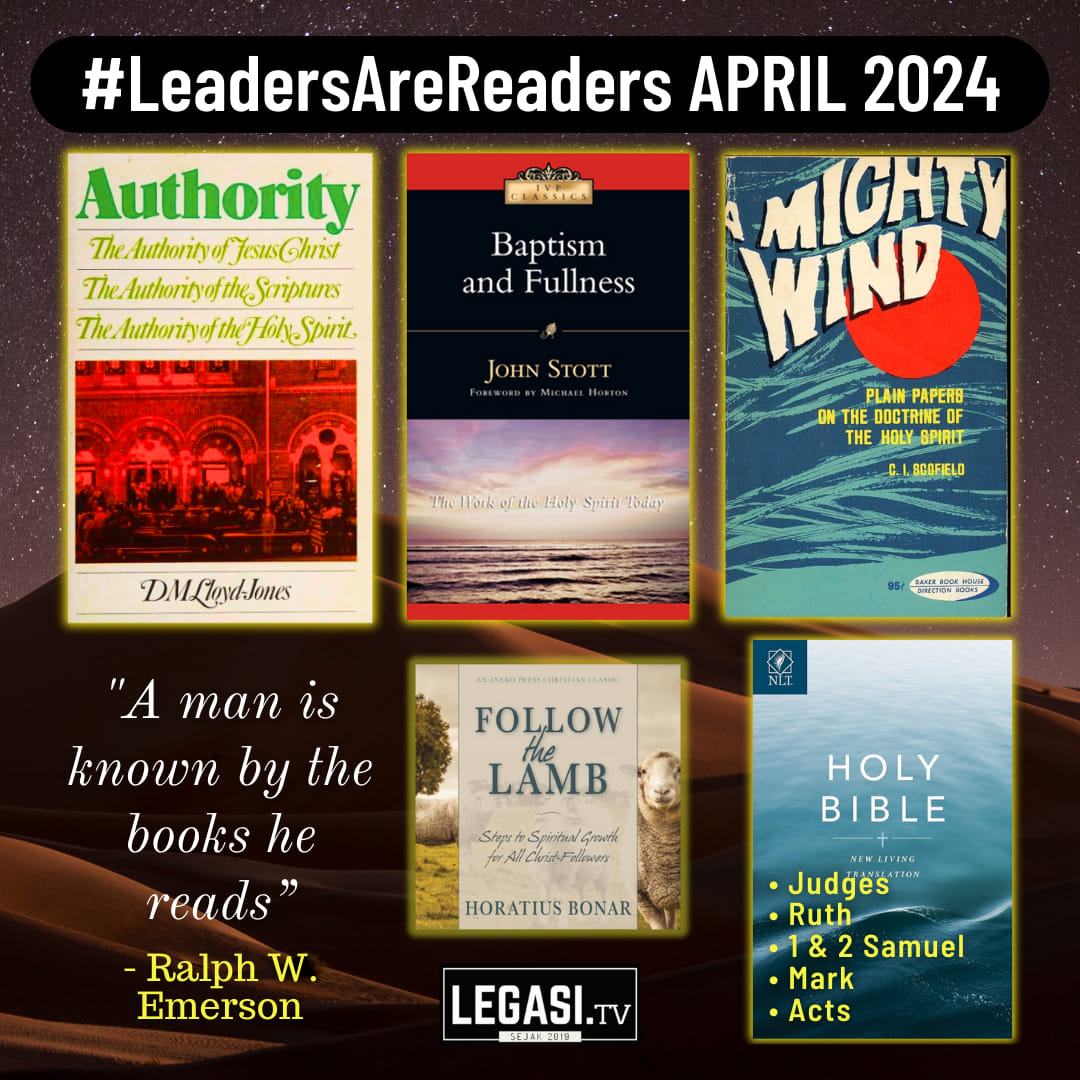
Read and Found the Joy of Knowing Christ #LeadersAreReaders April 2024


I was reading one of powerful stories from Richard Wurmbrand's Tortured for Christ (1969) about how he witnessed to a Russian lady officer on the street during the communist period in Romania. "I know that it is impolite to accost an unknown lady on the street, but I am a pastor and my intentions are earnest. I wish to speak to you about Christ," Wurmbrand said as he approached her. She asked, "Do you love Christ?" "Yes!" he replied passionately, "From all my heart." She fell into his arms and kissed him again and again. It was an embarrassing situation to do this in public, so he kissed her back, hoping people would think they were relatives. She exclaimed joyfully, "I love Christ too!"

He then took her home to
meet his wife and talked to her where it was safer. He read to her selected Scripture passages. Along the way, he discovered that she knew nothing (Biblical facts, Gospel stories, what the Saviour and salvation mean) about Christ - absolutely nothing - except the Name. And yet she loved Him. He wondered, "How can you love somebody if you know only his name?" When he inquired, she explained, "As a child, I was taught to read by pictures. For an 'a' there was an apple, for a 'b' there was a bell, for a 'c' a cat, and so on. When I went to high school, I was taught my holy duty to defend the communist fatherland. I was taught about communist morals. But I did not know what a 'holy duty' or 'moral' looked like. I needed a picture for these."

"Now I knew that our forefathers had a picture for everything beautiful, praiseworthy, and truthful in life," she continued. "My grandmother always bowed down before this picture, saying it was the picture of one called 'Cristos' (Christ). And I loved this name by itself. This name became so real to me! Just to say this name gave one such joy!" Wurmbrand commented in the book: "Listening to her, I remembered what is written in Philippians that at His Name every knee should bow. Perhaps, the anti-Christ will be able for a time to erase from the world the knowledge of God. But there is power in the simple Name of Christ (Jesus) and this will lead to the light."

That day, the lady officer found (and was found by) Christ in the pastor's home and since then, the One whose name she loved lived in her heart in person. So, what does this story have to do with reading books, especially the Scripture? The goal is to know the personhood of God, and the primary means, special revelation, is through the Book. Secondly, through books about the God of the Book. Read and be led to the light! May you find the joy of knowing Christ. From pictures to words to Person.

 #LetsMakeReadingCoolAgain #LeadersAreReaders #1Book1Week

THINK BIG. START SMALL. GO DEEP.

Best Blogger Tips

Monday, April 15, 2024

Reading Books Is Still Revelant #LeadersAreReaders November 2023

People are far more knowledgeable now than they were in the past. With a few phone clicks, people can discover information on nearly everything. They may now learn things more quickly and easily without having to waste time reading something that might not be helpful or relevant to them. With ChatGPT and Google Search on my phone (and internet data), I'm an information demi-god. So do you!

But some things still make reading books relevant. For example, compare books with online articles #1 Books often provide in-depth exploration of a subject, offering comprehensive coverage and nuanced perspectives that online articles may lack due to their brevity; #2 Books also allow for a sustained focus, encouraging deep understanding and critical thinking; and #3 Books present ideas more clearly and thoroughly than the fragmented nature of online content allows.

But perhaps I should add #4 Books can be your friends. There is a vast difference between holding a book and holding a phone to read an online article. "Books are the quietest and most constant of friends," said Charles W. Eliot, "they are the most accessible and wisest of counselors, and the most patient of teachers." Well, use both tools but be biased toward books.

#ServeToLead #LeadersAreReaders #ReadingBooksIsStillRevelant #LetsMakeReadingCoolAgain

THINK BIG. START SMALL. GO DEEP.

Best Blogger Tips

Tuesday, November 28, 2023

Roaring Lion: Spiritism In Borneo Challenged by the Power of Christ (1968) by Robert Peterson, Book Review

Roaring Lion: Spiritism In Borneo Challenged by the Power of Christ (1968) by Robert Peterson
 
This is an exciting book by Robert Peterson, a missionary in Borneo (particularly in Kalimantan) who has seen the Lord at work in the lives of many Chinese and some Malays who settle there. During this time (and still is), there were many customs and practices common to the animistic tribes of the islands. Spiritism and demon worship occupied a major place in their daily lives. All this while, Satan, that adversary who prowled around like a “roaring lion” (1 Peter 5:8), boldly manifested his unchallenged dominion over them. But that won’t be long, because when Christ’s faithful servants like Robert Peterson went there and preached the gospel of peace, darkness became light and our true King, “the Lion of Judah” (Revelations 5:5), reigned mightily. George M. Steed writes, “We believe it is not just coincidental that when the Lord’s servants commenced openly to challenge the power of darkness and, in the name of our victorious Lord, command the demons to come out of the possessed ones, the gates of hell began to yield and captives were set free.”

Of course, we must not believe there are demons under every bush, but we must not deny the existence and influence of demons in our world today either. The supernatural is natural in the spiritual realm. If you believe in God, then recognizing the reality of Satan and demons shouldn’t be a problem. But the sad fact is that so many Christians have little knowledge of spiritual warfare, or even if they do, they tend to ignore it. Based on my experiences and, more importantly, from the Scripture, we must remember that: “We do not wrestle against flesh and blood, but against the rulers, against the authorities, against the cosmic powers over this present darkness, against the spiritual forces of evil in the heavenly places” (Ephesians 6:12). As the author puts it, we must know a little better the ‘depths of Satan', and by knowing, we are able to ‘fight the good fight of faith.’

What I like about this book is that Peterson began the story by describing his failures in dealing with demon activities. After many encounters, risks, and mistakes, he started to examine the Scripture about the issue and progressively learned how to deal with it effectively through the power of the Holy Spirit and the living Word of God. The stories he told were very interesting because they reminded me of my own experiences during church mission trips to the interior parts of Sarawak many years ago. Read this book and know that God already gives us the weapons (for example, read Ephesians 6:13–20). The chief among them is that Christ is with and in us. “Many truths in the Word of God are a source of strength in our warfare against Satan, but the realization of the indwelling Christ and a day-by-day acknowledgement, acceptance, and utilization of this truth will set us on the victory road and keep us there,” writes Peterson. “Christ has never been and can never be defeated by Satan.” Amen.

#LeadersAreReaders #RoaringLion #TheLionOfJudah #Satan #JesusChrist #IndwellingChrist #RobertPeterson #BorneoForChrist #LetsMakeReadingCoolAgain

To read my other book reviews/summaries, CLICK HERE

THINK BIG. START SMALL. GO DEEP.

Best Blogger Tips

Pursuing Humility? Meditations of a Proud Heart (2021) by Joel Cornuz, Book Review

 Pursuing Humility? Meditations of a Proud Heart (2021) by Joel Cornuz

I read this book on a flight from Taiwan to Kuala Lumpur. As soon as I and my colleague landed home, I told them very proudly, “Yes, I’ve finished reading a book on humility!” What an irony! Letting people know that I’ve read books on humility (such as this one and Andrew Murray’s) is probably a sign of my pride. Maybe yes, maybe not. But it is more challenging if I write a book on humility. Joel Cornuz thought so in his introduction: “If you pretend to teach about humility, you already demonstrate pride. Go and present yourself as an expert on the subject, and you disqualify yourself from talking about it. ‘I am the best, especially at humility.' The statement may be funny, but it reflects the reality of the problem.” As the author revealed in the book about his own pride, I saw mine all too obvious too.

Thus, I find this book—a series of the author’s meditations on humility from the Scripture—very helpful in pointing out my personal sin of pride and being independent from God, either intentionally or unintentionally. It was scary, but I needed the realizations that I gained from this book. The Holy Spirit speaks through the meditations of His Word. I need humility, or more accurately, I need God for humility, or, essentially, I need God. Joel concludes, “Humility is first recognizing the reality of who I am (a proud person in need of forgiveness) and who God is (the one who offers me the forgiveness I so desperately need); humility is then accepting my dependence on that God (without Him, I can do nothing); and finally, it is placing my life at his disposal for the service of those around me (and for His glory).”

It is the humble recognition that God (YHWH) is God and placing our dependence on Him that freed us from the weight of pride so that we could be more like Christ, the ultimate embodiment and example of humility. Remember the word that says, “God opposes the proud but shows favor to the humble” (James 4:6; 1 Peter 5:5, Proverbs 3:34) #ServeToLead #LeadersAreReaders #Humility #Pride #LikeChrist #LetsMakeReadingCoolAgain

*Thanks to FES Singapore for the gift!

To read my other book reviews/summaries, CLICK HERE

THINK BIG. START SMALL. GO DEEP.

Best Blogger Tips

One In the Spirit (1973) by David C.K. Watson, Book Review

 One In the Spirit (1973) by David C.K. Watson

Before, I had two favorite Anglicans of the past: John C. Ryle (1816-1900) and James I. Packer (1926-2020). But now I want to add another person: David C. Watson (1933-1984). While Ryle and Packer are beloved friends of the Reformation and the Puritans, Watson however was known as a champion of charismatic evangelicalism. In this book, Watson addresses the need to be united in love - "one in the Spirit, one in the Lord." It is sad to see Christians in the past and present divided over the work of the Holy Spirit when undoubtedly He intends to make us united. We need to take heed of the urgent call to unite in Spirit and truth, but not take it to the extreme of syncretism. As the Scripture says, "Be completely humble and gentle; be patient, bearing with one another in love. Make every effort to keep the unity of the Spirit through the bond of peace" (Ephesians 4:2-3).

The first step, as the author begins the book, is to know the person and the work of the Holy Spirit through the Word of God. He is the key to everything in the New Testament Church. "The fifth book of the New Testament should really be called the Acts of the Holy Spirit," writes Watson. "If God had taken the Holy Spirit out of their midst in those days, about 95% of what they doing in their churches would ceased immediately. Everyone would know the difference." But today, sadly, if God would take the Spirit out of our midst, maybe we would not know the difference. Business as usual. And that's the danger! I recalled my observations when I read this book of how we have treated the Holy Spirit unintentionally - in our theology and conduct - as subordinated either to the Bible (by most Protestants) or the Church (by most Roman Catholics). Thus, Watson urges us to have "a fresh recognition of the Third Person of the Trinity, and deep longing for the same wind of the Spirit that energized believers both in the first century and in the revivals of the Church down the years." Amen.

This book is divided into five chapters that mostly derive from 1 Corinthians 12-14 and other passages: 1) The Person of the Holy Spirit; 2) The Holy Spirit in the Individual; 3) The Holy Spirit in the Church; 4) Walking by the Spirit; and 5) The Greatest Is Love. Obviously, David Watson was generally positive about the explosion of the charismatic movement during his time. He was aware of the danger of counterfeits and always pointed out to "not believe every spirit, but test the spirits to see whether they are from God" (1 John 4:1). In the same way, when I read this book, I tested his ideas and interpretations whether they were based on the Scripture or not. And asking, "What is God saying by His Spirit?" This is a good question - and prayer! - to ask when we read other books too, especially the one that He inspired or God-breathed Book (see 2 Timothy 3:16 and 2 Peter 1:21).

#ServeToLead #PreachTheWord #TheHolySpirit #DavidWatson #Unity #TheChurch #TheScripture #LetsMakeReadingCoolAgain

To read my other book reviews/summaries, CLICK HERE

THINK BIG. START SMALL. GO DEEP.

Best Blogger Tips

Sunday, October 1, 2023

Going On Retreat (2014) by Archbishop Fulton J. Sheen, Audiobook

For the past two months, I've been Catholicised (I made up that word) myself with a few good Catholic books and podcasts especially by Brant J. Pitre. Along the way, I stumbled upon recorded sermons and talks by the late Archbishop Fulton J. Sheen (recommended by Bishop Robert E. Barron). I'm immediately hooked by this man. He was known for his TV and radio broadcasts. Bishop Sheen was someone who was not only rock-solid theologically (obviously, I still have beef with some of the Roman Catholic major doctrines) but also a master communicator and could relate concepts with great insight, wisdom, humor, and seriousness that appealed even to the non-Catholics like me. When I hear the man, I hear a deep spiritual giant.

So, I searched for his other recorded materials and found
Going On Retreat a live sermon series in the form of an audiobook (6 hours+). Here Bishop Sheen teaches the priests and seminarians during a retreat (1973?) on such topics as the Nature of Christ, The Holy Spirit, Sin and Guilt, The Blessed Mother, the Apostle Peter, etc. Two concepts that stuck with me are: 1) 'Priest-Victim' - where he discusses the nature of sacrifice, the difference between priesthood and victimhood, and the need for priests to be both; and 2) 'The Daily Hour' - the need for priests to pray and fast as spiritual habits that nurture the soul and those who they serve. He once said, "Prayer begins by talking to God, but it ends by listening to Him. In the face of Absolute Truth, silence is the soul's language. Fasting detaches you from this world. Prayer re-attaches you to the next world." His Bible expositions - style and substance - on the Cross of Christ and the lives of the apostles Peter and Judas are superb! Go listen!

#ServeToLead #LeadersAreReaders #ArchbishopFultonSheen #Retreat #Priesthood #LetsMakeReadingCoolAgain

To read my other book reviews/summaries,
CLICK HERE

THINK BIG. START SMALL. GO DEEP.


Best Blogger Tips

How To Read the Bible for All Its Worth (3rd Edition, 2003) by Gordon D. Fee and Douglas Stuart

I read this book last month (August) when I was getting ready for a camp. I had already read it in previous years, but after reading the chapter on the Gospel for references, I became completely engaged. I therefore began at the beginning and completed it on the flights, off days, and days in between during the camp. One of the passages that speaks to me is this: "Whether one likes it or not, every reader is at the same time an interpreter. That is, most of us assume as we read that we also understand what we read. We also tend to think that our understanding is the same thing as the Holy Spirit’s or human author’s intent. However, we invariably bring to the text all that we are, with all of our experiences, culture, and prior understandings of words and ideas. Sometimes what we bring to the text, unintentionally to be sure, leads us astray, or else causes us to read all kinds of foreign ideas into the text."

The question is, therefore, not whether we should interpret the Bible or not, but is our interpretation is faithful or not. The goal of the late Gordon D. Fee (1934-2022) and Stuart in this book is to arm us with the awareness, tools, and skills needed to properly interpret the Bible in light of its original intent, audience, and context. The writers urge us to consider the various literary genres (such as poetry, narrative, epistle, etc.) and how those subtle differences influence our understanding. They also teach us to do the works of interpretation based on the conviction that the Bible is the inspired Word of God, while still being honest enough to acknowledge that inspiration may have varied ramifications for the various books of the Bible. Dear students of the Word, buy and read this book!

#ServeToLead #LeadersAreReaders #HowToReadTheBibleForAllItsWorth #GordonEFee #LetsMakeReadingCoolAgain

To read my other book reviews/summaries,
CLICK HERE

THINK BIG. START SMALL. GO DEEP.


Best Blogger Tips

Signs of The Apostles: Observations on Pentecostalism Old and New (1973, 1976) by Walter J. Chantry

After I read the first four (of eleven) chapters, I realized that Mr. Chantry is a Reformed cessationist. This explains a lot about how he interprets the Scripture. I first heard about 'cessationism' when I listened to Grace To You's Strange Fire Conference 2013. What is cessationism? It is a view that early on in the history of the Church, the charismatic gifts of the Holy Spirit - such as healing, prophecy, word of knowledge, and tongues - ceased to be practiced. Cessationists typically hold that the miraculous gifts were only given for the Church's founding, between the arrival of the Holy Spirit on Pentecost in Acts 2 and the accomplishment of God's purposes in history, which is typically referred to as either the conclusion of the final book of the New Testament or the death of the last apostle. I understand the main arguments for cessationism but I just can't see it clearly from the plain reading of the Scripture, records from Church history, stories from missiology, and personal experiences. I believe the Scripture - the written word of God, inspired by the Holy Spirit - is final and sufficient but this doesn't mean that the saints cannot be used by God to be equipped with the charismatic gifts of the Holy Spirit for His glory. Misuse of these gifts (which are many today!) cannot invalidate them.

To be fair, most cessationists like this author, believe that while God can and still does perform miracles today, the Holy Spirit no longer uses individuals to perform miraculous signs. Mr. Chantry writes:
"The question of our inquiry is not, 'Should God be working miracles today?' It is rather, 'Should men be doing miracles on behalf of God?'" From here he explores the primary purpose of miraculous gifts in the Scripture, namely, to attest to the commission of the spokesman of God. In the New Testament, they are signs of the apostleship. He also argues that since the canon of Scripture is complete, the pursuit of all the charismatic gifts of the apostolic age can only proceed upon the basis of failure to recognize the sufficiency and finality of the Scripture. "The lack of complete confidence in the Bible on the part of neo-pentecostal is to be greatly deplored," he wrote. He then expands his arguments through biblical exposition such as on 1 Corinthians 13, 2 Corinthians 10-13, Psalm 85, and selected quotes from preachers and authors that 'prove' his points. I learned so much from this book and I agree with most of what he said about the misuse and abuse of God's words and gifts among the Pentecostals today. His high view of the Scripture is also recommendable. But at the end of my reading, I was not convinced by his exegesis leaning on this subject and of his cessationist case. God will never cease to show signs and wonders, He is the supernatural God!

#ServeToLead #LeadersAreReaders #SignsOfTheApostles #Pentecostalism #Cessationism #SpiritualGifts #LetsMakeReadingCoolAgain

To read my other book reviews/summaries,
CLICK HERE

THINK BIG. START SMALL. GO DEEP.


Best Blogger Tips

Saturday, May 6, 2023

Kingdom Come, Kingdom Go: Luke-Acts (2007) by the International Bible Society, Book Review (2nd Reading)

The Gospel according to Luke and the Acts of the Apostles is a two-volume work by the same author, Luke, and the same recipient, Theophilus. It is meant to be read together and continuously. And what makes this book Luke-Acts special is that it comes without those annoying chapter and verse divisions that disrupt the context, logic, and flow of the grand narrative (I used to have a whole Bible like this, but I lost it in the train station). Reading the Scripture in this format is like reading an action-packed novel, except that it is about historical events, non-fictional people, and an actual person, the Lord Jesus Christ.

While the divisions are, in my opinion, good for reference and quotation, they can cause some serious problems. There are instances where chapters are wrongly divided and verses are taken out of context. Men such as Zakir Naik looked like a genius to the Bible illiterates when he quoted Bible verses out of memory, but if you check them in their original text, you will find that they are always out of context. Another problem is that the divisions encourage people (even sincere Christians) to read only small parts at a time. How many of you can quote John 3:16? Well, how about John 3:15 and John 3:17? Exactly!

The Bible and each book of the Bible is meant to be read as a whole and straight through from the beginning. Try reading the Gospel of Luke (or the Gospel of Mark, the shorter one) in one sitting. Set aside 2 to 3 hours this week to go to a quiet place, bring a physical Bible with you, turn off your smartphone, and read through it. I bet you will discover many truths for yourself, and the words of the Psalmer will echo in your soul:
"How sweet are your words to my taste, sweeter than honey to my mouth!" (Psalm 119:103)

#ServeToLead #LeadersAreReaders #TheGospelOfLuke #TheActsofTheApostles #TheScripture #ReadTheBible #LetsMakeReadingCoolAgain

I read this book two years ago and wrote something (sort of) about this issue too
, READ HERE

To read my other book reviews/summaries, CLICK HERE

THINK BIG. START SMALL. GO DEEP.

Best Blogger Tips

Saturday, June 4, 2022

Seeing Jesus In All of Scripture #LeadersAreReaders May 2022


After the resurrection, Jesus appeared to two of His disciples on the road to Emmaus. This is one of the many post-resurrection appearances. The Scriptures say that “God kept them from recognizing him” (Luke 24:16). Interesting. As they were walking, the two disciples talked about “the things that happened to Jesus, the man from Nazareth” (v.19) to… Jesus. Interesting indeed. I’m not sure whether they believe everything they heard about Jesus was true or not, for sure, they heard that “Jesus is alive!” (v.23). Then, imagine this, Jesus, a stranger to them said strongly, “You foolish people! You find it so hard to believe all that the prophets wrote in the Scriptures. Wasn’t it clearly predicted that the Messiah would have to suffer all these things before entering his glory?” (v.26). There and then, Jesus did an overview Bible Study with them. He took them through the writings of Moses and all the prophets, explaining from ALL the Scriptures the things concerning himself (v.27). read the rest of the passage. The good ending is this: “Suddenly, their eyes were opened, and they recognized him” (v.31).

I love this sacred narrative. We can know about Jesus without really knowing Jesus. We can study the Scriptures diligently without recognizing Jesus in them (In John 5:39, Jesus said the Scriptures
“point to me!”). And we can outline facts about what happened to Jesus from A to Z without really believing what we said. The two disciples were foolish and so are we if we don’t have faith to see Jesus the Messiah as He is. By God’s grace, He has opened my eyes to see and recognized Jesus in the pages of the Scriptures (This simply means I was foolish then and if I don’t see it now, I’m being foolish again). Now, this is both a supernatural and natural phenomenon. We can’t see and believe if God doesn’t open and make known to us the truth first. So we need to pray, “Open my eyes that I may see wonderful things in your law [or the Scriptures]” (Psalm 119:18, bracket mine). Yet, we can’t see and believe if we don’t read and study the Scriptures. The supernatural and natural must go hand in hand. For example, in Isaiah 32 verses 1 and 3, “Look, a righteous king is coming! [So we must look]… Then everyone who has eyes will be able to see the truth” [But God is the One who enables us to see].

I have no advice for the supernatural since it is beyond our willpower to do so except to pray and ask God the Holy Spirit with humility. But I do have advice for the natural ways to see Jesus in “
ALL the Scripture.” First, read the Scriptures a.k.a. the written Word of God a.k.a. the Bible prayerfully. This is essential and all else is subordinate! Secondly, join sound teaching and Jesus-centered Bible Study (if you want to join #DugDownDeep let me know). And thirdly, read books that can supplement and instruct you deeper into the Scriptures. Good faithful pastors, preachers, teachers, and writers are God’s gifts to us for the growth of His church. Two books that I finished reading in May 2022 that are very instrumental in helping me to see and read the Scriptures with Jesus at the center anew are: 1) Finding Jesus In the Old Testament (2015, 2017) by David Limbaugh. He wrote, “Just as the Old Testament is foundational to the New, our basic understanding of the Old Testament is crucial to our comprehension of how Christ dominates its pages”; and 2) Encountering the Book of Hebrews: An Exposition (2002) by Donald A. Hagner. The Book of Hebrews doesn’t make sense without the Old Testament and the Old Testament - particularly the Law, the sacrificial ritual, the covenants, and typologies - doesn’t make sense without it all being fulfilled by Jesus the Messiah as explained very beautifully in the Book of Hebrews. Blessed!

#ServeToLead #PreachTheWord #LetsMakeReadingCoolAgain #JesusInAllofScripture

To read my other monthly articles on reading,
CLICK HERE 
LEGASI.tv Media: https://linktr.ee/LEGASI.tv   

THINK BIG. START SMALL. GO DEEP.

Best Blogger Tips

Tuesday, May 10, 2022

Three (3) Categories of Books To Avoid #LeadersAreReaders April 2022

In his highly recommended book, Lit! A Christian Guide To Reading Books (2011), Tony S. Reinke shares three categories of books to avoid:

1) AVOID CERTAIN BOOKS BECAUSE OF TIMING. "Choosing what books to read is often not a yes/no decision but a now/later decision," writes Reinke. "The same is true for young Christians who are new to the faith. Be cautious of reading literature that you are ill-equipped to read with discernment. Sometimes the proper Christian approach to literature is humble postponement." I agree. One day, a student saw me reading Richard Dawkins' The God Delusion, a passionate atheist who states that it is irrational to believe in God and why religion is harmful to mankind. After he noticed that I'd written the review, he wanted to borrow the book because he was interested too. I'm all out for reading widely and books that I don't agree but he was not equipped to read this kind of book with discernment (Dawkins, although a brilliant scientist, is such a lousy layperson theologian). I know because I've observed his knowledge of the Scripture is still under development. So I refuse kindly, explained to him patiently, and encourage him to study the Scripture first. I love that he wants to read books at all but at this rate, he needs to practice "humble postponement."

2)
AVOID CERTAIN BOOKS THAT GLORIFY EVIL. This does not mean avoiding books that mention evil or give descriptions of evil or capture the dark realities of life. The Scripture doesn't even avoid the topic of evil explains Reinke. "The more important questions are these: How are the violence, sexual sin, and skepticism presented? Is it presented as evil? Is fornication celebrated, or are the consequences of sin made obvious? Does the book celebrate sin, or leave evil unresolved?" These are good questions to think about. This is why I'm very concerned with the rise of open occultism and the glorification of witchcraft in the Marvel Cinematic Universe. Books such as The Harry Potter and the likes should be avoided. As the Scripture says, "Woe to those who call evil good and good evil, who put darkness for light and light for darkness, who put bitter for sweet and sweet for bitter" (Isaiah 5:20). Books that expose evil, yes; books that glorify evil, no.

3)
AVOID CERTAIN BOOKS FOR CONSCIENCE'S SAKE. Reinke asserts, "While there are no rigid rules for what Christians should or should not read, we must be sensitive to our own consciences and the consciences of those around us. As we establish our own understanding of what books we will and will not read ourselves, we must respect the parameters that other Christians have chosen to set for themselves and their children." For me, as an example, I have no problem reading books on Islam and from Muslim writers although I don't believe in their core teachings. I enjoy especially the writings of the liberal Muslim modern-day intellectuals. But I find myself couldn't even read a page or two of Anton S. Lavey's The Satanic Bible. Both are false religions (respectfully honest), yet, I couldn't consciously endure the other. It's a matter of conscience, a level of tolerance, and a mass amount of discernment. On this, Reinke has a good reminder: "A firm grasp of the biblical worldview learned directly from the study of Scripture is essential for a Christian book reader because distortions to the biblical worldview can be found on every shelf in the bookstore." Yes!

#ServeToLead #BooksToAvoid #LetsMakeReadingCoolAgain

CLICK THE LINKS
 to read my book reviews of #LeadersAreReaders for April 2022

1)
The Science of Self-Learning (2018) by Peter Hollins, CLICK HERE
2) The Spirit-Filled Life (1895, 2019) by John MacNeil, CLICK HERE
3) The Message of Matthew: The Kingdom of Heaven (1988, 2000) by Michael Green, CLICK HERE
4) Matthew: The College Press NIV Commentary (1997) by Larry Chouinard, CLICK HERE


LEGASI.tv Media: https://linktr.ee/LEGASI.tv  

THINK BIG. START SMALL. GO DEEP.

Best Blogger Tips

Tuesday, April 12, 2022

The Spirit-Filled Life: Restoring A Biblical Understanding and Experience of the Holy Spirit (1895, 2019) by John MacNeil, Book Review

To listen to the audiobook of this book, go to Aneko Press YouTube Channel


 The Spirit-Filled Life: Restoring A Biblical Understanding 
and Experience of the Holy Spirit (1895, 2019) by John MacNeil

If I want to listen to or read Bible-saturated Christian classics, the first place I go is the Aneko Press website and YouTube. So many good titles, sound authors, and the best is - it’s free! Although it's an old book, the heart of MacNeil’s message is timeless. Aneko Press has done a good job of updating and revising it. This book can be scary to read because it sometimes emphasized heavily the teaching of ‘inner life’ like that of Andrew Murray’s books. In fact, he, Murray, and others were parts of the controversial Higher Life Movement. If not careful, it will make you feel spiritually inferior. But with prayerful reading and Scripture meditating, your eyes will be open to how much God desire for His children to be filled with the Holy Spirit - and to know Him. “The fullness of the Holy Spirit,” writes MacNeil, “is the birthright of every believer.”

The author begins this book by quoting Acts 19:1-2, “Now it happened that while Apollos was in Corinth, Paul passed through the upper country and came to Ephesus, and found some disciples. He said to them, ‘Did you receive the Holy Spirit when you believed?’ And they said to him, ‘On the contrary, we have not even heard if there is a Holy Spirit.’” MacNeil comments on this situation, “Many - oh, so many - of God’s dear children are living on the wrong side of Pentecost, living on the same plane as that on which the disciples were living before they were filled with the Holy Spirit, and thus by their lives they practically make the sad confession, ‘We did not so much as hear whether the Holy Spirit was given or whether there is any Holy Spirit.’” Indeed, this is a sad confession. I have said it before too. Chapter 3: A Command to Be Obeyed; Chapter 4: Something Different from the New Birth; Chapter 7: The Time Between Regenerating and Filling; and Chapter 8: Other Words for Being Filled With the Spirit; are very helpful chapters to understand the distinction between being filled with the Spirit from being born (again) of the Spirit. The Scripture examples and passages that MacNeil used to support his writings are very persuasive. Don’t take it all at face value, of course, but do consider it seriously.

We need to continually be filled with the Holy Spirit (Ephesians 5:18). I find that if I don’t, my spiritual life will be dry. There were times when I preached the Word of God, it was all rhetoric but no power. Bones with no skins. iPhone 13 software with short battery life. At one-third of the book, MacNeil gave a very valuable reminder: “[Be] on guard against desiring such an important blessing from wrong motives. We must seek it for the one supreme reason - the glory of God. If self is at the root of our motives at all, God will most surely block our way to fullness of blessing... there is a need for the refining fire to go through our hearts. God must be Alpha and Omega in the matter. ‘For God’s glory, and for God’s glory alone’ must be our motto as we proceed with our search for the fullness of the Spirit.” Amen. Read it!

#ServeToLead #LeadersAreReaders #TheSpiritFilledLife #TheHolySpirit #LetsMakeReadingCoolAgain

 To read my other - a hundred plus - book reviews, CLICK HERE and all things media https://linktr.ee/LEGASI.tv 


THINK BIG. START SMALL. GO DEEP.

Best Blogger Tips

Sunday, January 2, 2022

The Message of 2 Timothy: Guard the Gospel (1973, 1984) by John R. W. Stott, Book Review

The Message of 2 Timothy: Guard the Gospel (1973, 1984) by John R. W. Stott
 

“During the gestation of this book, I seem to have lived inside this second letter of Paul to Timothy. In imagination I have sat down beside Timothy and have tried myself to hear and heed this final charge from the aging apostle,” writes John Stott in the introduction. As for me, I imagine myself sitting down under the teachings of ‘Uncle’ Stott (1921-2011) as I read this commentary and take notes of his excellent exposition of the words of God in 2 Timothy. He also writes, “I have been impressed afresh by the timeliness for today what the apostle writes, especially for young Christian leaders. For our era too is one of theological and moral confusion, even of apostasy. And the apostle summons us, as he summoned Timothy, to be strong, brave, and steadfast.” Stott was 51 years old when he writes this and surely he had witnessed many ups and downs of Christianity in Europe particularly and the world generally during the five decades of his life. If it was true about 49 years ago when this commentary was originally published, how truer it is today!

He continues, “The words which crystallize the letter for me are the two little monosyllables su de (‘but as for you’), which occur four times. Timothy is called to be different. He is not to yield to the pressures of public opinion or conform to the spirit of his age, but rather to stand firm in the truth and the righteousness of God. In my judgment, nothing is more needed by Christians in today’s world and church than this same courage.” I couldn’t agree more. A call to be different is not a call to be a weirdo or taking it as merely a motivational talk. It’s about to be different from the world who don’t know the truth, the false teachers who distort the truth, and the unfaithful who neglect the truth. It’s about guarding and standing firm in the truth of the gospel. “Hold on to the pattern of wholesome teaching you learned from me - a pattern shaped by the faith and love that you have in Christ Jesus,” remind the apostle Paul to Timothy when he was in prison in Rome waiting for his death sentence (see 4:6), Through the power of the Holy Spirit who lives within us, carefully guard the precious truth that has been entrusted to you (2 Timothy 1:13-14). When I decided to accept God’s calling for me to enter the full-time student ministry about a decade ago, 2 Timothy is where I always go to draw encouragement from, to remind me of the mission, and to be a solid foundation for me to stand firm in the truth. My life verse - and not surprisingly, the purpose for LEGASI.tv ministry - to “Preach the Word” is taken from 2 Timothy 4:2.

In the previous article, I already shared why The Bible Speaks Today is one of the best expository ‘commentaries’ series out there and how to use it [CLICK HERE to read]. But here I would like to zero in and declare with no apology that John Stott’s The Message of 2 Timothy is one of the best and important books in this series. I highly recommend this book to every Christian minister, especially the young leaders, who aspire to serve God in this high risk but also high reward calling in their lives. Stories of fallen ‘celebrity’ preachers nowadays shouldn’t be a surprise for us. In fact, Paul has warned us about this and more in 2 Timothy 3:1-9 and 4:3-4. Thus, we all have the potential to be in the statistic. We must with all our might and rely on God’s grace to “fully carry out the ministry God has given [us]” (2 Timothy 4:5, bracket mine) faithfully till the end. I think (although I cannot confirm with surety) the late Dr. John Stott end his ministry well. Paul’s statement can be his’ and ours’ in the near future: “I have fought the good fight, I have finished the race, and I have remained faithful” (2 Timothy 4:7). Amen 😉✌💡

#ServeToLead #GrowingLeaders #LeadersAreReaders #JohnStott
#BibleCommentary #LetsMakeReadingCoolAgain

To read my other #1Book1Week book reviews, CLICK HERE

FB Page
: https://facebook.com/LEGASI.tv/                                    
Podcast: http://bit.ly/LegasiSpotify                     
YouTube: https://www.youtube.com/c/LEGASItv/                 

THINK BIG. START SMALL. GO DEEP.

Best Blogger Tips

Sunday, December 5, 2021

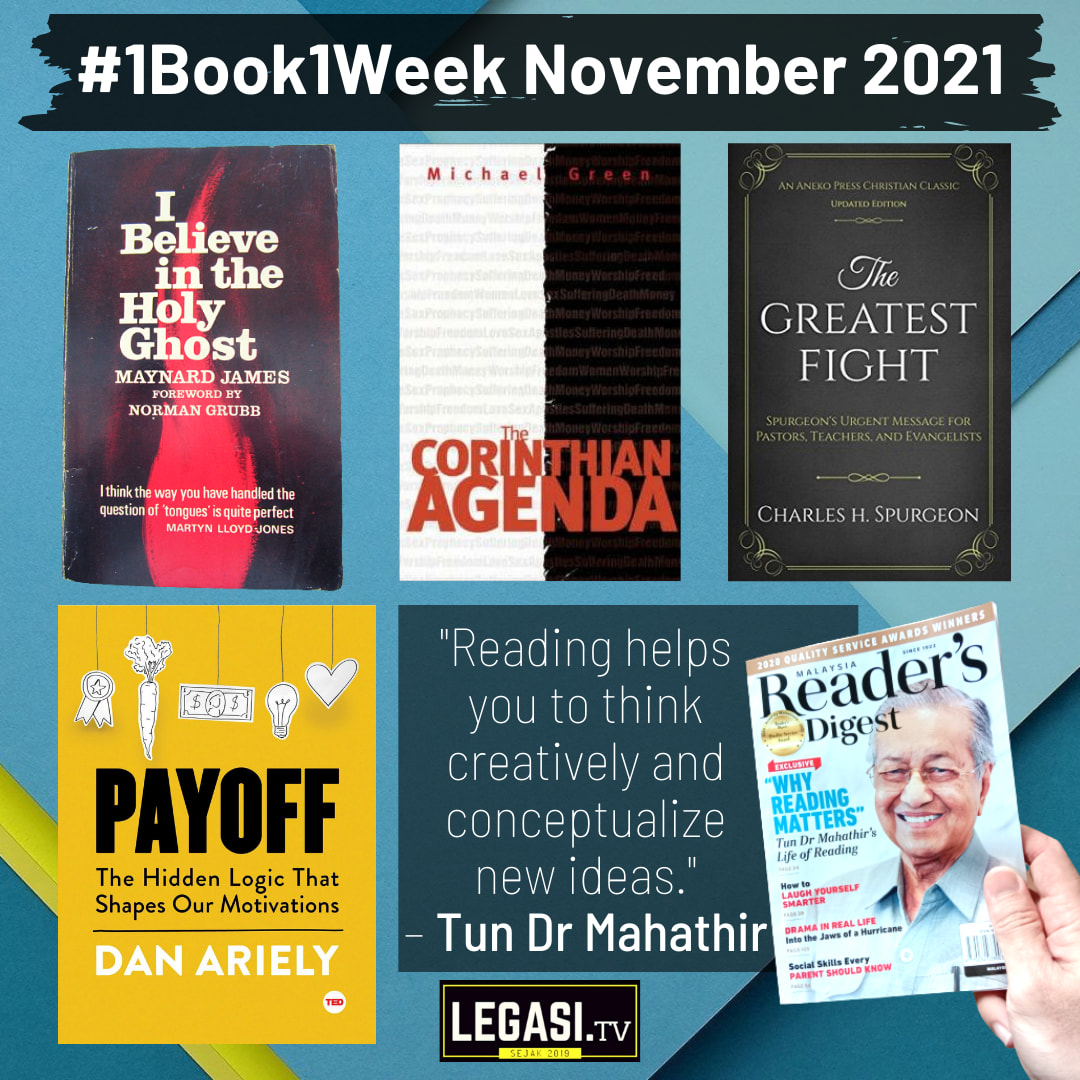
Tun Dr. Mahathir's Life of Reading #November 2021

There are so many things to disagree with Tun Dr. Mahathir Mohamad on politics but the man is a legend. In my opinion, his political stands are questionable yet his passion for the people* is admirable (I think he would be better off if he were to remain as Minister of Education in the previous government instead of being Prime Minister all over again). Set aside politics, which is a very discouraging subject nowadays, one thing that Tun Mahathir influences me the most is his love for reading. "I read books every day," he said during an interview with Reader's Digest for April 2020 cover magazine. He continues: "Reading is acquiring knowledge, and knowledge contributes toward your ability to tackle problems and your relationships with other people." He also said that reading gives him the substance to talk with some degree of authority.

At the age of 96, Tun Mahathir's mental sharpness can put many young people in their 30s to shame (Don't be one of them!). The term for this is 'super-agers' which refers to people in their 80s and above who have cognitive or physical function equal to that of people decades younger. One of the key factors is their lifestyle choices such as having a good habit of reading - and enjoying it. There are at least Five (5) Mental Benefits for seniors who enjoy reading books: 1) Enhancing memory; 2) Sharpening decision-making skills; 3) Delaying onset of Alzheimer’s and Dementia; 4) Reducing stress and anxiety; and 5) Help to sleep better. Well, you don't have to wait for your senior years to cultivate the habit of reading books and reap the benefits, you can start now. Actually, you MUST start now. The earlier the better. "Any time that I am free I read," remarks Tun Mahathir, "I cannot imagine doing nothing." Legend! 

#ServeToLead #PreachTheWord #LeadersAreReaders #GrowingLeaders #WhyReadingMatters #TunDrMahathir #LetsMakeReadingCoolAgain

To read my summary-review of these books for #1Book1Week November 2020, click titles below:

  1.  The Greatest Fight: Spurgeon’s Urgent Message for Pastors, Teachers and Evangelists (2018) by Charles H. Spurgeon
  2. I Believe In The Holy Spirit (1965) by Maynard James
  3. The Corinthian Agenda (1982, 2004) by Michael Green
  4. Payoff: The Hidden Logic That Shapes Our Motivations (2016) by Dan Ariely                            

FB Pagehttps://facebook.com/LEGASI.tv/       
Podcast: http://bit.ly/LegasiSpotify                     
YouTube: https://www.youtube.com/c/LEGASItv/                 

THINK BIG. START SMALL. GO DEEP.

Best Blogger Tips

They Click it A lot. [Top 7 last 7 Days]