Showing posts with label Michael Green. Show all posts

Saturday, April 30, 2022

Very Short Reviews of Michael Green's The Message of Matthew & Larry Chouinard's Matthew NIV Commentary (Why and How to Use Bible Commentary)

 The Message of Matthew: The Kingdom of Heaven (1988, 2000) by Michael Green
& Matthew: The College Press NIV Commentary (1997) by Larry Chouinard

I’ve finished 198 episodes of Bible study on the Gospel according to Matthew (check it out here: http://bit.ly/LegasiSpotify) in the Malaysian language and these two commentaries are very instrumental in helping me to think contextually about some difficult passages in this precious book. I’m biased but I truly believe that the Gospel according to Matthew is perhaps one of the most important books of the New Testament next to the Epistles to the Romans and Hebrews. In it, we have the fullest account of the birth, life, teaching, miracles, death, resurrection, divinity, and humanity of our Lord Jesus the Messiah. It is an excellent continuation after we read and study the Old Testament because the Jewishness of Matthew can be best understood in this context. As the saying attributed to Augustine of Hippo: “The new is in the old concealed; the old is in the new revealed.” Matthew revealed the long-awaited Messiah foretold by the prophets in the Old Testament and expanded by the apostles in the New Testament. Matthew, in short, helps us to see the unity of God’s revelation from beginning to end.

As I have hinted earlier, Matthew is a very Jewish Gospel. This can be a challenging task for interpretation a.k.a. hermeneutics and many like myself - especially my earliest podcast episodes, I realized - probably have missed the mark. Perhaps errors, hopefully not heresies. Yes, getting so familiar with the Old Testament is a great advantage for Biblical backgrounds and theological truths (as another saying goes,
“Scripture interprets Scripture”) but we also need to know the historical insights, textual research, and cultural understandings to bridge the gap between the world of Scripture and our world today. This is where good Bible commentaries are needed. My go-to commentary is always from The Bible Speaks Today series by Inter-Varsity Press. The Message of Matthew (323 pages), the late Dr. Michael Green is the expositor and author. I love this series because each book is characterized by a threefold ideal, namely, 1) To expound the biblical text with accuracy, 2) To relate it to contemporary life, and 3) to be readable. Dr. Green is faithful to these ideals. Plus, he has a vast knowledge of Jewish customs and manners and derives many practical applications from the texts. Larry Chouinard’s Matthew (512 pages), however, was unique in the sense that it is thorough and detailed without being too technical and academic. The Greek words are not distract-full and the footnotes are just essential. Sweet!

Let me end with a word of caution: Don’t read or depend on Bible commentaries more than the Bible itself. Don’t go to it first or second or third… go to the Bible first. Gordon Fee and Douglas Stuart, authors of a classic book,
How to Read the Bible for All It’s Worth, give excellent advice: “You do not begin your Bible study with a commentary… You go to the commentary after you have done your own work; the reason you eventually consult a commentary is to find answers to the content questions that have arisen in your own study.” When I prepare for Bible study, I make sure I’ve read the entire book (e.g. Matthew) first. I read from at least 2 to 3 translations such as ESV, NIV, NLT, AVB, and TB. Then, I meditate on the passage or chapter that I’m working on and come out with rough outlines. I will refer to cross-references, if any, and check by memory for connections. Usually, I have the big picture before I go with the details. Only afterward I will consult commentaries and other tools for second opinion, expertise, verification, correction, background, insights, and wisdom. But if I don’t have the clue (which rarely happens), I will go straight to commentary on the particular verse(s). Good Bible commentaries, if used wisely and properly, will add value to your personal Bible study, teaching, preaching, and even - thinking.

Tip: You can also read (and buy) pocket-size Bible commentaries like William Barclay's The New Daily Study Bible series or Tom Wright's For Everyone series or Warren Wiersbe's BE Series or my favorite, J.C. Ryle's Expository Thoughts series as any normal books. These are easy to read. Read them at your leisure and fill the well of your knowledge. They can be handy if you needed them!

Note: D. A. Carson’s Matthew: The Expositor’s Bible Commentary, John MacArthur’s sermon series on Matthew, and David Pawson's Unlocking the Bible overview also have been valuable resources for me. Thank you, gentlemen!

#ServeToLead #LeadersAreReaders #BibleCommentary #TheGospelOfMatthew #LetsMakeReadingCoolAgain

To read my other reviews on Bible commentary,
CLICK HERE

FB Page: https://facebook.com/LEGASI.tv/                                
Podcast: http://bit.ly/LegasiSpotify                               
YouTube: https://www.youtube.com/c/LEGASItv/                           

THINK BIG. START SMALL. GO DEEP.

Best Blogger Tips

Sunday, December 5, 2021

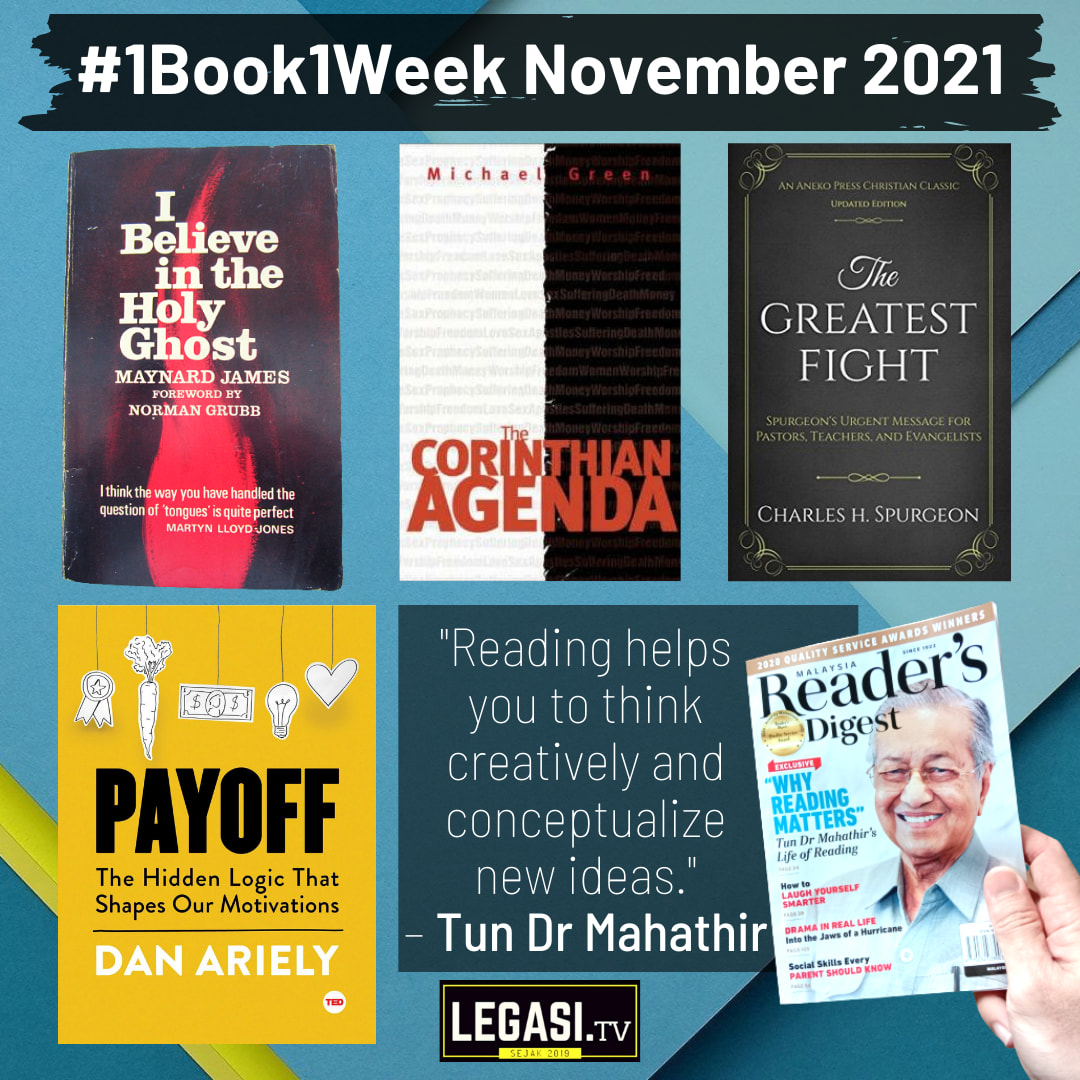
Tun Dr. Mahathir's Life of Reading #November 2021

There are so many things to disagree with Tun Dr. Mahathir Mohamad on politics but the man is a legend. In my opinion, his political stands are questionable yet his passion for the people* is admirable (I think he would be better off if he were to remain as Minister of Education in the previous government instead of being Prime Minister all over again). Set aside politics, which is a very discouraging subject nowadays, one thing that Tun Mahathir influences me the most is his love for reading. "I read books every day," he said during an interview with Reader's Digest for April 2020 cover magazine. He continues: "Reading is acquiring knowledge, and knowledge contributes toward your ability to tackle problems and your relationships with other people." He also said that reading gives him the substance to talk with some degree of authority.

At the age of 96, Tun Mahathir's mental sharpness can put many young people in their 30s to shame (Don't be one of them!). The term for this is 'super-agers' which refers to people in their 80s and above who have cognitive or physical function equal to that of people decades younger. One of the key factors is their lifestyle choices such as having a good habit of reading - and enjoying it. There are at least Five (5) Mental Benefits for seniors who enjoy reading books: 1) Enhancing memory; 2) Sharpening decision-making skills; 3) Delaying onset of Alzheimer’s and Dementia; 4) Reducing stress and anxiety; and 5) Help to sleep better. Well, you don't have to wait for your senior years to cultivate the habit of reading books and reap the benefits, you can start now. Actually, you MUST start now. The earlier the better. "Any time that I am free I read," remarks Tun Mahathir, "I cannot imagine doing nothing." Legend! 

#ServeToLead #PreachTheWord #LeadersAreReaders #GrowingLeaders #WhyReadingMatters #TunDrMahathir #LetsMakeReadingCoolAgain

To read my summary-review of these books for #1Book1Week November 2020, click titles below:

  1.  The Greatest Fight: Spurgeon’s Urgent Message for Pastors, Teachers and Evangelists (2018) by Charles H. Spurgeon
  2. I Believe In The Holy Spirit (1965) by Maynard James
  3. The Corinthian Agenda (1982, 2004) by Michael Green
  4. Payoff: The Hidden Logic That Shapes Our Motivations (2016) by Dan Ariely                            

FB Pagehttps://facebook.com/LEGASI.tv/       
Podcast: http://bit.ly/LegasiSpotify                     
YouTube: https://www.youtube.com/c/LEGASItv/                 

THINK BIG. START SMALL. GO DEEP.

Best Blogger Tips

Saturday, November 20, 2021

The Corinthian Agenda (1982, 2004) by Michael Green, Summary-Review

 The Corinthian Agenda (1982, 2004) by Michael Green

“The apostle
[Paul]’s love for his wayward church at Corinth is very obvious,” concludes the late Dr. Michael Green, an author, evangelist, and theologian. “He had after all found it. He had visited them at considerable inconvenience on numerous occasions. He had poured out his heart in letters to them and sent colleagues to help them. They were very dear to him. And yet, like any good father, he has to correct their failures and weaknesses. I am thankful he did. For what he has to say is of enormous value for the contemporary church, if only we will heed it.” I agree. God’s church in Corinth was very privileged in the early New Testament times. Paul testified: “I always thank my God for you and for the gracious gifts He has given you, now that you belong to Christ Jesus. Through Him, God has enriched your church in every way…” and “you have every spiritual gift you need…” (1 Corinthians 1:4-5, 7).

But with all of these gifts, it doesn’t guarantee that the church is all well. The issues within the church in Corinth were very serious and yet it is a blessing for us today. Why? Because without them, we won’t know how to think theologically and handle practically based on the Scripture the same issues facing the church today! So we should thank God for using Paul to give us these two sacred letters - 1 and 2 Corinthians. These letters (the scholars suggest that perhaps Paul have written at least three or four letters to the Corinthians, two of them completely or partially lost) are a remarkable record of the relations “between the greatest of church planters and one of the most influential communities [Paul] founded and cared for.” In the period of reading this book, I also took time to read 1 & 2 Corinthians in the New Living Translation (NLT) and listened to audio Bible in King James Version (KJV) read by the legendary voice of Alexander Scourby. In this way, I can get the most from the Scripture and the book. I recommend this practice especially if you’re reading Bible commentary!

In this book, Michael Green (1930 - 2019) selected some very important issues or major themes and devoted a short chapter for each. This is not a verse by verse commentary but the author just wants to show how “Paul speaks directly to us over a broad range of issues in the Christian life, and speaks with an incisiveness, clarity, and authority that are rare.” There are 3 parts (The Church, The Members & Authority) and 17 short chapters on Mission, Baptism, The Lord’s Supper, Body Life, Love, Worship, Prophecy, Intellect, Freedom, Giving, Sex, Suffering, Death, Leaders, Women & Apostles. As you can see, some of these themes are still hot issues nowadays and very much debate between and within the Christian denominational circles. Of course, I don’t agree with everything Dr. Green writes but if I only read books that I agree with, what benefits will I get? For sure, he was very passionate for the word of God, always trying to provide a balanced view on difficult issues, making sure that important points have Scripture references, and aim to be as plain and practical as possible so that we can apply these truths or principles in our everyday life. The Corinthian Agenda (first published as To Corinth with Love) is a good overview of these sacred letters. But if you want to study in-depth I suggest getting a set of 1 & 2 Corinthians MacArthur New Testament Commentary and those from The Bible Speaks Today commentary series.

#ServeToLead #LeadersAreReaders #GrowingLeaders #MichaelGreen #TheCorinthianAgenda #GodsChurch #LetsMakeReadingCoolAgain

To read my other #1Book1Week book reviews, CLICK HERE

FB Page: https://facebook.com/LEGASI.tv/                                 
Podcast: http://bit.ly/LegasiSpotify                  
YouTube: https://www.youtube.com/c/LEGASItv/              

THINK BIG. START SMALL. GO DEEP.

Best Blogger Tips

They Click it A lot. [Top 7 last 7 Days]