Showing posts with label Creativity. Show all posts

Tuesday, October 29, 2024

(A Tale of) Libau Discovers the Bible - and Reads It! #LeadersAreReaders September 2024


In a longhouse where everyone lived simple, predictable lives, there was a boy named Libau who was different. One day, while wandering around, he found an old, forgotten missionary house. Curious, he picked up a book (unknowingly, a Bible) and started reading. It was as if a whole new world opened up to him—he learned about the Creator, Jesus, the Son of God, the Holy Spirit, and truths that stretched beyond anything he had ever known.

As Libau kept reading, he began to think differently. He used the knowledge and truth he gained to teach other young men and women in his longhouse, helping them better understand the world and the reality of God around them. At first, the people were suspicious and even opposed him. But as time went on, they began to notice that Libau lived differently and saw things in a way they didn’t. Some of them started turning to him for advice and prayers, though, overall, he was still rejected by many.

One day, missionaries came through the longhouses, speaking about the Kingdom of God and the call to preach the Gospel beyond the horizon. Libau, filled with curiosity and a sense of God's calling, decided to join them and go into all the world. The people of the longhouse saw Libau leave, knowing he had risen above the ordinary, not because he was stronger or richer, but because he had the power of the knowledge of God through reading, meditating, and living the Bible.

The missionary house, with all its hidden wisdom, remained—waiting for the next curious and seeking mind to discover its truths. Will you pick up the Bible and read it too?
🙏

To read my monthly reading articles,
CLICK HERE

THINK BIG. START SMALL. GO DEEP.


Best Blogger Tips

Wednesday, December 14, 2022

The Message of Hebrews: Christ Above All (1982) by Raymond Brown, Not-A-Review

Every time you hear or read something insightful from someone, you got to ask the question, "Where does she get that?" I believe that there are no good - or great and godly - insights that are totally original. It is not ex nihilo. Creative people or creativity, in my opinion, is just mastering the art of combining ideas. In the case of spiritual insight, it is the combination of life experience, personal reflection, and the Holy Spirit's inspiration (except for divine revelation and/or prophesy). If you hear or read something insightful from me, for example, be sure that I get that from other sources either directly or indirectly, consciously or subconsciously. If it sounds convincing, it's because I make it my own. The style, articulation, and language perhaps are mine but it's not original. The same goes for everyone else that we labeled as 'insightful' persons.

In the same way, when I preach and teach the Book of Hebrews, my insights come from many sources. I rely on the Holy Spirit as my main Teacher (see John 14:26) and the Scripture as my main Text. I also get help from other people and books too. It is arrogant to say/think,
"I only need my Bible." I love The Book of Hebrews because of its obvious Christocentricity. But for those who aren't familiar with the Old Testament narratives and themes, Hebrews can be very difficult to understand. Preachers like John MacArthur, David Pawson, and David Guzik have helped me greatly. Bible commentaries such as this one, Donald A. Hagner's Encountering the Book of Hebrews: An Exposition (2002), and Leon Morris's The Expositor's Bible Commentary: Hebrews (1982) are good companions for the journey. These I treated as references only. The first rule of hermeneutics is "Let Scripture interpret Scripture." So, reading and interpreting Hebrews from the Scripture itself is essential.

A brief words about Raymond Brown's commentary on Hebrews. This commentary is part of my favorite
The Bible Speaks Today Series. It is easy to read and follow especially if you want to see the big picture of Hebrews. Not too detailed but also not too simplistic. The Series is characterized by a threefold ideal: 1) To expound the biblical text with accuracy; 2) To relate it to contemporary life, and 3) To be readable. This book has all these ideals. His outlines are divided into three major themes: a) God's Son (Hebrews 1:1-6:20) focusing on the person of Christ; b) Christ's Work (7:1-10:18) focusing on the work of Christ, and c) Our Response (10:19-13:25) focusing on Christian ethics. Hebrews "illustrations are certainly drawn from a different world, but their message is timeless. Far from escaping into the past, it beckons us on to a better future, with its firm assurance that the eternal Son of God is supreme and sufficient." And then Brown concludes, "The message of Christ's uniqueness is always relevant." Amen!

#ServeToLead #LeadersAreReaders #BookOfHebrews #BibleCommentary #LetsMakeReadingCoolAgain

To read other articles on reading and book reviews,
CLICK HERE
All things media: https://linktr.ee/LEGASI.tv   

THINK BIG. START SMALL. GO DEEP.

Best Blogger Tips

Sunday, December 5, 2021

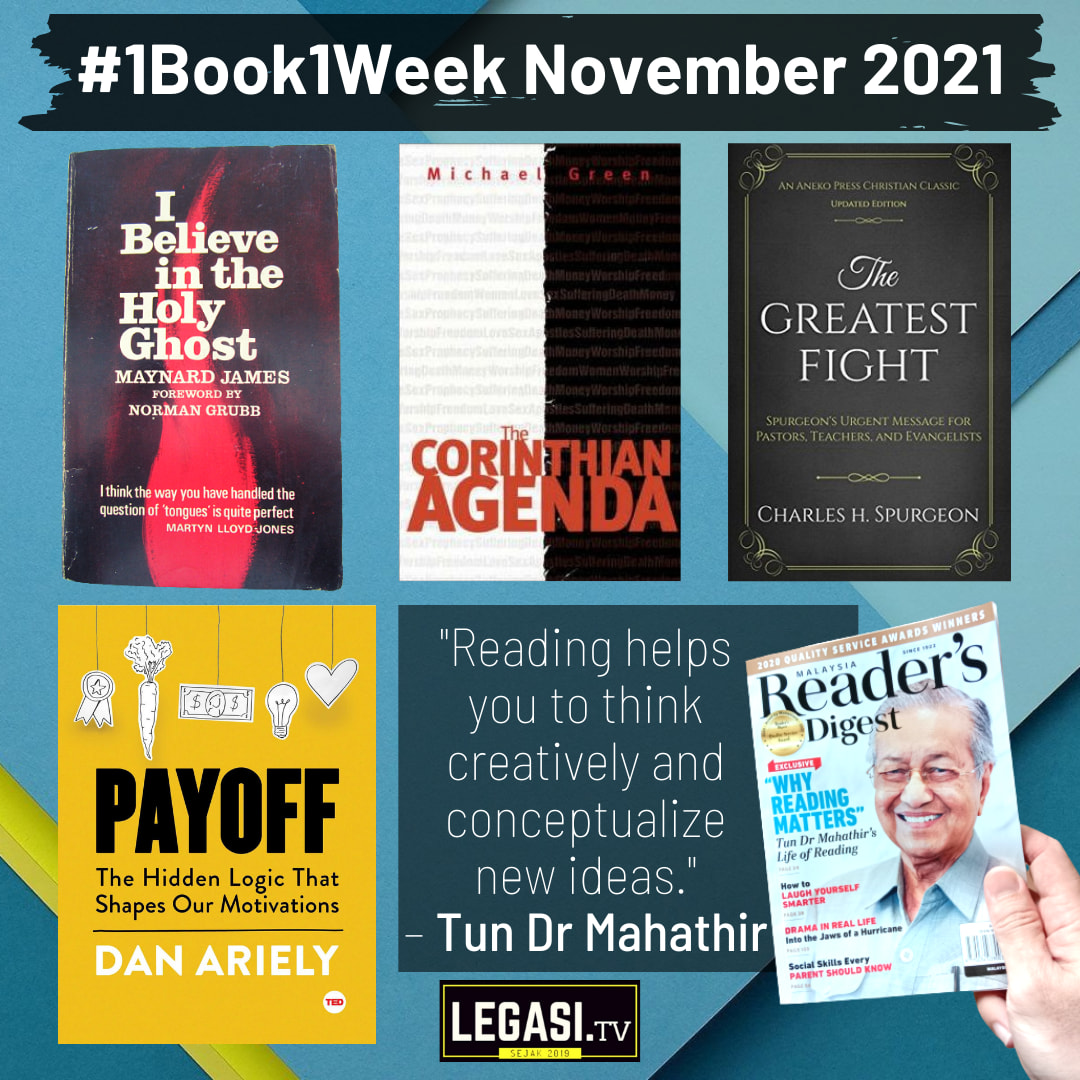
Tun Dr. Mahathir's Life of Reading #November 2021

There are so many things to disagree with Tun Dr. Mahathir Mohamad on politics but the man is a legend. In my opinion, his political stands are questionable yet his passion for the people* is admirable (I think he would be better off if he were to remain as Minister of Education in the previous government instead of being Prime Minister all over again). Set aside politics, which is a very discouraging subject nowadays, one thing that Tun Mahathir influences me the most is his love for reading. "I read books every day," he said during an interview with Reader's Digest for April 2020 cover magazine. He continues: "Reading is acquiring knowledge, and knowledge contributes toward your ability to tackle problems and your relationships with other people." He also said that reading gives him the substance to talk with some degree of authority.

At the age of 96, Tun Mahathir's mental sharpness can put many young people in their 30s to shame (Don't be one of them!). The term for this is 'super-agers' which refers to people in their 80s and above who have cognitive or physical function equal to that of people decades younger. One of the key factors is their lifestyle choices such as having a good habit of reading - and enjoying it. There are at least Five (5) Mental Benefits for seniors who enjoy reading books: 1) Enhancing memory; 2) Sharpening decision-making skills; 3) Delaying onset of Alzheimer’s and Dementia; 4) Reducing stress and anxiety; and 5) Help to sleep better. Well, you don't have to wait for your senior years to cultivate the habit of reading books and reap the benefits, you can start now. Actually, you MUST start now. The earlier the better. "Any time that I am free I read," remarks Tun Mahathir, "I cannot imagine doing nothing." Legend! 

#ServeToLead #PreachTheWord #LeadersAreReaders #GrowingLeaders #WhyReadingMatters #TunDrMahathir #LetsMakeReadingCoolAgain

To read my summary-review of these books for #1Book1Week November 2020, click titles below:

  1.  The Greatest Fight: Spurgeon’s Urgent Message for Pastors, Teachers and Evangelists (2018) by Charles H. Spurgeon
  2. I Believe In The Holy Spirit (1965) by Maynard James
  3. The Corinthian Agenda (1982, 2004) by Michael Green
  4. Payoff: The Hidden Logic That Shapes Our Motivations (2016) by Dan Ariely                            

FB Page: https://facebook.com/LEGASI.tv/       
Podcast: http://bit.ly/LegasiSpotify                     
YouTube: https://www.youtube.com/c/LEGASItv/                 

THINK BIG. START SMALL. GO DEEP.

Best Blogger Tips

Friday, October 8, 2021

Reading Christians Are Growing Christians #1Book1Week September 2021

“Reading Christians are growing Christians,” said John Wesley, “When Christians cease to read, they cease to grow.” How true! In the past, I used to give three books per month through my blog (this was before I entered the full-time ministry. Cash is king!). There were three main reasons why I giveaway books for free: 1) So that my readers can gain godly wisdom, get inspired, and be motivated to live a Christian life through Christian’s literature; 2) To give them a tool to stir, exercise, and polish the edge of their God-given mind; and 3) To cultivate their passion for reading. Although I’m not giving away books anymore, the reason number 3) is still part of my purpose why I write book reviews and this kind of post.

In my opinion, reading is essential for Christians to grow mentally and spiritually. I venture to say that today, reading is one of the main ways God effectively speaking to us on a daily basis (Have you ever wonder why God give us The Book - a.k.a. The Bible - as the medium for us to know His will, His works, and His sovereignty?). On reading, the apostle Paul’s counsel to young Timothy to “focus on reading the Scripture” (1 Timothy 4:13), which in context referred to the public reading of the Old Testament. J. Oswald Sanders, in his classic book Spiritual Leadership, comments on 2 Timothy 4:13: “Paul’s advice is appropriate for other areas of reading as well. Paul’s books – the one he wanted Timothy to bring along – were probably words of Jewish history, explanations of the law and prophets, and perhaps some of the heathen poets Paul quoted in his sermons and lectures. A student to the end, Paul wanted to spend time in study.” If Paul, who God used to write half of the New Testament and was in prison waiting for his death sentence when he wrote letters to Timothy, continues his study by [wanted to] reading books, do you think reading is not important for Christians?

Read to “fill the wells of inspiration,” advise Harold Ockenga, an evangelist and avid reader himself. I say read for spiritual benefit, read for intellectual growth, read to cultivate speaking and writing style, read to acquire new information and knowledge, read to keep current with the time and read to polishes the edge of your God-given mind. Aldous Huxley, an English writer and philosopher, reminds us: “Every man who knows how to read has it in his power to magnify, to multiply the ways in which he exists, to make his life full, significant and interesting.”

#ServeToLead #GrowingLeaders #LeadersAreReaders #LetsMakeReadingCoolAgain

To read my previous #1Book1Week book reviews, CLICK HERE  

1) Unveiling the End Times In Our Time (2004) by Adrian Rogers, READ HERE

2) A Word to Fellow Pastors and Other Christian Leaders (1875, 2019) by Horatius Bonar, READ HERE

3) How To Think Like Einstein (2000, 2015) by Scott Thorpe, READ HERE

4) The Chronicles of Narnia: The Horse and His Boy (1954) by Clive Staples Lewis, READ HERE

FB Page: https://facebook.com/LEGASI.tv/                             
Podcast: http://bit.ly/LegasiSpotify              
YouTube: https://www.youtube.com/c/LEGASItv/          

THINK BIG. START SMALL. GO DEEP.

Best Blogger Tips

Tuesday, September 14, 2021

How To Think Like Einstein (2015) by Scott Thorpe, Book Review


How To Think Like Einstein: Simple Ways to Break the Rules and Discover Your Hidden Genius (2000, 2015) by Scott Thorpe

Three primary materials sparked my interest in the life of Albert Einstein, namely, Walter Isaacson's Einstein (2007, an extensive volume biography that I didn't get to finished), a TV series Genius: Einstein (2017, based on Isaacson's book), and John Gribbin's Einstein's Masterwork (2015). I also watched lots of documentaries about his life and works. Thus, I can boast about having general knowledge about Albert Einstein. Still, I cannot say the same when it comes to an understanding of how the general theory of relativity really works (Yes, YouTube videos are helpful. Thank you). Although Albert Einstein wasn't the only gifted intellectual during his lifetime, his accomplishments, especially the 1905 papers, make him the poster-child or the symbol of GENIUS. The words Einstein and genius are synonymous. So no wonder many authors who want to write books on being a genius or discovering your hidden genius will go to Einstein for reference or as the chief model. But I think we shouldn't want to be like Einstein or think precisely like Einstein because Einstein is one of a kind. We are created by God (not evolve) wonderfully and uniquely from everyone else. However, we can - and should - learn from others, including Einstein, even if we disagree with them. When I approach this book with this attitude, I get more from it.

The essence of Einstein's secret to think like a genius, according to the author, is that "you've got to break the rules." I know this is not a piece of top-secret information. But I agree with Scott Thorpe when he writes: "Rules are not always bad things. They are like railroad tracks. If you want to go where the track goes, they are perfect. But like destinations without a rail line, some solutions cannot be reached by following our rules. The only way to get there is to leave the tracks. Rules stunt innovative thinking because they seem so right. They hide the numerous superior solutions that exist but are outside our rule ruts. These great solutions will only be found by breaking the rules." As I observe myself and others, I find that most of our rule ruts are in our heads: we are trained to obey the rules mindlessly, we refuse to think differently when we become 'experts', we hold on to our limited perceptions, we don't stop to notice external forces that influence us, we quickly rejecting contrary evidence, we tend to conform to groupthink, the fear of rejections paralyzes us, etc. A world-class problem-solver and master of rule-breaker, Albert Einstein said, "We must recognize what in our accepted tradition is damaging to our fate and dignity - and shape our lives accordingly."

But even Einstein is not immune to rule ruts. Imagine this: Einstein's intelligence was consistently high throughout his life, and as he grew older, his vast knowledge of mathematics and science increased steadily. At the beginning of 1905, the young Einstein made significant discoveries in physics in his spare time, especially when he developed his special and general theories of relativity (and don't forget the formula, E = MC2). One of the rules that he broke was Isaac Newton's 'time is absolute' rule. When most scientists think that time is absolute, as decreed by Newton, Einstein believes otherwise, saying that time is relative. His productivity and problem-solving skills are in the beast mode. But as he gained reputation and acquired more knowledge, the old professor's spark was diminishing (Ronald William Clark's remarked in his book, Einstein: The Life and Times, another book that I didn't finish, "…later years, he moved his interest from science to politics"). He was still brilliant, but he didn't solve any more critical scientific problems after that. Why? Thorpe explains, "If rule-breaking was the secret to Einstein's genius, then we should expect his problem-solving decline when he didn't break the rules - and that is exactly what happened." Isn't this is sad but true? When you first enter the Christian ministry, you're so full of revolutionary ideas, but after few years of service, you are settling for the old-unchristian rules? When you were appointed leader, you wanted to make a difference, but now it seems like you're stuck in the same situation as before? Perhaps it's time to rethink and examine your current physical and mental rules and start to break the rules! Read this book is an excellent way to know-how.

#ServeToLead #LeadersAreReaders #GrowingLeaders #ThinkLikeAlbertEinstein #BreakTheRules #LetsMakeReadingCoolAgain

To read my previous
#1Book1Week book reviews, CLICK HERE  

FB Page: https://facebook.com/LEGASI.tv/                         
Podcast: http://bit.ly/LegasiSpotify           
YouTube: https://www.youtube.com/c/LEGASItv/       

THINK BIG. START SMALL. GO DEEP.


Best Blogger Tips

Sunday, July 25, 2021

The Element: How Finding Your Passion Changes Everything (2009) by Ken Robinson, Ph.D, Book Review


The Element: How Finding Your Passion Changes Everything (2009)
by Ken Robinson, Ph.D. (with Lou Aronica)

"My aim in writing [this book]," writes the late Sir Robinson (1950 - 2020) in the introduction, "is to offer a richer vision of human ability and creativity and of the benefits to us all of connecting properly with our individual talents and passions." This aim resonates with my own belief and probably that was why I bought the book when I first saw it (or subconsciously I was influenced by his most popular TED talk of all time, Do Schools Kill Creativity? Check out his other TED talks too). As a student of the Word of God and a temporary citizen of the world, I firmly believe in the depths of human depravity and at the same time, I have a high view of human ability and potential. The lens of which I read this book is from the Biblical worldview but let me write this review from the humanistic worldview as it is written.

What is the Element? Sir Robinson defines it as "the place where the things we love to do and the things we are good at come together." I find that this concept is not unique. For example, Jim Collins' The Hedgehog Concept consists of these two factors and another one, namely, what drives your economic engine. And the Japanese Ikigai is more detailed which consists of what you love, what you are good at, what the world needs, and what you can be paid for. But what makes Ken's Element interesting is that - besides its simplicity - it takes a holistic approach not just from an individual perspective (like Ikigai) or from the business standpoint (like Jim Collin's Good To Great) but the discovery of the Element will not only makes us more fulfilled "but because, as the world evolves, the very future of our communities and institutions will depend on it." In The Afterword, he is making a good case about this. Of all the inspiring stories told in the book about how people like Richard Branson, Paul McCartney, Arianna Huffington, Paulo Coelho, etc. from very different backgrounds and circumstances found their Elements and self-help antidotes permeate throughout the pages (I love the chapters on Think Differently, Beyond Imagining, Finding Your Tribe & What Will They Think?), one subject that sparks my most interest is on EDUCATION (the last chapter Making the Grade focus on this).

"Many of the people we've met in this book didn't do well at school, or at least didn't enjoy being there," emphasized Sir Robinson. "Of course, many people do well in their schools and love what they have to offer. But too many graduate or leave early, unsure of their real talents and not knowing what direction to take next. Too many think they're not good at anything." This is exactly the problem that I see in most of the education systems in the world today especially in Malaysia. In school and university, I was an average student based on the system standards. My teachers think I'm smart at mathematics because I get an A and dumb in English because I get a D but in my job now it doesn't require my math skill to succeed but my ability to communicate well that is more important. My parents gave me approval when I get a B+ for history and disappointed when I get a C for science but as it turns out I'm more interested in the wonder of science now than the history lessons of Kesultanan Melayu Melaka. I studied civil engineering in the university to secure a good future vocation but God ends up calling me to be in the full-time Christian ministry. I appreciate every experience and education that I've learned when I was in school and university but truth be told I only discover my Element - what I love to do and the things that I'm good at - years after I left that 'cage' and enter the real world.

I'm not anti-education (as you can see from the volume and variety of interests that I have and the books that I read) but I'm against standardizing education. "One size does not fit all," said the author. For example, in school, the measure of our smartness or intelligence is based on our test or exam results. If you have a good memory, are very intellectual, and know the 'right' answers, you will definitely get good grades. But human intelligence is not limited to knowledge-based or one-right-answer for everything. Our human intelligence, explains Sir Robinson, is extraordinarily diverse, tremendously dynamic, and entirely distinctive (or unique). The question we should ask is not "How intelligent are you?" which suggest limitation but "How are you intelligent?" which suggest many possibilities. By schooling standard, culinary arts is probably the secondary subject (if any) but look at what Datuk Chef Wan has accomplished and sports or PJK may be seen as a recreational subject but see what Pandelela Rinong has become. Both of them have discovered their Elements in the less known (or order of importance) subjects in school. How about others who have these talents too but are unable to express them because they are stuck in a mathematics group study, language class, and science tuition to get good grades at school which may or may not be relevant to them in the ever-changing future?

"The fact is that given the challenges we face, education doesn't need to be reformed - it needs to be transformed." Sir Robinson continues: "The key to this transformation is not to standardize education but to personalize it, to build achievement on discovering the individual talents of each child, to put students in an environment where they want to learn and where they can naturally discover their true passions. The key is to embrace the core principles of the Element. Some of the most invigorating and successful innovations in education around the world illustrate the real power of this approach." Yes, I agree wholeheartedly! There are other gems and aha moments that I get from this book. I haven't mentioned another subject that I'm very interested in, namely, CREATIVITY. But enough for me to say: if you're still in search of your Element and you want to be inspired and if you are in the business of helping others to discover their Elements, read this book!

[Note: There is a follow-up book after this one, Finding Your Element: How to Discover Your Talents and Passions and Transform Your Life (2014). I suggest, if you already read The Element, you don't need to read this one because the contents are apparently not that good. Average. Just find his keynotes and talks on this subject online. Try YouTube videos.]

#ServeToLead #LeadersAreReaders #GrowingLeaders #KenRobinson #TheElement #EducationSystem #LetsMakeReadingCoolAgain

To read my other reviews of #1Book1Week CLICK HERE

FB Page: https://facebook.com/LEGASI.tv/                           
Podcast: http://bit.ly/LegasiSpotify            
YouTube: https://www.youtube.com/c/LEGASItv/        

THINK BIG. START SMALL. GO DEEP.

Best Blogger Tips

Monday, February 3, 2020

Angelus' Quote: Leader Must Willing to Break Ranks


There are so many dysfunctional families and groups in our society today that a person must have uncommon courage to break free. Sometimes breaking free may require drastic measures and cause conflict. Churches can be dysfunctional. Companies can be dysfunctional. Laws can be dysfunctional. And a leader who is not willing to break ranks is not a leader at all, but merely a puppet set up to maintain the status quo.

The Pharisees were dysfunctional religious leaders whom Jesus felt so strongly about that he called them “whited sepulchers, broods of vipers” and other choice words. He had such strong words for them because they were supposed to help set people free, yet instead, they enslaved people for their own selfish gain. Jesus knew he had to step out of that crowd in order to set people free. He broke ranks 💪 #ServeToLead #GrowingLeader #SpiritualLeader
_____________


THINK BIG. START SMALL. GO DEEP.

Best Blogger Tips

Angelus' Quote: What Separates a Leader from a Follower?


What separates a leader from a follower? Steve Jobs, a visionary and creative leader himself answers this question this way: “Innovation distinguishes between a leader and a follower.” In order to get ahead in today’s fast-paced world, a leader must be creative and innovative at the same time.

Creative thinking and constant innovation are what make you and your team stand out from the crowd. Plus, boring and sameness is a bad culture. Think out of the box to come up with unique ideas and turn those ideas and goals into reality... even a small adjustment is good 😉🤞#ServeToLead #CreativeLeader
______________


THINK BIG. START SMALL. GO DEEP.

Best Blogger Tips

Monday, June 3, 2019

3 Tips to Be a Leader from Iron Man (Angelus Leadership Video)


One of my favorite quotes on leadership is by Jim Rohn, author and motivational speaker: "The challenge of leadership is to be strong, but not rude; be kind, but not weak; be bold, but not a bully; be thoughtful, but not lazy; be humble, but not timid; be proud, but not arrogant; have humorous but without folly.”

Maybe not the first Ironman, but as the character progress, surely this quote is best describing Tony Stark a.k.a. Iron Man and his leadership. Taken from Disney XD Asia (https://youtu.be/bMaZt1-ewTQ), here are Iron Man's three (3) tips to becoming a leader:

1) Think Ahead
2) Be Inventive
3) Take Risks
_______________


THINK BIG. START SMALL. GO DEEP.

Best Blogger Tips

Thursday, April 25, 2019

Angelus' Quote: What Distinguish a Leader?


What separates a leader from a follower (a leader in a different field)? Steve Jobs, the greatest visionary of our time answers this question this way, “Innovation distinguishes between a leader and a follower.”

In order to get ahead in today’s fast-paced world, a leader must be creative and innovative at the same time. Creative thinking and constant innovation are what makes you and your team stand out from the crowd. Think out of the box to come up with unique ideas and turn those ideas and goals into reality.
_________

MORE QUOTES ON LEADERSHIP LEGASI.tv: https://web.facebook.com/pg/LEGASI.tv/

THINK BIG. START SMALL. GO DEEP.

Best Blogger Tips

Monday, April 1, 2019

The One Thing: The Surprisingly Simple Truth Behind Extraordinary Results (2013) by Gary Keller, Book Review


The One Thing: The Surprisingly Simple Truth Behind Extraordinary Results (2013)
by Gary Keller with Jay Papasan

If you chase two rabbits, you will not catch either. Gary Keller writes, “We overthink, over the plan, and overanalyze our careers, our businesses, and our lives; that long hours are neither virtuous nor healthy; and that we usually succeed in spite of most of what we do, not because of it. The key to success isn’t in all the things we do, but in the handful of things we do well.” Since I read this book (this is my 3rd time already), I always ask myself these three questions: What am I passionate about? What am I good at? What gives the greatest return to others and rewards me personally? My answer is – I want to motivate and inspire others through my writing and teaching on the topics of Scriptures, leadership and creativity. These are my ONE things. I read books, attend seminars, listen to audiobooks, and invest money & time on these topics. Focus. All else is secondary to me. I learned this through Zig Ziglar too, who asserts, “Lack of direction, not lack of time, is the problem. We all have twenty-four hour days.”

We all have 24 hours… so true. Let me quote at length here: “If everyone has the same number of hours in the day, why do some people seem to get so much more done than others? How do they do more, achieve more, earn more, have more? If time is the currency of achievement, then why are some able to cash in their allotment for more chips than others? The answer is they make getting to the heart of things the heart of their approach. They go small. Going small is ignoring all the things you could do and doing what you should do. It’s recognizing that not all things matter equally and finding the things that matter most. It’s a tighter way to connect what you do with what you want. It’s realizing that extraordinary results are directly determined by how narrow you can make your focus.” In the book, Gary discusses the benefits of prioritizing one single task at a time, and also provides examples (“Success Leaves Clues”) of how to engage in those tasks with a singular focus. The examples and practical applications suggested in the book are very good and easy to understand and execute (although, you do need to have good habits to maintain the practice until it starts to have “The Domino Effect”). The book is divided into three (3) parts:

Part 1 The Lies: They Misled and Derail Us. In this part, Gary analyses the ways in which multitasking has erroneously been praised as a desirable trait. “Multitasking is a lie!” Gary also challenges the concept of work-life balance in one of the chapters A Balanced Life, calling it "idealistic, but not realistic.” In a chapter called Willpower Is Always on Will-Call, the author advise the readers to take the advantage of willpower while it still high and not to depend on it every time, “If you want to get the most out of your day, do your most important work – your ONE Thing – early, before your willpower is drawn down. Since your self-control will be sapped throughout the day, use it when it’s at full strength on what matters most.”

Part 2 The Truth: The Simple Path to Productivity. In the second part, the author deals with productivity principles like habit-building and benchmarking. For instance, Gary suggests that readers should engage in 4-hours of work on their “ONE thing” each day (This reminded me of Timothy Harris’ The 4-Hour Workweek. I recommend this book too!). “The key is over time,” writes Gary, “Success is built sequentially. It’s one thing at a time.” As economist Vilfredo Pareto puts it (this is called The Pareto Principle), focus on 20% of the effort in productivity and you’ll get 80% more of the results.

Part 3 Extraordinary Results: Unlocking the Possibilities Within You. Part 2 basically outlines the principles of The One Thing and part 3 details how to make the principles actionable. One of the concepts it illustrates is “time blocking,” which suggests that the readers should focus on only their ONE thing during a given amount of time. It also encourages that readers should schedule a time to reflect, plan, and even rest. Everything else during scheduled time blocks is characterized as a distraction. I like the three chapters on Live with Purpose, Live by Priority and Live for Productivity. “As long as you are working on your ONE thing, you’re making sure that when you’re working, you’re doing what’s most important.”

Each chapter ends with a “Big Ideas” review that gives a summary of the chapters' concepts and principles. I love the illustrations and graphics in the book and I appreciate the simplicity in presenting the ideas. Even though Gary Keller (and Jay Papasan) background is in real estate, this book is a general reading for anyone who wants to maximize their potentials and get extraordinary results. Currently, I’m reading John C. Maxwell’s Good Leaders Ask Great Questions and so, I’m on the look of great questions when I read a book. One question that always rings in my head after I finished reading every chapter is this (ask yourself this question too): “What’s the ONE Thing I can do such that by doing it everything else will be easier or unnecessary?” Wow!

Success Demands Singleness of Purpose.
THINK BIG. START SMALL. GO DEEP.


Best Blogger Tips

Tuesday, February 5, 2019

4 Books on Creativity/Innovation/Inspirational for SALE


Latest Books Addition! 4 Books on Creativity/Innovation/Inspirational:

#1 The Greatness Guide by Robin Sharma
#2 The Accidental Creative by Todd Henry
#3 Little Bets by Peter Sims
#4 Ingenius (my favorite!) by Tina Seelig

To get your soon-to-be-favorite-copy and/or browse other books, go to https://my.carousell.com/richard_angelus/


THINK BIG. START SMALL. GO DEEP.
Best Blogger Tips

Tuesday, January 29, 2019

Success… Or Your Money Back (2012) by Shed Simove, Book Review


Success… Or Your Money Back (2012) by Shed Simove

I like his British accent, I dislike his attires. I love his creativity and ideas, I hate that he also smart and wealthy. I thank God that I can beat his handsomeness but I regret that I didn’t read this book before I start my blog(s) or some other projects that I’ve left behind. If only I read this manual for success (and awesome ideas) earlier, then probably I wouldn’t give up too soon. Mind you, this book isn't 'a unique success manual', I have heard or read most of the information and input in other self-help and business books before. What makes this book awesome is the personal touch, vulnerability and Shed’s (it’s short for ‘Sheridan’) sense of humor and ingenuity throughout these pages. I don’t feel like I’m merely reading a book, I feel like Shed is coaching me personally. “In this book,” Shed, a modern day entrepreneur genius, speaker and author, writes, “my aim is to remind you how amazing your brain is and to get you both excited and inspired about what it can do, by sharing powerful secrets that’ll hopefully dispel any doubts you may have about yourself (because we all have many) and by delivering solid techniques for achieving anything you desire.” Bold proposition… and it’s possible.

Sheridan ‘Shed’ Simove, the Ideas Man’s author, not just talk the talk but also walk the walk. He had done some amazing things that can be label as innovative, sometimes weird and ‘success’ failure. He creates a range of novelty products which have sold over one and a half million units worldwide. He was renowned as a TV producer (Big Brother, The Big Breakfast, Space Cadets) and had produced a ground-breaking documentary that involved him going undercover as a 16-year-old schoolboy when he was 30 (This end up with disaster, a scandal which he explained in one of the chapters in the book). At the peak of his creativity, he also launches his own currency – the EGO (banknote and probably, coming soon, coin!). He also made publishing history by becoming the first person ever to get a totally blank book into the top 50 of Amazon’s bestseller chart for his book What Every Man Thinks About Apart From Sex. Believe it or not, this book contains 200 completely blank pages! It also achieved a Guinness World Records for Most Pages In Published Book. If you think that that is unbelievable, then you should know that he also created a dating App called Shinder that matches women with the same single man – himself. “I thought, if you can’t beat them, maybe create your own competition where you’re the only person in the competition, therefore, you will then by a de facto win,” he said during an interview about this App. Always with the sense of humor. To know more about Shed, go to https://shedsimove.com/about

Okay, about the book. This useful, entertaining and interesting book is divided into 30 chapters that outline Shed’s secrets to getting anything you desire. These secrets are practical and easy to execute techniques. If you’re “someone who wants to make things happen” and “someone who searches for information about how to make things happen” then this book is for you and “these two facts about you mean that you’ve got all the necessary skills for success in any field you want: namely, you’ve got both the desire to succeed and also the intelligence to search for ways to make that success come to life.” I thought I can just read this book in one sitting but in the end, I did not because right after I read about 2-3 chapters, I take time to write down ideas and sometimes I take one day off just to think of Shed’s insights. Among my favourite chapters are: Secret #2 The Four Words You Must Get Used to; Secret #10 Failing Upwards or Please, Please Fail; Secret #12 ‘Negnets’ and How to Avoid Them; Secret #17 The 33% Rule; Secret #18 Treat Your Life Like an Experiment; Secret #21 The Drunk Life; and Secret #29 The Chunking Method. I like one reviewer, Mrs. D, writes on Amazon.com which resonate with my heart: “Why don't they teach this stuff in schools?” Yes, why?

THINK BIG. START SMALL. GO DEEP.


Best Blogger Tips

Monday, January 21, 2019

Entrepreneur for the Rest of Us (2015) by Paul B. Brown, Book Review


Entrepreneur for the Rest of Us: How to Create Innovation and Opportunity Everywhere (2015)
by Paul B. Brown

I was looking for a book on entrepreneurship/business at the library last week and my criteria were: 1) Less than 200 pages [because I need to bring it during my travel, travel light]; 2) Hardcover [tough for my traveling bag]; 3) Easy-to-read [thus the subtitle]; and recently published [2015 is quite recent] – and so, I choose this one! Surprisingly, I enjoy reading Paul Brown’s book and I have about a dozen ideas taken from this book ready for actions. I read on average one book per week and sometimes readers like me can get caught in the trap of consistently reading and never taking action on anything they read. I must make sure that if I found good ideas from a book, I will take notes (and write a review) and if it is applicable, I will test the wisdom and take actions accordingly.

Entrepreneur for the Rest of Us is really… for the rest of us. If you want to improve your company or if you’re working for a growing company or if you own a start-up or (like me) you are thinking about going out on your own, then this book is suitable for you. For about 30 years, Paul Brown has been studying and writing about entrepreneurs, and he said that the most important is “to study how the most successful entrepreneurs think.” What do they have in common? Brown listed 6 of them. They… #1 Figure out what they really want to do, they get a firm handle on what they want to create; #2 Take a small step toward that goal; #3 Pause after taking that small step to see what they have learned; #4 Build off that learning and take another small step; #5 Pause after taking that step; and #6 Build off what they learned from taking that second step and take another small step. Brown reduced the process into this formula: Act – Learn – Build – Repeat. “Successful entrepreneurs don’t spend a lot of time planning or playing ‘what if’ games,” write the author, “They start (with a small step) and see how the world responds.” There are three benefits if we follow these steps: 1) You can get started right away; 2) You don’t need a lot of resources, and 3) You can respond quickly to market needs. I like what I’m reading!

This book is divided into 9 chapters and end with an afterward. For each chapter, there is three points summary (but I shorten it here), except for chapter 1:

Chapter 2: How the Best Entrepreneurs Think. “Don’t reinvent the proverbial wheel. You don’t need to learn everything the hard way. Serial entrepreneurs… have a proven approach to creating innovation and opportunity. The approach that has worked for them will work for you.” “Despite the myths, the best entrepreneurs take small steps.” “The formula the best entrepreneurs follow is: Act. Learn. Build. Repeat.”

Chapter 3: Always Start with a Market Need (And Not the Great Idea). “Always, always, always start by solving a market need instead of coming up with a wonderful idea.” “Make sure the need is real and big enough…” “Get underway quickly. Don’t wait to perfect your product or service.”

Chapter 4: The Secret of Marketing? Compete Differently. “At the highest level, marketing is remarkably simple: you figure out who you want to sell to, and then you determine how you are going to get those people to buy.” “Listen, listen, and listen some more.” “Costumer is not a ‘nice to have.’ It must be an essential part of your business strategy.”

Chapter 5: Don’t Sell Out to Become Rich. “Focus on making customers happy. If you do, the money will follow.” “Prove it to yourself. [Study the rich and] you will inevitably find that becoming rich was never a motivating force for them.” “Don’t wait until you have a lot of money in hand before you start something new.”

Chapter 6: You Need Less Money Than You Think. “You are going to need substantially less money than you think you get underway if you do things correctly.” “Spending less allows you to experiment more.”

Chapter 7: Building the Team. “Hire before you have to.” “Hire better than you have to.” “Delegate before you have to.”

Chapter 8: How the Most Successful People Turn Obstacles into Assets. “If you faced with a pleasant surprise, simply proceed down the path you were heading…” “If you encounter an unwanted surprise, treat it as a gift…” “Attitude is key. If you assume that everything, even the unexpected, is a gift, it will be.”

Chapter 9: Getting Motivated and Staying Motivated for the Long Haul. “When it comes to obstacles, your attitude and mindset are probably the most important things.” When times get tough, focusing on your end goal can help keep you going.” “Keep things as simple as you can.”

Afterward: Being an Entrepreneur Is Less Scary Than You Think. “Breaking your ideas for something new into extremely small steps diminishes the risk and thus (hopefully) the fear as well. It also gives you early confirmation that you are on to something, or it could reveal that you need to do more work.”

This formula: Act – Learn – Build – Repeat, is memorable and I’m practicing it now for my personal project and the other project with my friend lately. I do feel like I’m an entrepreneur now. Indeed this book is “for the rest of us” and I enjoy reading it!

THINK BIG. START SMALL. GO DEEP.


Best Blogger Tips

Tuesday, January 1, 2019

Finding the Next Steve Jobs: How to Find, Keep and Nurture Creative Talent (2013), Book Review


Finding the Next Steve Jobs: How to Find, Keep and Nurture Creative Talent (2013)
by Nolan Bushnell with Gene Stone

At first I was disappointed with this book because I thought I’ll find more anecdotes about Steve Jobs as the title was suggesting. But after about 5 chapters, I realized that this is not just about Steve Jobs (actually the best biography about Jobs is written by Walter Isaacson, check it out) but about how to find creatives such as Steve Jobs – and considering myself as working in a creative ministry – I was hooked by this insightful and brilliant book! The ideas presented by Bushnell, the founder of Atari and the man who launched Steve Jobs’ career, are based on his way of nurturing creatives in his own gaming company and two other dozen other companies. The ideas are direct and easy to execute.

“As the world changes, you need to make sure your entire company shapes your product to suit the shape of the new society – and that new society is coming, whether you want it to or not. The key to survival in this new world is creativity,” said Bushnell. He continues, “So every company needs to make sure it is constantly pushing the envelope, because it takes time to move a new process or project into the marketplace efficiently. Few companies can innovate on a dime. The ability to move quickly must always be present. That ability exists only where creativity thrives.” He said that creativity must be present at all levels of any company. Creativity doesn’t reside in one person (true!) or even a few chosen-people, it must be found, kept and nurture in every level or it won’t bloom anywhere. Bushnell explains, “The person who identifies a problem is part of the creativity chain. The person who thinks of a solution is also part of the chain. The person who executes the solution is yet another part of the chain, as is the person who then moves that solution into the mainstream, through marketing and production.” 

This book is divided into 2 sections – Part 1: Finding and Hiring the Next Steve Jobs; and Part 2: Keeping and Nurturing the Next Steve Jobs – and each Pong (or idea. ‘Pong’ is one of the earliest arcade video games invented by Nolan Bushnell at Atari, one of Steve Jobs’ favourites) are interrelated with one another. “If you are able to abide by many of the pongs in this book,” claims Bushnell, “you, too, will be on your way to success. However, there’s one last pong to keep in mind. It’s a simple one: Act!” Isn’t that a crucial pong for every book that we read? We must take action! It isn’t enough to understand that we must find, hire and nurture creative people, we must actually go out and do it. Here are some of my favourite pongs: Hire the Crazy, Ask about Books, Ask Odd Questions, Celebrate Failure, Promote Pranksterism, Champions the Bad Ideas, Require Risk, Mentor, Treat Employees as Adults, Encourage ADHD, Think Toys, Taka a Random Walk through Wikipedia, and Go to Sleep. Seth Godin, entrepreneur, marketer and author say this about the book, “Nolan is a genius, and a generous one, too. Like most geniuses who share their secrets, his secrets are simple, and available to anyone with the guts to listen.” I hope more young people know about this man - Nolan Bushnell.

THINK BIG. START SMALL. GO DEEP.

Best Blogger Tips

They Click it A lot. [Top 7 last 7 Days]