Showing posts with label Freedom. Show all posts

Sunday, June 18, 2023

Freedom of Simplicity: Finding Harmony In a Complex World (1981, 2005) by Richard J. Foster, Book Review

Freedom of Simplicity: Finding Harmony In a Complex World (1981, 2005) by Richard J. Foster
 
I was first introduced to Christian spiritual disciplines through Richard Foster's classic Celebration of Discipline many years ago. I learned so much from that book, and I've practiced some of it until today, such as the disciplines of study, service, solitude, celebration - and simplicity. But then, I read and heard other authors criticize this book as being very influenced by ancient Catholic mystics, Eastern practices, and extrabiblical advice. In my opinion, some of the critics are valid (such as contemplative prayer, Lectio Divina, etc., which I'm very uncomfortable with), and some simply disagree on methods and traditional streams of Christianity, which are very subjective. This is a good reminder - for me and you - to read any books, even so-called Christian books with spiritual discernment, and holy skepticism, and get the most out of them (perhaps Philippians 4:8 is applicable here).

With this in mind, I reread Richard Foster's
Freedom of Simplicity, an extension of one of the disciplines in his classic book as mentioned above. The idea of Christian simplicity is similar to secular minimalism but with one major difference: the main focus of simplicity is on God first, not the self. It is about intentionally getting rid of the things and reordering our lives that hinder our walk with God. Or, to put it positively, to enable us to walk with God with joy and freedom. God is calling us to live a simple life as Jesus lived simply. It allows us to create more space and the mental capacity for the Holy Spirit to move in all areas of our lives. This book reminds me of Proverbs 30:8b-9, "Give me neither poverty nor riches! Give me just enough to satisfy my needs. For if I grow rich, I may deny you and say, 'Who is the Lord?' And if I am too poor, I may steal and thus insult God’s holy name." Give me Jesus!

Foster divided the book into two parts:
the foundation and the practice. He first argues why the discipline of simplicity is urgent, challenging, complex, and yet necessary. He also shows that it is rooted in the Old Covenant (Testament), the New Covenant, and church history among the saints. Based on his survey of Biblical texts, witnesses and practices, he concludes that inward simplicity must consist of 1) The Divine Center and, 2) Holy Obedience. From these, outward and corporate simplicity will overflow from our lives to affect our community and the world around us. Foster ends this book with encouragement, namely, the simplicity of simplicity: "There are not many things we have to keep in mind - in fact, only one: to be attentive to the voice of the true Shepherd. There are not many decisions we have to make - in fact, only one: to seek first his kingdom and his righteousness. There are not many tasks we have to do - in fact, only one: to obey him in all things." Come to think about it, the discipline of simplicity IS indeed simple because it is by God's grace. How do I get there? Well, hard work! A paradox.

#LeadersAreReaders #FreedomOfSimplicity #RichardFoster #SpiritualDiscipline #GraceAndWork #ChristianLifestyle #ServeToLead #LetsMakeReadingCoolAgain

To read my other book reviews/summaries, CLICK HERE

THINK BIG. START SMALL. GO DEEP.

Best Blogger Tips

Wednesday, January 12, 2022

Education, Free & Compulsory (1999) by Murray N. Rothbard, Book Review

 Education, Free & Compulsory (1999) by Murray N. Rothbard, audiobook

Murray N. Rothbard, an influential American historian, natural law theorist, and economist of the Austrian School who helped define modern libertarianism*, in this short book (66 pages only and audiobook 2 hours 35 minutes), explores the history of compulsory schooling in Europe and especially in the United States. I find that the main ideas and concerns in this book are interesting although I have to keep in mind that my context is Asia or Malaysia in particular not Western countries. But it seems that, in terms of education, we almost always facing the same problem: our educational system, if not seriously reformed, is doomed to fail. For the past few weeks, I’ve been listening to an excellent podcast series by BFM radio called Malaysia’s Education Challenges with a focus on Malaysia’s Education Blueprint (MEB). As I reflect on what has been discussed in this series and Rothbard’s thoughts in this book, I cannot help but agree that we should seriously rethink public schooling. More than ever I observe that our educational system, instead of for the betterment of individuals and communities, has become very burdensome for the students, parents, and teachers and continues to be used to impose political, racial, and religious agendas or ideologies. Through the misuse of formal education, dictatorship can be disguised as democracy. Beware!

There are three (3) short but powerful chapters in this book, namely, 1) The Individual’s Education; 2) Compulsory Education in Europe; 3) Compulsory Education in the United States. There are half-a-dozen ideas that are worth considering such as the importance of individual or homeschooling, the function of the parents and the state (government) in child education, the history and philosophy of compulsory education, the shadow of ‘citizen control’, the influence of religious (particularly by Calvinism in Europe) reformation, the demons of Fascism, Nazism, and Communism. There are things that I don’t agree with, don’t understand, and don’t care much about. The most essential read, in my opinion, is the first half of Chapter 1: The Individual’s Education because regardless of our context and background, race and nationality, it deals with our universal human need and uniqueness. Rothbard writes:

“[The] entire process of growing up, of developing all the facets of a man’s personality, is his education. It is obvious that a person acquires his education in all activities of his childhood; all his waking hours are spent in learning in one form or another. It is clearly absurd to limit the term ‘education’ to a person’s formal schooling. He is learning all the time. He learns and forms ideas about other people, their desires, and actions to achieve them, the world and the natural laws that govern it; and his own ends, and how to achieve them. He formulates ideas on the nature of man, and what his own and others’ ends should be in light of this nature. This is a continual process, and it is obvious that formal schooling constitutes only an item in this process. In a fundamental sense, as a matter of fact, everyone is ‘self-educated.’ A person’s environment, physical or social, does not ‘determine’ the ideas and knowledge with which he will emerge as an adult. It is a fundamental fact of human nature that a person’s ideas are formed for himself; others may influence them, but none can determine absolutely the ideas and values which the individual will adopt or maintain through life.

If you’re interested to dive further into this subject, you can get this ebook and audiobook for FREE at https://mises.org/library/education-free-and-compulsory-1 #ServeToLead #LeadersAreReaders #LetsMakeReadingCoolAgain

*Libertarianism: a political philosophy that advocates only minimal state intervention in the free market and the private lives of citizens.

To read my other #1Book1Week book reviews, CLICK HERE

FB Page: https://facebook.com/LEGASI.tv/                                     
Podcast: http://bit.ly/LegasiSpotify                      
YouTube: https://www.youtube.com/c/LEGASItv/                  

THINK BIG. START SMALL. GO DEEP.


Best Blogger Tips

Sunday, December 13, 2020

Freedom, Authority & Scripture (1982) by James I. Packer, Book Review


Freedom, Authority & Scripture (1982) by James I. Packer

Before I was born, this book already existed 🤣 My first introduction to the late Dr. J.I. Packer is through his phenomenal life-changing book, Knowing God (fully recommend). It's a bit heavy in theology, but once you get the essences of it, your eyes will be open to see how the Scripture reveals the majesty and greatness of God. In Freedom, Authority & Scripture, Dr. Packer expands on the inerrancy and authority of the Scripture that can bring true freedom in our lives.

All of us want to be free, but many do not know what true freedom is, much less how to achieve it. Freedom is not freely doing whatever we want or desire without boundaries. Nor the liberty to harm others and the absence of responsibility. "There is no freedom apart from external authority," explains Dr. Packer, "To say 'I am my own authority, a law to myself' is to enslave myself to myself, which, as Seneca (the Roman moralist) said, is the worst bondage of all. Only as I bow to an authority which is not myself am I ever free." And what is that authority? God through the Scripture! "Real freedom is only ever found under authority - God's authority in Christ, the authority which reaches us via God's written Word." 📖🔥😊 #ServeToLead #1Book1Week #LeadersAreReaders #LetsMakeReadingCoolAgain #FreedomAuthorityScripture #DrJIPacker

FB Page: https://facebook.com/LEGASI.tv/             
Podcast: https://anchor.fm/LEGASI.tv/          
YouTube: http://bit.ly/LEGASItv

THINK BIG. START SMALL. GO DEEP.

Best Blogger Tips

Monday, June 3, 2019

Angelus' Quote: Books Were My Pass to Personal Freedom


Oprah's Book Club was a book discussion club segment of the American talk show 'The Oprah Winfrey Show', highlighting books chosen by host Oprah Winfrey. Winfrey started the book club in 1996, selecting a new book, usually a novel, for viewers to read and discuss each month. I'm sure her desires is to #LetsMakeReadingCoolAgain

_______________


THINK BIG. START SMALL. GO DEEP.

Best Blogger Tips

Monday, May 13, 2019

Great Leaders Inspired Greatness In Others (Angelus Leadership Video)


William Wallace, a Scottish Knight (played by Mel Gibson in the Braveheart movie. Must watch!), inspires the armies by saying:

"Fight and you may die. Run and you will live at least a while. And dying in your bed many years from now, would you be willing to trade all the days from this day to that for one chance, just one chance, to come back here as young men and tell our enemies that they may take our lives but they will never take our freedom!"

Watch this video to see this scene 😉


THINK BIG. START SMALL. GO DEEP.

Best Blogger Tips

Thursday, March 14, 2019

8 Lessons I Learned from Captain Marvel (No #7 Is the Cutest One)


I don’t watch movies as much I do last year. I think that movie ticket nowadays is quite expensive (in comparison to the second-hand book, of course. I bought The Last Lecture, CLICK HERE for RM10 only). Although I make three exceptions: #1 If someone wants to sponsor me a free ticket, then I’ll go; #2 Family time or dating by watching a movie is worth the investment, and #3 If the movie ticket is RM10 or below. Oh, maybe I should add another one… if its Marvel or DC movie, without exception, I go for the first-day screening! I was excited for Captain Marvel and I’m not disappointed by the storyline and good acting. The challenge for Caption Marvel is that people will always try to compare it with other Marvel movies (fairly so) and thus, some people dislike Captain Marvel because it doesn’t achieve their expectations (again, fairly so). In my opinion, you got to watch it because it is a good movie on its own and in order for you get the most of The Avengers: Endgame this coming April 2019 (P.s: Wait for the Captain Marvel first end credit).

Okay, since I say that movie ticket is getting expensive nowadays, it is a waste of money if I only watch it for the sake of entertainment. I want to treat it as I would reading books. I’m a learner and I want to learn from movies too. So, here are Eight (8) Lessons that I Learned from Captain Marvel a.k.a. Binary a.k.a. Warbird a.k.a. Carol Susan Jane Danvers:

Lesson #1 Don’t Suppress Your Emotions, Control It. At the beginning of this movie, Vers (named by the Kree, taken from the last 3 words of her name, Dan-vers), suffers from recurring mysterious nightmares. So she meets Yon-Rogg, Vers' mentor and commander of Starforce, to talk about it and train with her. Yon-Rogg trains her to control her abilities and emotions. “You have to let go of the past,” Yon-Rogg advice Vers. “But I don’t remember my past,” she replied. “Control it,” Yon urges her. The Supreme Intelligence, an artificial intelligence, and ruler of the Kree, also urges Vers to keep her emotions in check. Later in the movie, you’ll realize that the reason they ask her to control her emotion is that she might release the great power within her. Actually, what they do is they want Vers to suppress her power. The link between emotion and power can be negative or positive. By suppressing your emotion like anger, it will destroy you internally. It will eat you alive. Anger, on the other hand, can be a good emotion if kept under control. I’m angry with Bible illiteracy among young people today, so I teach Bible Study. I’m angry with false and negative blog articles on social media, so I write inspiring and motivational blog articles. Suppressed your emotions and you’ll lose your power. Control your emotions, and you're in power.

Lesson #2 Your Memory Helps Make You Who You Are. During a mission to rescue an undercover Kree from a group of Skrulls (alien shapeshifters) with whom the Kree are at war, Vers is captured by Skrull commander, Talos. While the Skrull scientists subjected Vers to a memory probe, they found out that her memory is strange and unlike normal Kree. They wanted to find out about Dr. Wendy Lawson, but in turn, they jolted Vers’ memory of the past. It turns out that, Vers was brainwashed by the Kree. “I have this power, but I don’t know where it came from,” she once recalled. When Vers escapes in a pod and crashes in Los Angeles, she makes friend with Nick Fury. In one of the scenes, Vers tells Fury (please don’t call him ‘Nick’!), “I keep having these memories. I see flashes. I think I had a life here, but I can’t tell if it’s real... Something in my past is the key to all of this.” Yes, something in the past, the memory that we have, is what makes us who we are. Memory plays a vital role in every aspect of our lives. It provides us with a sense of self and makes up our continual experience of life. Although the memory can be distorted (I read about it somewhere), nevertheless, memory influence the way we make decisions, the way we see things and perceive events in our lives. The rule to a better life is simple but often neglected: Makes good memory.

Lesson #3 The Power of I Am. When Vers and Fury meet former pilot Maria Rambeau, Vers’ best friend, gradually Vers’ memory comes back to her. Vers discovers her real name is Carol Danvers. Talos, the Skrull commander (who they found out is actually a friend, not a foe), plays the recovered black box from Lawson's plane, prompting Danvers to regain her memories and remember the day of the crash. “I AM Carol,” Danvers realizes, “not Vers.” When she knows who she is and what she is capable of, she finally knows her purpose. She was an aimless soldier but now she is a determined hero. The Kree lies to her. Yon-Rogg lies to her. The Supreme Intelligent lies to her. So her aim is to destroy her enemies (and saved the oppressed). During Danvers intense conversations with the Supreme after she was captured by the Krees, she is able to destroy an implant that was suppressing her powers, gaining full access to all her abilities. How she did it? By denying the lies that people put in her mind and accepting her true self that come from the heart. “I AM Carol, not Vers.” And then she glows! The immense power radiate from within her. Awesome! Who are you?

Lesson #4 True Freedom Is When You Know the Truth (Not by Running from It). This is easy to explain. The desire for Danvers to know the truth about herself is what makes her discover true freedom. But to gain this freedom you need to want it. Franklin Roosevelt once said, “In the truest sense, freedom cannot be bestowed; it must be achieved.” Truth is a vital element for true freedom. “The truth will set you free” but first, it will hurt you. Don’t run from it… run to it. Know the truth about yourself. You never know, just like how Danvers finds freedom for herself and at the same time fight for the Skrull’s freedom, you too might help and inspire others to find theirs’.

Lesson #5 Your Power Is A Part of You. After watching the black box video from Lawson’s plane, Danvers’ memory triggered and she suddenly remembers the day of the crash when Lawson, a renegade Kree scientist who want to help the Krulls, died at Yon-Rogg's hands. When Danvers attempting to destroy the engine's energy-core before Yon-Rogg gets it, she pulled the trigger toward the energy-core and causes it to explode! During the explosion, Danvers flew away and at the same time absorbing the energy from the core and losing her memories. That’s how she gets the power. Since then, the power is a part of her. The Supreme Intelligent masquerades as Dr. Wendy Lawson (Mar-Vell? Let’s stick with the movie version okay) says to Danvers, “Your life began the day it nearly ended. We found you with no memory. We made you one of us so you could live longer, stronger, superior. You were reborn.” That’s half-bullshit, half-true. No matter how what or why Danvers gets her power, the power is part of her. When Yon-Rogg asks her to fight one-on-one without power, our Captain Marvel just blast Yon-Rogg with a photon blast and coolly says, “I don’t have to prove myself to you… I’m kind of done with you telling me what I can’t do.” Yes! She doesn’t have to separate her power with who she is. Whatever talents, gifts, and advantages that you have, it’s part of you and uses it without apology!

Lesson #6 Even Hero Needs Friends. Even Carol Danvers, Captain Marvel, one of the most powerful characters in the Marvel universe, needs friends, a team – Nick Fury, Phil Coulson, Maria Rambeau, Talos, and Goose! If you want to make a change in the world, you need help. No-one makes a significant impact without people supporting and encouraging them. Unless you’re more powerful than Danvers, you need friends too.

Lesson #7 Do Not Despise the Small Thing (or Cat is A Dangerous Animal). Goose a.k.a. Cutest Little Thing a.k.a. Cool Cat a.k.a. Stowaway a.k.a. Flerken Kitty is not your normal cat. Fury petting Lawson’s cat, “Aren’t you the cutest little thing! Aren’t you cute? And what’s your name?” The cat didn’t answer. Carol Danvers called him, “Fury.” “Hmmm?” She indicates they need to go, and so Fury says to the cat, “I’ll be back.” Little that they know that this cat is an alien Flerken with a pocket dimension inside its body that can swallow the Tesseract and the one responsible for scratching Fury's left eye and permanently blinding him (funny). Small characters, small things, small events, small beginnings, small actions can cause big things to happen. Never underestimate the power of, “Think Big. Start Small. Go Deep.” Inside the small thing, there is a pocket dimension!

Lesson #8 Help Is Only… One Call Away. In the last scene Avengers: Infinity War, Thanos wiped out half the universe that includes Nick Fury. Fury, however, had time to page Carol Danvers. In the first post credit of Captain Marvel, Steve Rogers, Natasha Romanoff, Bruce Banner, and James Rhodes are monitoring the pager in which Danvers appears in the scene. “I'm only one call away,” sang Charlie Puth, “I'll be there to save the day.” I’m not sure about call now and you get help now. I’m sure about this: If you ask for help (or better, if you keep asking for help) soon or later, you’ll get the help that you need. My teacher once said to me: “You are never strong enough that you don't need help.” Ask. Call. Page.

THINK BIG. START SMALL. GO DEEP.

Best Blogger Tips

Friday, January 25, 2019

There Is a Free or Less Expensive Education...


Education supposes to free us not enslaving us. No wonder after graduated (or finished schooling) many people link pain with education instead of pleasure. This is not supposed to happen! Learning supposes to be fun and exciting, not chaining you with loans here and there. There are lots of free or less expensive ways of learning that doesn't enslave you, for example, BOOKS! Don't stop learning, read books and sure enough, it will link you with pleasure. This is the kind of self-education that will free you!

THINK BIG. START SMALL. GO DEEP.
Best Blogger Tips

Thursday, December 6, 2018

Rich Dad’s Cashflow Quadrant: Guide to Financial Freedom (2012) by Robert T. Kiyosaki, Book Review


Rich Dad’s Cashflow Quadrant: Guide to Financial Freedom (2012)
by Robert T. Kiyosaki

After I read the first chapter of this book, I realized that I should read Robert’s Rich Dad Poor Dad (1997) first because he always refers to it every time. But I don’t want to stop my momentum, so I downloaded the audiobook and decide to listen to Rich Dad instead (I listened to 6 hours audio in a week) while reading this book. In this way, I can understand this book as much as I can since I have only a little knowledge about financial education (sad) and economic terms. I regret that I only read this book NOW but at the same time I’m glad that I read it NOW. I wish I was more concern about my financial education early in my life. I was an ignorance then. But yeah, it’s not too late if I start now, right?

The main reason people struggle financially is that they have spent years in school but learned nothing about money,” said Robert Kiyosaki matter of fact. “The result is that people learn to work for money… but never learn to have money work for them.” As Robert’s Poor Dad used to say, “Go to school, get good grades, and find a safe secure job.” His Poor Dad as with many of our parents and parent parents always advise us to become either a well-paid employee (usually in Malaysia, work with the government) or a well-paid self-employed professional (such as a medical doctor, lawyer, engineer or accountant). Poor Dad was very concerned about a steady salary, benefits, pension, and job security. Poor Dad’s keyword is SECURITY.

But Robert’s Rich Dad (his friend’s dad), although uneducated in term of formal education, offered very different advice. He said, “Go to school, graduate, build a business, and become a successful investor.” Don’t be a slave of money, said Rich Dad. He believed that life is more important than money, but that money was important for supporting life. He often said, “You only have so many hours in a day, and you can only work so hard. So why work hard for money? Learn to have money and people work hard for you, and you can be free to do the things that are important.” To Robert’s Rich Dad, what was important was: Having lots of time to raise his kids; having money to donate to charities and projects he supported; bringing jobs and financial stability to the community; having time and money to take care of his health; and being able to travel the world with his family. “Those things take money,” said Rich Dad. “That’s why money is important to me. Money is important, but I don’t want to spend my life working for it.” Rich Dad’s keyword is FREEDOM. How? Robert introduces CASHFLOW Quadrant and tells us that we need to move from the left quadrants (E = employee; S = small business or self-employed) to the right quadrants (B = big business [500 employees]; I = investor). The CASHFLOW Quadrant represents the different methods by which income or money is generated.

This book is divided into Three (3) Parts:

Part 1: The CASHFLOW Quadrant. This part focuses on the core differences between people in the four quadrants. It shows why certain people gravitate to certain quadrants and often get stuck there without realizing it (now I realize it). It will help readers to identify where they are today in the quadrant and where they want to be in 5 years. Chapter #1 Why Don’t You Get a Job?; Chapter #2 Different Quadrants, Different People; Chapter #3 Why People Choose Security over Freedom; Chapter #4 The Three Kinds of Business Systems; Chapter #5 The Five Levels of Investors; and Chapter #6 You Cannot See Money with Your Eyes.

Part 2: Bringing Out the Best in You. This part is about personal change. It’s more about who you have to be, instead of what you have to do. Chapter #7 Becoming Who You Are; Chapter #8 How Do I Get Rich?; and Chapter #9 Be the Bank, Not the Banker.

Part 3: How to Become a Successful B and I. In this last part, Robert explains how to find success on the right side of the CASHFLOW Quadrant. Chapter #10 Take Baby Steps; The Seven (7) Steps to Finding Your Financial Fast Track. Step 1: It’s Time to Mind Your Own Business, Step 2: Take Control of Your Cash Flow, Step 3: Know the Difference Between Risk and Risky, Step 4: Decide What Kind of Investor You Want to Be, Step 5: Seek Mentors, Step 6: Make Disappointment Your Strength, and Step 7: The Power of Faith.

I have to admit that I don’t understand fully what Robert says in this book (although I find out that it was written in the simple language). I don’t understand how tax, mortgage, most investing methods, business systems, even loan, etc. works. This doesn’t bring me down. In fact, it makes me want to learn more. I might be far from financial freedom (but not so far) but I'm determined to learn more and take actions necessary to achieve financial freedom in my life! “Your boss’s job is to give you a job,” reminded Robert, “It’s your job to make yourself rich.”

THINK BIG. START SMALL. GO DEEP.

  
Best Blogger Tips

Tuesday, May 22, 2018

Book Review: Deliverance from Evil Spirits (2009) by Francis MacNutt


Deliverance from Evil Spirits: A Practical Manual (1995, 2009)
by Francis MacNutt

This is not my favorite genres. Angelology, Demonology and Spiritual Warfare topics seem too much for me to bear and digest. In the past, I read few of Mary K. Baxter's books, one Choo Thomas' Heaven is So Real!, one during my campus mission trip by Billy Graham entitled Angels, and recently Visions of Heaven by H. A. Baker. I'm curious and also skeptical. Come to think about it, I highly doubt Mary Baxter's and Choo Thomas's personal revelations. Billy Graham's is more believable because he supported his stories with the Scripture.

About this book. I read it because I'm going to attend a seminar based on this topic next week. At first, I read it out of obligation (to quickly finished my assignment), but after few chapters, I'm hooked. Of course, I read it with an open mind, critical thinking and prayed for a teachable spirit. I have to admit that this is one of the more balanced books on the topic of deliverance. The author points out the importance of discerning when the problem or a display of behavior is simply an expression of human emotions and the person may be purging his thoughts and feelings and when it may be influenced by evil spirits.

Francis mentions how many people (especially ministers) have caused damage to people who were already suffering by trying to exorcise demons from them when people were just experiencing pain and grief and needed tender loving care and comforting. He also mentions cases where people have developed multiple personality disorder from abuse and again how they are in need of healing and therapy, and not of exorcising demons. He advises ministers to be especially careful to not treat mental/physical/emotional wounds as demonic oppression. He repeatedly emphasizes the need for discernment and humility in this work. Be careful.

I like how MacNutt emphasizes the reality of what we see in the Scripture, especially in the Gospels and in Jesus' own ministry, in relation to the deliverance of demons/evil spirits. He shows how the deliverance ministry is as essential today as it was then and the church needs to be the experts in it. There is plenty of evidence in this book that demonic oppression is active in our cultures and the world today (but I might not agree with all the things that he said in this book. In fact, I have more questions than answers). MacNutt also gives good advice and warnings for Christian ministers. I personally think that he could emphasize more than he does how important a person's own devotional life is when involving in deliverance ministry, and this includes the necessity of having people to pray for and over his or her ministry and family members.

Overall, MacNutt is thoroughly Scriptural and Christ-centred in his approach to deliverance. He does not present himself as a super-minister who stands above others in ministry, but he sees himself as part of the larger body of Christians and as one who needs others. I respect that. Francis and his wife, Judith, founded Christian Healing Ministry to expand the often-forgotten, often-avoided ministry of deliverance. He writes, "Only when we are able to free the oppressed and heal those suffering from the curse of sickness can we really preach Christ's basic message: The Kingdom of God is at hand and the kingdom of Satan is being destroyed."

There are seven (7) parts in this book:

Part 1: Necessary Background: Clearing Away Misconceptions [How I Got Involved in Casting Out Demons: A Parable for the Church]

Part 2: The Existence and Kinds of Evil Spirits [Do Demons Really Exist? The Scriptural Evidence / What Is the Evidence of Human Experience? / Should We Call It Possession? / How Do We Know If an Evil Spirit Is Really Present? / The Different Kinds of Evil Spirits]

Part 3: Curses and the Power of False Judgement [Falling Under a Curse / Curse-like Judgement and Ties That Bind / Who Can Pray for Deliverance?]

Part 4: Getting Ready [How to Prepare / Selecting a Team / How the Demonized Person Prepares for Deliverance]

Part 5: How to Pray for Deliverance [The Basic Form / Freeing a Person from Spirits of Trauma / Spirit of Sin / Spirit of the Occult / Satanic Ritual Abuse (SRA) / Other Kinds of Spirits / Deliverance through ‘Blessed Objects' / Follow-Up]

Part 6: Setting Places Free [Larger Dimensions of Deliverance / Deliverance of Places]

Part 7: Final Words [Baptism of the Holy Spirit]

Since Francis MacNutt often quotes Derek Prince, I now listened to Prince's sermons – YouTube and audio Mp3s.


THINK BIG. START SMALL. GO DEEP.
Best Blogger Tips

Monday, February 19, 2018

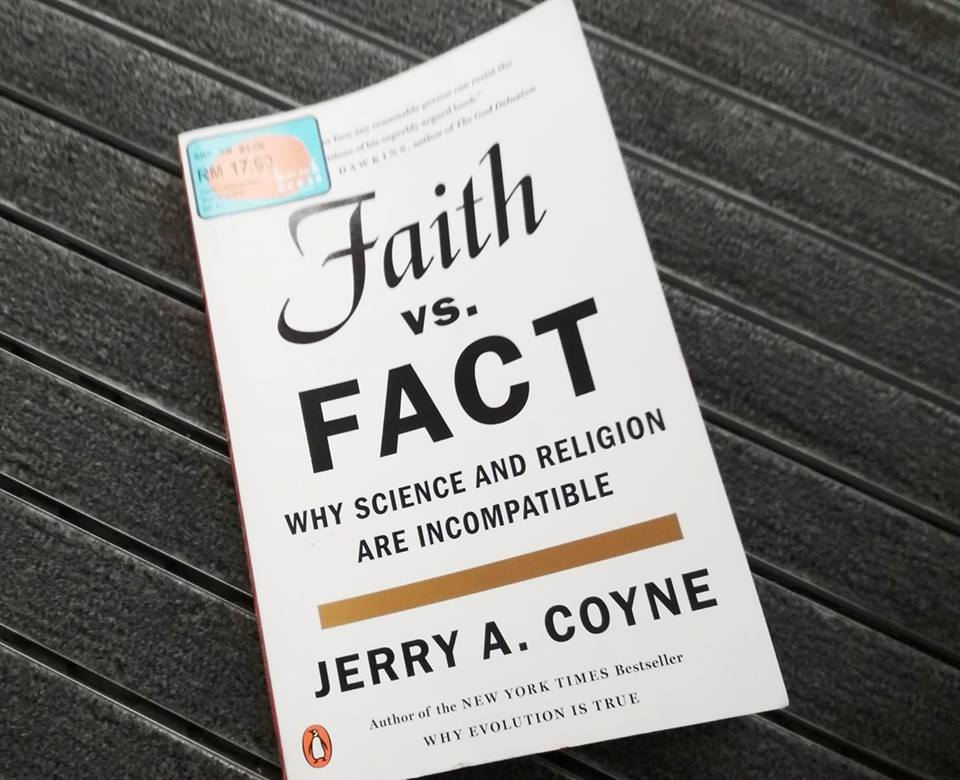
Book Review: Faith versus Fact: Why Science and Religion Are Incompatible (2015)


Faith versus Fact: Why Science and Religion Are Incompatible (2015)
by Jerry A. Coyne

The New Atheist leaders such as Richard Dawkins argues that “it’s hard to see how any reasonable person can resist the conclusions of [Coyne’s] superbly argued book”; and Sam Harris praises Coyne by saying that he “has showing that the honest doubts of science are better – and more noble – than the false certainties of religion.” Jerry Coyne, an evolutionary biologist, author of his first own book Why Evolution is True, argues that “religion and science compete in many ways to describe reality – they both make ‘existence claims’ about what is real – but use different tools to meet this goal… the toolkit of science, based on reason and empirical study, is reliable, while that of religion – including faith, dogma and revelation – is unreliable and leads to incorrect, untestable, or conflicting conclusions. Indeed, by relying on faith rather than evidence, religion renders itself incapable of finding truth.”

In May 1988, a 13-year-old girl named Ashley King was admitted to Phoenix Children’s Hospital by court order. She had a tumour on her leg—an osteogenic sarcoma—that was “larger than a basketball” and was causing her leg to decay while her body started to shut down. Ashley’s Christian parents, however, refused to allow doctors permission to amputate and instead moved their daughter to a Christian Science sanatorium, where, in accordance with the tenets of their faith, “there was no medical care, not even pain medication.” Ashley’s mother and father arranged a collective pray-in to help her recover—to no avail. Three weeks later, she died. Had Ashley received medical care, Coyne writes, she would likely have recovered. The Kings, tried in an Arizona court for negligent homicide, expressed no remorse, pleaded no contest, and were convicted on a lesser charge. They effectively escaped punishment, because their actions were faith-motivated. “Had the Kings been atheists,” Coyne writes, “there was a good chance [Ashley] would have lived.

One day after Coyne giving a talk on evolution, one of the attendees approached him, shook his hand and said, “Dr. Coyne, I found your evidence for evolution very convincing – but I still don’t believe it.” Coyne was amazed. “How could it be that someone found evidence convincing but was still not convinced?” he writes, “The answer, of course, was that his religion had immunized him against my evidence.” He also highlighted one survey stating that 64% of Americans would retain a religious belief even if science disapproved it (which only 23% would consider changing their belief): “If science contradicts the Bible, I will believe the Bible, not science,” one interviewer responded. Some people, he writes, claiming that science and religion are not in conflict but complimenting one another. But in chapter 3, he shows that accommodationist fails.

Jerry Coyle simply argues – from historical, psychological, philosophical, sociological, historical and mainly from scientific views – that any attempt to make religion compatible with science is doomed to fail. “It is time for us to stop seeing faith as a virtue, and to stop using the term ‘person of faith’ as a compliment.” Either you agree or not with his thesis, if you read this book, your faith will be challenge and your mind will be stimulated… I mean, in a good way. What good if you read a book that doesn’t do these things?

[To help me understand this book, I’ve watched two of his interviews on YouTube entitled “Freedom from Religion” and “Faith vs. Fact”]

THINK BIG. START SMALL. GO DEEP.

Best Blogger Tips

Saturday, January 23, 2016

Jesus Wants to Hear You Pray: We Have Freedom of Speech with God (1 John 5:13-15)


I have written this to you who believe in the name of the Son of God, so that you may know you have eternal life. And we are confident that he hears us whenever we ask for anything that pleases him. And since we know he hears us when we make our requests, we also know that he will give us what we ask for
(1 John 5:13-15, NLT).

The Apostle John begins by mentioning that this letter is written especially for people who are already believers: “to you who believe in the name of the Son of God” (although anybody else is welcome to read it as well, I’m sure). Why? So that we know for sure that we “have eternal life.” John is concerned that we must have the confidence and toughness we need as we are confronted by false teachers and other pressures. Some false beliefs in John’s day as well as today, were probably attractive and promised all kinds of things. So, in moments of weakness, some people would give in to the pressure and leave their faith in Jesus. Friends, in tough times, we need to be confident in the “Son of God” that we will receive “eternal life”! No ifs, ands, or buts. Our futures are in God’s faithful hands.

There are other sources of confidence besides knowing that we have eternal life: We can live with the confidence that God cares for us so much that we can speak boldly with God through prayer. “We are confident that he hears us whenever we ask for anything that pleases him.” We can share with God what is on our minds without being afraid of how He will respond. We have a freedom of speech with God. We can share our frustrations and anger as well as our praise, love, and concerns with God. God can take whatever we need to share. We don’t have to force our way into God’s presence to make an appointment months in advance as if He were the CEO of a large company or government. God is always available. There is no answering service, no busy signal, and no forwarding e-mail address. God is ready to talk with us, 24-7 a day.

God wants what is best for us. Pray for “anything.” But we are taught to pray for “anything that pleases him” or more accurately – pray “according to His will” (NIV). This is a balanced prayer. In other words, we should share our concerns with God and ask that we will want what God wants for us. This can help us get beyond presenting God with a grocery list of “our requests” for which we expect certain answers. As we tell God about our concerns, we can say that we may not be sure what the best answer is – but God knows the best for us.

Remember: Prayer involves both talking and listening. Maybe you are wondering how we can listen to God. I never have heard an audible “voice” from God. I know that some people claim to hear God on a daily basis. But that hasn’t been true for me (Am I or you less ‘spiritual’ than others if we don’t? Maybe not so). I find that Lord Jesus most often speaks to me through my own common sense and conscious, through circumstances and other people, and especially – the written Word of God, the Bible. However God speaks to you – I hope mainly from God’s Word – you can be sure and confident that He wants to hear you and wants the very best for you as well. Amen.


THINK BIG. START SMALL. GO DEEP.
Best Blogger Tips

Tuesday, January 12, 2016

Jesus Freaks: 'Kim' of North Korea, Friend's Died, Faith Alive!

North Korea publicly executes 80 people, some for reading the Bible
If the Son sets you free, you will be free indeed
(John 8:36, NIV).

Kim had come home, unable to speak. His mother could tell he was in shock and sat with him, soothing him and trying to find out what had happened. Finally he began to open up to her.
            “I was with one of my best friends today when two police officers approached us. They grabbed my friend and accused him of being a Christian. One of the officers knocked him to the ground while the other took out his gun. My friend didn’t get angry or curse anyone. He… he didn’t even try to defend himself.
            “Even as the gun was pointed directly at him, his face remained peaceful. He looked straight into my eyes, and without speaking a word, I knew exactly what he was saying. He wanted me to believe the same thing he did. And then he just said, ‘Bless them.’
            “He was executed right in front of me – because he was a Christian. I do not even know what a Christian is. I don’t understand any of this.
            Kim’s mother held his head in her hands. There were tears in her eyes. Now it was she who was in shock. She then told him simply, “I understand.”
            “How could you possible understand why they would kill my friend?”
            She slowly began to tell her son about her Lord Jesus Christ, how He had miraculously been born of a virgin and crucified on a cross to save all those who would believe in Him. As she continued sharing with her eldest son, she began to sob. Now it was she who couldn’t go on. She felt the pain of never daring to tell her son about Jesus Christ, lest his fate would be like that of his friend. She also felt the overwhelming joy of knowing that God had not forgotten her son, but allowed someone else to bring him the Gospel.
            Finally she told him, “God allowed you to witness the martyrdom of one of His brave children. As those bullets hit his heart, a seed of hope was planted in yours.”
            The son prayed that night and received Jesus Christ into his heart. He was filled with joy as he embraced his mother and thanked her for telling him the truth. But suddenly he began to weep again and appeared distraught. Confused, the mother asked, “Now what’s wrong?”
            “My brothers,” Kim cried, “they do not know Jesus. We must tell them!”
            His three brothers soon came home and discovered their older brother and mother crying together. Their first thought was that something terrible had happened to their father, and they quickly knelt down beside their mother, asking what was wrong.
            With unnatural boldness the eldest son stood up and responded, “You should also receive Jesus Christ.” Before the evening had passed, all three had done exactly that.
            The mother was filled with joy. Although she had never dared to speak to her children about her Christian faith, she had diligently prayed for them every day. Now that her children had accepted Jesus, she began cautiously looking for a Bible so they could learn more of God’s Word. But she could not find any.
            Eventually her oldest son secretly crossed the Yalu River into China in search of Bibles. You can imagine the look on his face when he finally came across a miniature Bible in the Korean language. He pleaded with the Christians in China, asking how he could obtain some of these Bibles. Regrettably no more were available. Refusing to admit defeat, he told the Christians the dramatic story of how he had witnessed his friend’s death and how he and his brothers had learned of Jesus Christ. Before departing for North Korea, he said, “I am in need of five thousand of these Bibles to share with my family and others in North Korea. I will be back in one month to pick them up.”
            Hearing of her request, some Christian workers hurriedly printed five thousand copies of the miniature Korean Bibles. Over the next year or so, Kim returned on several occasions to smuggle the Bible back across the border. All four of these brothers are now actively sharing their faith, knowing first-hand the consequences if they are discovered. Since their last pickup of these Bibles some months ago, no one has heard further news of them.
[Taken from Jesus Freaks: Revolutionaries (2002) by dc Talk. Title mine]

The cost of serving Jesus Christ is your life.
What are you doing with your life now? For Christ and His Kingdom? or for self?
THINK BIG. START SMALL. GO DEEP.


Best Blogger Tips

Friday, October 30, 2015

Jesus, the One Who Takes Away Our Shame


I invite you to think carefully about the supreme test Jesus faced in the race. Hebrews 12:2 offers this intriguing statement: “[Jesus] endured the cross, despising the shame.” Shame is a feeling of disgrace, embarrassment, humiliation. Forgive me for stirring the memory, but don’t you have a shameful moment in your history? Can you imagine the horror you would feel if everyone knew about it? What if a video camera of that event were played before your family and friends? How would you feel?

That is exactly what Jesus felt. Why? You ask. He never did anything worthy of shame. No, but we did. And since on the cross God made Him became sin (2 Corinthians 5:21), Jesus was covered with shame. He was shamed before His family. Stripped naked before His own mother and loved ones. Shamed before His fellow men. Forced to carry a cross until the weight caused Him to stumble. Shamed before His church. The pastors and elders of His day mocked Him, calling Him names. Shamed before the city of Jerusalem. Condemned to die a criminal’s death. Parents likely pointed to Him from a distance and told their children, “That’s what they do to evil men.”

But the shame before men didn’t compare with the shame Jesus felt before His Father. Our individual shame seems too much to bear. Can you imagine bearing the collective shame of all humanity? One wave of shame after another was dumped on Jesus. Though He never cheated, He was convicted as a cheat. Though He never stole, heaven regarded Him as a thief. Though He never lied, He was considered a liar. Though He never lusted, He bore the shame of an adulterer. Though He always believed, He endured the disgrace of an infidel.
[Taken from Just Like Jesus by Max Lucado]

THINK BIG. START SMALL. GO DEEP.


Best Blogger Tips

Monday, September 28, 2015

Jesus wants Us to Count the Cost of Discipleship

Picture taken from: tmcklang1908.wordpress.com
If you refuse to take up your cross and follow me, you are not worthy of being mine. If you cling to your life, you will lose it; but if you give up your life for me, you will find it. Anyone who receives you receives me, and anyone who receives me receives the Father who sent me
(Matthew 10:38-40
NLT).

In Matthew 10:32-40, Jesus laid it all out for the disciples: Follow Him would come with a high cost. Thus all who wished to follow him should consider the cost before signing up.

Jesus’ followers would encounter enemies on all sides, even in their own homes. They would feel great pressure to turn back, to deny the truth and their Lord. Christ must be everything to them, more important than any family member or loved one. Jesus was not encouraging disobedience to parents or conflict at home; rather, he was showing that his presence demands a decision. In the early church, Jews who became Christians would be excommunicated from the synagogues and often shunned by their families. Jesus did not come to make such divisions happen, but his coming, his words, and his call inevitably causes conflict between those who accept him and those who reject him.

When Jesus used this picture of “take up your cross and follow me”, the people knew what it meant. Death on the cross was a Roman form of execution, the most shameful execution. To follow Christ means denying self and carrying one’s cross, being prepared to die for him. Earlier in these verses, Jesus had described how the disciples should go about their ministry – staying in homes of worthy people (Matthew 10:11-14). Here he added that even giving “a cup of cold water” (10:42) would be important – serving others, not just preaching.

Think about this: The best way to find life is to loosen your grasp on earthly rewards so that you can be free to follow Christ. You will risk pain, discomfort, conflict, and stress as you acknowledge Christ’s claim over your relationships, possessions, and career. But in doing so, you will experience the benefits of following Christ, namely here, having a Life and knowing the Father. Do not neglect your family, but remember that living for God should be your first priority. Jesus is worthy to risk all!

THINK BIG. START SMALL. GO DEEP.


Best Blogger Tips

Tuesday, August 18, 2015

So You Often Quote Him? Augustine of Hippo on the Relation of God and Evil


In his early period, Augustine was attracted to Manicheism, partly because it provided a simple explanation of the origin of evil (You can read this in Augustine’s autobiography The Confessions). According to this movement, evil had its origins in an evil or defective deity, who was opposed to the true and righteous God. On becoming a Christian, Augustine rejected this dualism, and was therefore obligated to give an alternative explanation of the origins of evil. In this passage, written in Latin during the period 388-395, he argues that evil represents a free turning away from God, rather than a positive entity in its own right. However, he is unable to provide a convincing explanation of why someone should wish to turn away from God in this manner. He writes:

If there is a movement, that is a turning away of the human will from the Lord God, which without doubt is sin, we can then say that God is the author of sin? God, then, will not be the cause of that movement. But what will its cause be? If you ask this question, I will have to answer that I do not know. While this will sadden you, it is nevertheless a true answer. For that which is nothing cannot be known. But hold to your pious opinion that no good thing can happen to you, to your senses or to your intelligence or to your way of thinking which does not come from God. Nothing of any kind can happen which is not of God… For all good is from God.

Hence there is no nature which is not from God. The movement of turning away, which we admit is sin, is a defective movement; and all defect comes from nothing. Once you have understood where it belongs, you will have no doubt that it does not belong to God. Because that defective movement is voluntary, it is placed within our power. If you fear it, all you have to do is simply not to will it. If you do not will it, it will not exist. What can be safer than to live a life where nothing can happen to you which you do not will? But since we cannot rise by our own free will as we once fell by our own free will spontaneously, let us hold with steadfast faith the right hand of God stretched out to us from above, even our Lord Jesus Christ, and look forward to receiving the certain hope and love which we greatly long for.”

You might want to read this quote one more time… maybe twice and slowly.
THINK BIG. START SMALL. GO DEEP.

References:
1) de libero arbitrio, II.xx.54; in Corpus Scriptorum Ecclesiasticorum Latinorum, vol. 74, ed. W. M. Green (Vienna: Hoelder-Pichler-Tempsky, 1961), 87.18-88.20
2) The Christian Theology Reader, edited by Alister E. McGrath (Oxford UK: Blackwell Publishers Inc., 1995), p. 104

Best Blogger Tips

Saturday, August 15, 2015

Jesus' Kingdom grow Quietly and Abundantly (At First, it is Indistinguishable)

Wheat and weeds look very similar, it takes an experienced eyes to discern between them
’The Kingdom of Heaven is like a farmer who planted good seed in his field. But that night as the workers slept, his enemy came and planted weeds among the wheat, then slipped away. When the crop began to grow and produce grain, the weeds also grew. The farmer’s workers went to him and said, ‘Sir, the field where you planted that good seed is full of weeds! Where did they come from?’ ‘An enemy has done it!’ the farmer explained. ‘Should we pull out the weeds?’ they asked. ‘No,’ he replied, ‘you’ll uproot the wheat if you do. Let both grow together until the harvest. Then I will tell the harvesters to sort out the weeds, tie them into bundles, and burn them, and to put the wheat in the barn.’” (Matthew 13:24-30, NLT).

Jesus explained that the Kingdom grows quietly and abundantly, but evil still exists in the world. As Jesus provides the meaning of this parable in Matthew 13:36-39, he revealed that himself, the “Son of Man” is the farmer; the “field” is the world; the “good seed” symbolizes God’s people; the “weeds” are Satan’s people; the “enemy” is Satan; and the “harvesters” are angels. A common practice in ancient warfare and feuds was to destroy the enemy’s agriculture. Thus, the presence of Satan’s people among the people of God would weaken them. So it seems.

At first, the weeds and wheat are indistinguishable; eventually, however, the differences become obvious. At harvest time, harvesters remove the weeds and get rid of them. The “weeds” may be people in the church (and of course the world too) who appear to be believers, called themselves ‘Christian’, but who never truly believe. Later, the apostles would battle the problem of false teachers who had come from within the ranks of the believers (see, for example, 2 Peter 2:1-3; 13-22), and this problem is still exist even today – until Jesus’ second coming.

As new believers begin to mature in faith, their lives begin to reflect the Holy Spirit’s work, affecting values, perspectives, priorities, attitudes, and actions. Those who aren’t true followers of Christ, however, continue to reflect the values and attitudes of the world. Eventually, the truth will be revealed, and God will judge righteously and send each group to their deserved eternal destination. For the “weeds”, whose who “cause sin” and “do evil” (Matthew 13:41), that will be terrible. But “the righteous will shine like the sun in their Father’s Kingdom” (Matthew 13:43).

Think about this: God is the ultimate judge of who truly belongs to him. We should be slow to judge others, realizing people have different levels of spiritual maturity. Only God knows their hearts. Instead, we can lovingly share the gospel, teach, encourage, and comfort and discipline, when necessary, leaving the final judgment to him. As for you and me, Jesus said we can tell a lot about people by their “fruit”, how they act and what they produce (Matthew 7:20), so what “fruit” are we producing that shows we belongs to Jesus? How our values, perspectives, attitudes, and actions differ from those who don’t know Christ? It is very well with our souls if we can ask these crucial questions to ourselves and examine our own hearts in the light of Christ’ gracious mercy and love. Amen.

THINK BIG. START SMALL. GO DEEP.

Best Blogger Tips

They Click it A lot. [Top 7 last 7 Days]