Showing posts with label Sacrifice. Show all posts

Monday, April 15, 2024

The 10-Minute Rule #LeadersAreReaders February 2024

The months of February and March are quite packed for me but I still managed to find time to read. First, it's due to necessity. If I don't read, I can't do my work and ministry efficiently. Secondly, it's due to habit. Since reading books is a part of my life, I can't imagine a day without reading, especially the Scriptures, even if only for a few sentences. Thirdly, it's due to a principle that I've practiced since last year: the 10-Minute Rule. Namely, starting to read from a book for at least 10 minutes every day. My aim is at least 10 minutes, but usually, I end up reading longer than that.

I find that this rule is helpful because it is achievable and a good way for me to jump-start my mind's engine! Plus, if I don't feel like I want to read (which is rare), I can just endure the 10 minutes and close the book! So, would you like to try a 10-Minute Rule? If it's too hard, try 5 minutes; you have to at least try. Reading books 1) keeps me inspired by other people’s thoughts and if I read the Scriptures, by God's thoughts, wow!; 2) gives me a different perspective; 3) restores my ability to be more discerning with my time; 4) encourages me to spend time with lasting benefits; 5) opens the creative flow as concepts and ideas appear in my mind; and many more. Pick a book, set the timing to 10 minutes, and read!

NOTE: Currently, I'm exploring Roman Catholicism. The book on the Eucharist by Bishop Robert Barron is inspiring, and as I examine the Scriptures and some traditions regarding the argument for transubstantiation, I find myself more inclined to this interpretation. Jimmy Akin, Trent Horn, Joe Heschmeyer, and especially Scott Hahn and Brant Pitre have argued very well on this subject. However, in the case of a book by Father Frederick William Faber on Purgatory, I still find myself skeptical. As I heard half a dozen arguments by Catholics to defend the doctrine of purgatory, I came to my initial suspicion that it is more philosophical rather than Scriptural. By the way, a debate between Trent and James White on this subject is interesting.

#ServeToLead #LeadersAreReaders #The10MinuteRule #ReadingIsLiving #LetsMakeReadingCoolAgain

THINK BIG. START SMALL. GO DEEP.

Best Blogger Tips

Saturday, January 21, 2023

Shifting Currents - Issues, Challenges, and the Way Forward for Global Christianity (2019) by Hwa Yung, Book Review

Usually, I don't write reviews for a booklet that I read but since the message here is quite important (and perhaps urgent) for us Christians - especially the East Asian Christians - to look at, I think it is good for me to share it briefly. This booklet is based on Bishop Emeritus Hwa Yung's talk at the World Assembly of the IFES, South Africa, in July 2019. Hwa Yung believes that there are significant shifts in global Christianity, namely, from the Western World to the Majority World, and with it comes great issues and challenges. "Christians in the Majority World (or Global South) will forever owe an incalculable debt of love to those from the West who brought the gospel to us in the past, often at great cost to themselves... Moreover, there is still so much in western Christianity that is good, noble, and worth emulating," he writes, "Nevertheless, in recent years, I have reluctantly come to the conclusion that I have to think twice before I look to today's western churches for answers." I agree with Hwa Yung's realistic comment here. We need to be grateful and yet, careful.

Churches in the Majority World must have their own identities, independence, and influence from the West. The goal, I believe, is not for separation but for mutual benefits. It doesn't mean that we have to reject everything (God forbids!) but we do have to contextualize certain areas of our differences such as theology, culture, ways of thinking, and doing church and mission. Hwa Yung observes that
"many churches in the Majority World still function as appendages and extensions of the churches in the West." The Majority World must grow into maturity so that instead of depending on the West for models and answers, they will "be able to work alongside those in the West with real confidence and contribute to their well-being." In short, genuine mutuality and mature partnership with one another. In his talk, the author outlines five (5) key issues and their related challenges (to know more, read this booklet or watch his talk on YouTube):

1) Worldviews and the Intellectual Challenge
2) The Growth of the Majority World Churches and the Recovery of the Supernatural
3) Ministry and Mission by Human Management vs. Dependence of the Spirit
4) The Challenge of Shallow Discipleship or Nominalism
5) Confidence In the Gospel of Christ

His concluding thoughts - the way forward for global Christianity - are worth considering and praying about. One that stands out for me is this:
"If we the Majority World are to live out our calling to serve the global church, we must learn one important lesson from western church history. It is simply that the advance of the kingdom of God will inevitably involve costly sacrifice.” Amen.

To read my other book reviews/ summaries by the same author, CLICK THE
TITLES to read:

Beyond AD 2000: A Call to Evangelical Faithfulness (1999)

Bribery and Corruption: Biblical Reflections and Case Studies for the Marketplace in Asia (2018)

#ServeToLead #PreachTheWord #ShiftingCurrents #GlobalChristianity #HwaYung #IFES #LeadersAreReaders #LetsMakeReadingCoolAgain

To read other articles on reading and book reviews, CLICK HERE
All things media: https://linktr.ee/LEGASI.tv    

THINK BIG. START SMALL. GO DEEP.

Best Blogger Tips

Sunday, May 2, 2021

The Book on Leadership (2004) by John MacArthur, Book Review


The Book on Leadership (2004) by John MacArthur

Where do I go if I want to read Bible expositions, commentaries, and topical all at the same time? I go to John MacArthur’s books (to read my review of MacArthur’s Ashamed of the Gospel & my Top 15 Books on Leadership, click the titles). MacArthur has been one of the biggest influences in my life in the areas of expository preaching, Word-centered writing, and leadership teachings. I learned so much from the free resources online at Grace to You webpage and The Master’s Seminary YouTube channel. I admire the man because he stands for the truth and his love for the Lord Jesus and the Word of God is very contagious. I don’t fully agree with some of his views such as on charismatic movement as a whole in his book, Charismatic Chaos (1992) and later became a conference and a book, Strange Fire (2013). There are some other ‘controversies’ that I’m aware of but none really that clear and I will not defend someone that I don’t know personally such as MacArthur. One must draw the line between admiring the man for what the Lord has done through him and obsessing – even idolizing – the man, thinking that his theology and life are perfect. Never put your trust and allegiance to a mere man but Christ alone!

Now, let me discuss about this book (in 2010, it was retitled, Called to Lead). As of this writing, amidst many fallen leaders, Pastor John MacArthur, 81 years old, still standing strong. Probably that, I think, mostly attributed to his leadership. What is leadership? Based on Matthew 20:25-28, MacArthur wrote: “According to Christ, then, the truest kind of leadership demands service, sacrifice, and selflessness. A proud and self-promoting person is not a good leader by Christ’s standard, regardless of how much clout he or she might wield. Leaders who look to Christ as their Leader and their supreme model of leadership will have servants’ hearts.” The fact that we must look to Christ as our Leader and “supreme model of leadership” means that He must influence our entire lives. Thus, leadership at its core is influence. “The ideal leader is someone whose life and character motivate people to follow,” explains MacArthur. Not style but character. So, the best example to follow is Christ Himself (one book that I would like to recommend here is C. Gene Wilkes’s Jesus on Leadership) and the next ones are the people who follow Christ faithfully. To MacArthur, it would be Paul the apostle. “Follow my example,” Paul urged the Christians, “as I follow the example of Christ” (1 Corinthians 11:1). MacArthur reasons, “Of all the biographies I have read and the lives that have left their mark on my character, no one mortal individual has left a deeper impression on me than the apostle Paul. I sometimes feel I know more about him than anyone else except Christ, because I spent a major portion of my life studying the biblical account of his life, letters, and ministry, learning leadership at his feet.” That is not a surprise since he took 42 years to preach the entire 27 books of the New Testament verse by verse of which about half of the books (letters) attribute to Paul.

There are 26 characteristics of a true leader outline in the book and it is divided into three parts. MacArthur writes largely based on biographical material from the life-action of Paul from the Book of Acts and autobiographical from his letters. In Part 1: Paul In Chains: Leadership In Action, he examines from Acts 27 how Paul’s leadership was manifest in the most unlikely of situations; in Part 2: Paul In Corinth: Leadership Under Fire, he helps us to see how Paul deals with issues regarding spiritual leadership and how to handle conflicts in the church primary based on 2 Corinthians; in Part 3: An Approved Workman – Leadership Held to Biblical Standard, he answers these two questions, “How Not to Be Disqualified” and “Who Is Fit to Lead?”; and in Part 4: Epilogue, my favorite, where he skilfully highlights Paul’s triumphant last days on earth even though he might seem to the world as a failure due to his imprisonment and execution. I’m touched by Paul’s testimony in 2 Timothy. “Paul measured his own success as a leader, as an apostle, and as a Christian by a single criterion: He had ‘kept the faith’ – meaning both that he had remained faithful to Christ and that he had kept the message of Christ’s gospel intact, just as he had received it.” Indeed, this is his legacy (come on, LEGASI!) in this life and through eternity. Amazing. To you who are called to lead, read this book!

#ServeToLead #PreachTheWord #LeadersAreReaders #GrowingLeaders #LetsMakeReadingCoolAgain #JohnMacArthur #TheBookOnLeadership #TheApostlePaul #SpiritualLeadership

FB Pagehttps://facebook.com/LEGASI.tv/                    
Podcasthttps://anchor.fm/LEGASI.tv/            
YouTubehttps://www.youtube.com/c/LEGASItv/  

THINK BIG. START SMALL. GO DEEP.


Best Blogger Tips

Tuesday, September 3, 2019

Four (4) Things about Sacrifice that Leaders Should Know


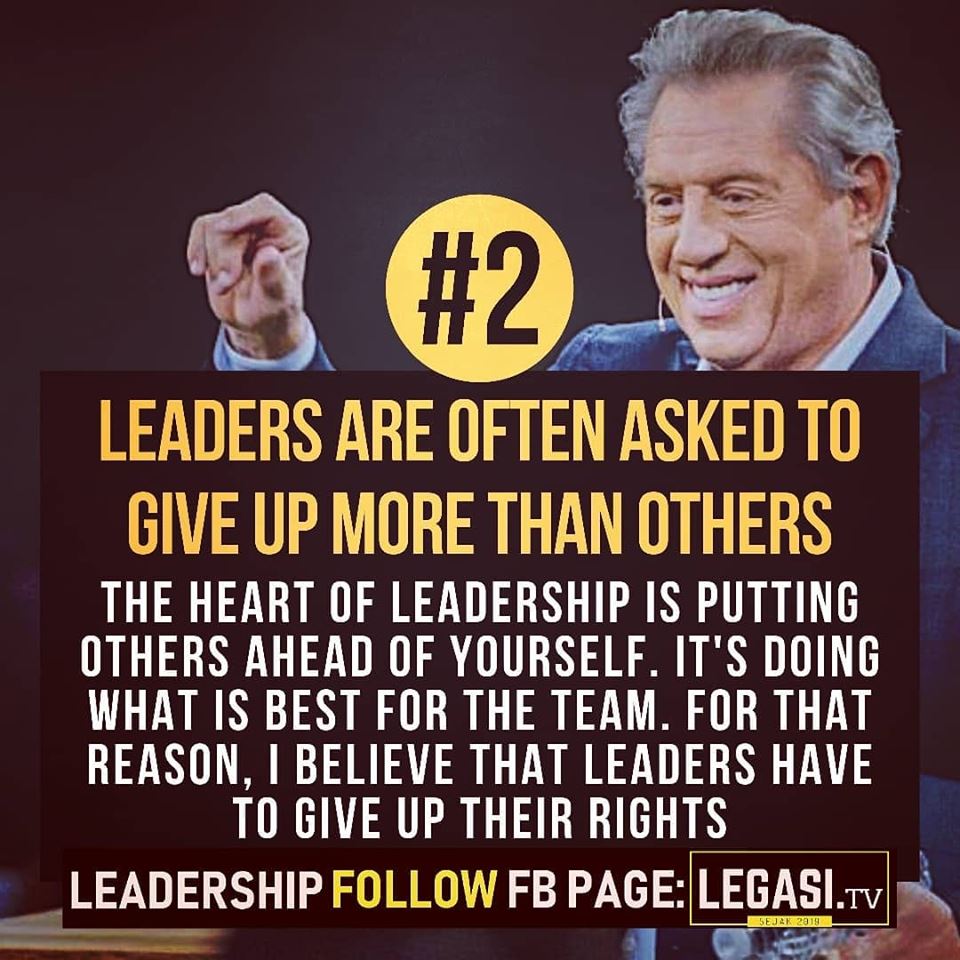
If you desire to become the best leader you can be, then you need to be willing to make sacrifices in order to lead well 🙏 The Law of Sacrifice, writes John C. Maxwell, stated that: “A leader must give up to go up" 🔝 If that is your desire, then here are four (4) things you need to know 👇:


THINK BIG. START SMALL. GO DEEP.

Best Blogger Tips

Tuesday, August 14, 2018

Play the Man: Becoming the Man God Created You to Be (2017) by Mark Batterson, Book Review


Play the Man: Becoming the Man God Created You to Be (2017)
by Mark Batterson

Before I read it, when I first saw the title of this book, it reminds me of many Bible verses such as 2 Samuel 10:12 where Joab told Abishai, “Be of good courage and let us play the men for our people…”; 1 Kings 2:2 when David encouraged Solomon to “be strong and act like a man…”; and 1 Corinthians 16:13 as Paul reminded the Christian men at Corinth to “be watchful, stand firm in the faith, act like men…” It also reminds me of the Church fathers such as Polycarp when he was about to be executed a voice from heaven said to him, “Be strong, Polycarp. Play the man.” When Hugh Latimer, Nicholas Ridley, and Thomas Cranmer were also persecuted for their faith, Cranmer said to Ridley for the last time, “Be of good comfort, Master Ridley, and play the man.” Play the man, act like a man, being a man. I’m so pumped up by the title of this book that I bought it without first browsing it through. To buy the book (and desire to read it), I thought, is already a manly act!

Play the man. Somewhere along the way, our culture – even our churches – has lost its definition of manhood, leaving generations of men and men-to-be confused about their roles, responsibilities, relationships, and the reason God made us men. “The white noise of cultural confusion coupled with the deafening silence of the church has left us insecure and unsure of our manhood,” observes Mark Batterson. “So we settle for something far less than what God originally intended.” It’s in this much-needed message that Batterson declares his mantra for manhood, one that we all men must aspire to act: Play the man!When you play the man,” he writes, “you are lighting a candle for the next generation – a candle that shall never be put out.” Oh, where are men of God today?

Batterson from the beginning mention that Jesus Christ is the archetype of manhood (or manliness), “He is the Lamb of God and the Lion of the Tribe of Judah. He is a gentle Jesus, meek and mild. But meek isn’t weak, and Jesus definitely had a wild side! He was tough as nails, seven-inch nails that pierced His hands and feet. But He was also man enough to cry.” He continues, “Jesus is an enigma, the Enigma, and that is because He was fully God, fully man. Yes, He is the omniscient, omnipotent, and omnipresent Son of God. But for 33 years, Jesus played the man… Like us, He had to learn reading, writing, and arithmetic. And He had to discover His destiny, His identity, and His masculinity. Of course, after discovering it, He defined it.” Once that is established, Batterson then lists down Seven (7) Virtues of Manhood where he creatively unveiled it one by one through Biblical, personal and historical perspectives and stories. What I like about Mark is that he writes with such scholarly-passionate, humorously-serious, practically-doable, and theologically-clear. Right after I finished reading this book, I prayed:

Lord, by Your grace, I want to play the man!

This 200 pages book is divided into 2 parts and 10 chapters:

Part 1 Play the Man: The Seven Virtues

1 Tough as Nails: Virtue #1 Tough Love
2 A Gentleman and a Scholar: Virtue #2 Childlike Wander
3 Unbroken: Virtue #3 Will Power
4 The Three-Headed Dragon: Virtue #4 Raw Passion
5 Sockdolager: Virtue #5 True Grit
6 Born for the Storm: Virtue #6 Clear Vision
7 Call of Duty: Virtue #7 Moral Courage

Part 2 Make the Man: The Rite of Passage

8 No Man’s Land
9 The Discipleship Covenant
10 The Rite of Passage

I wish every man to read this book or at least this kind of book on manhood – books that are written by men for men. But that in itself is very challenging. Why? Because most men didn’t like to read books… Maybe the first virtue should be #1 Teachable or Learner.

THINK BIG. START SMALL. GO DEEP.

Other books on Manhood that I’ve review and recommend:

#1 Finishing Strong: Going the Distance for Your Family (1995) by Steve Farrar (http://richardangelus.blogspot.com/2018/07/finishing-strong-going-distance-for.html)

#2 Tender Warrior: God's Intention For a Man (1993) by Stu Weber (http://richardangelus.blogspot.com/2018/07/tender-warrior-gods-intention-for-man.html)

#3 Tough and Tender: What Every Woman Wants In a Man (1981) by Joyce Landorf (https://richardangelus.blogspot.com/2018/06/tough-and-tender-what-every-woman-wants.html)

#4 Healing the Masculine Soul: How God Restores Men to Real Manhood (1988, 2003) by Gordon Dalbey (https://richardangelus.blogspot.com/2018/04/healing-masculine-soul-how-god-restores.html)

#5 Book Review: Wild at Heart, Discovering the Secret of A Man's Soul (2001) by John Eldredge (https://richardangelus.blogspot.com/2017/12/book-review-wild-at-heart-discovering.html)


#6 The Hidden Value of a Man: The Incredible Impact of a Man on His Family (1992) by Gary Smalley and John Trent (https://richardangelus.blogspot.com/2017/12/book-review-hidden-value-of-man-1992-by.html
Best Blogger Tips

Saturday, June 16, 2018

Book Review: A Leader’s Legacy (2006) by Jim Kouzes and Barry Posner


A Leader’s Legacy (2006) by Jim Kouzes and Barry Posner

One of the top leadership books recommended by other leaders is The Leadership Challenge by the same authors. Since I found this one in the library, and this one is the latest between the two and is shorter in volume than the other, and since each chapter in this book is briefer and nontechnical like the other one – I borrowed this one and I’m pleased with my decision. Satisfied customer! The idea of this book begins when their editor, Susan Williams, wanted both of them to write a book that was “a free-flowing exploration of leadership topics and lessons” that they learned over about two decades of experiences. She challenged them to “come down from the podium” and to be “much more personal, introspective, subtler, and at times, more blunt” in their writing style. And so this book is concise lessons that they learned in all those years. As a reader, this is good because it means I don’t have to read their other books.

What interest me about this book is the word “legacy.” Either you’re a leader or a leader with no formal title or a student of leadership (like me), every leader I’ve ever worked and talked with wants to leave a legacy. Thinking about our legacies requires us to move beyond short-term definitions of success. Legacies encompass past, present, and future, and when I pondered about my legacy, I’m forced to consider where I’ve been, where I’m now and where I’m going. I’m brought face-to-face with questions of who I am and why I’m here. “By asking ourselves how we want to be remembered,” writes Kouzes and Posner, “we plant the seeds for living our lives as if we matter. By living each day as if we matter, we offer up our own unique legacy. By offering up our own unique legacy, we make the world we inhabit a better place than we found it.”

Even though there were little ‘new ideas’ on leadership in this book, I’m challenged to think (or focus-thinking) about the legacies that I want to leave behind me. I’ve read books on leadership that touch on the subject of legacy, but none as intentional, personal, and provocative as this one. Here Kouzes and Posner examine in 21 chapters – arranged into four parts – the critical questions all leaders must ask themselves in order to leave a lasting impact. Below are the contents with my selection of quotes for each part:

Part One: SIGNIFICANCE

When we move on, people do not remember us for what we do for ourselves. They remember us for what we do for them. They are the inheritors of our work. One of the great joys and grave responsibilities of leaders is making sure that those in their care live lives not only of success but also of significance” (p.10)

Chapter 1: Leaders Serve and Sacrifice
Chapter 2: The Best Leaders Are Teachers
Chapter 3: We All Need Loving Critics
Chapter 4: You Are the Most Important Leader in Your Organization
Chapter 5: No One Likes to Be an Assumption

Part Two: RELATIONSHIP

Leadership is a relationship. It’s a relationship between those who choose to follow. Whatever the relationship is with one or many, leadership requires engaging others. No matter how much formal power and authority our positions give us, we’ll only leave a lasting legacy if others want to be in that relationship with us. Other people decide whether to follow or to run away. Others decide whether to cheer or jeer. Others decide whether to remember us or forget us. No discussion of leadership is complete without considering the quality of the leader-constituent relationship. Leadership requires a resonant connection with others over matters of the heart” (p.48).

Chapter 6: Leadership Is Personal
Chapter 7: Leaders Should Want to Be Liked
Chapter 8: When You Don’t See Eye to Eye, Seek to Understand
Chapter 9: You Can’t Take Trust for Granted
Chapter 10: Let Your People Go

Part 3: ASPIRATIONS

People commit to causes, not to plans. Commitment is fuelled by what we cherish. If the values about which we care deeply are vividly clear to us, then the whims of fashion and the opinion polls won’t side-track us. A lasting legacy is built on a firm foundation of principles and purpose... Leaders must decide on what matters in life, before they can live a life that matters” (p.90).

Chapter 11: Lead from the Inside Out
Chapter 12: Forward-Looking Is a Leadership Prerequisite
Chapter 13: It’s Not Just the Leader’s Vision
Chapter 14: Liberate the Leader in Everyone
Chapter 15: Leaders Are Followers, Too!

Part 4: COURAGE

Leaving a legacy is all about making a difference. We can only make a difference when we take stands. Every one of us is capable of taking stands on things that matter. That’s what it really means to live a courageous life. It takes courage to realize your dreams and to give meaning to your values. If you’re going to leave a legacy of lasting significance, it’ll be the result of acting courageously… Courageous is the virtue that makes all other virtues possible” (p.132).

Chapter 16: There’s Courage in All of Us
Chapter 17: You Can’t Plan to Be Courageous, But You Can Choose It
Chapter 18: It Takes Courage to Make a Life
Chapter 19: The Courage to Be Human
Chapter 20: Failure Is Always an Option
Chapter 21: No Money-Back Guarantee

Afterward: The Legacy You Leave Is the Life You Lead

The afterward title is worth repeating, read and let it sink in your mind. Read slowly:
The Legacy You Leave Is the Life You Lead. Lead on!

THINK BIG. START SMALL. GO DEEP.
Best Blogger Tips

Wednesday, May 23, 2018

Self-Leadership #8 Be Prepared to Sacrifice


When we hear the word sacrifice, we often think of completely selfless acts in which someone does something for another entirely for the other person's benefit. The image of a soldier sacrificing his life for his comrades frequently comes to mind. But sacrifice isn't purely selfless. The best definition of sacrifice is one that I found in American Heritage Dictionary: "To forfeit something for something else considered to have a greater value." Sacrifice does not mean giving up something for nothing; it means giving up one thing for something else we believe is worth more, "a greater value." This means a leader who lays down his life for his family or for his team has chosen to place more value on their lives than on his own.

In The 21 Irrefutable Laws of Leadership, John C. Maxwell points out that the Law of Sacrifice says, "A leader must give up to go up." A leader cannot achieve and get something without giving up something in return. In order to attain something you believe is of greater value, you must give up something you believe is of lesser value. Our society today tries to minimize sacrifice at every turn, promising people that they can fulfill their desires without having to forsake anything at all. "Lose weight without giving up your favorite foods!" "Get ripped without long workouts!" "Get rich without having to work hard!" All of these are fantasies! Leaders understand that there is always a price to pay. Time, energy, money, commitment – all require sacrifice. Without hard work, pain, turmoil, commotion, anxiety, stress, and tension, there is no growth, no change. You must pay the price!

Here are three (3) ways to think about sacrifice:

Sacrifice Leads to Success: Its sacrifice, during all those hours of training that equips you to hang in there against all odds. Sacrifice and self-denial lie behind every success.

Use Failure as Stepping Stones: It hurts to fall short of a goal. However, when you use a failure to your advantage, it can become merely a stepping stone on the road to victory.

Pay the Price: Greatness is worth the cost. Great achievements require courage, determination, drive, and a willingness to pay the price.


THINK BIG. START SMALL. GO DEEP.
Best Blogger Tips

Thursday, October 12, 2017

Timothy, Sound Doctrine will Produce: Sacrificial Love, Godly Conscience, and Unhypocritical Faith (1 Timothy 1:5)


The aim of our charge is love that issues from a pure heart
and a good conscience and sincere faith

(1 Timothy 1:5,
ESV)

In 1 Timothy 1:3-4, the apostle Paul writes against “different doctrine.” He warned Timothy and the church of Ephesus to rejects false doctrines and stay away from meaningless myths and endless genealogies. Now Paul is calling their attentions instead to sound doctrine or more accurately, the product of sound doctrine. The “aim” or “end” here is the goal. Thus, as we preach and teach and live God’s Word, it will produce these results:

#1 “Love that issues from a pure heart…” as you know, there are three Greek words for love. First, eros has to do with sensual passion, sexual involvement (our word erotic is from this). Secondly, philo, meaning ‘affection, human feeling or tenderness.’ We live in a society which can’t seem to tell the difference between these two and can’t seem to move from first to the second. Thirdly, is agapao and refers to divine love, love which is measured by sacrifice (remember Jesus). It is the main word in John 3:16. This is the word which is used here. Sound doctrine produces God’s love in our hearts. This love comes from a “pure heart,” a heart that has been cleansed and made pure by the blood of Christ.

#2 “…a good conscience…” Let your conscience be your guide,’ someone advise. Ever hear that? For many, this is the rule of life (‘Ikut gerak hati atau nanuri kamu’). Good advice? Not necessary, not always. You see, your conscience can be influenced. Or let me put it this way: Your conscience acts on the basis of the knowledge it has. In the Old Testament, when the pagan Canaanites worship their gods, they would sacrifice their babies into the fire. Their consciences would have hurt them if they had not done it. However, child sacrifice is wrong! Their consciences were wrong! They had been feed the wrong information, indoctrinated. “A good conscience” here is one which has been purified by the blood of Christ from “dead works to serve the living God” (Hebrews 9:14). It is now give guidance to the believers like us based upon the right information in the light of God’s Word as applied by the Holy Spirit.

#3 Finally, sound doctrine will produce “…sincere faith.” In another word, the result is unhypocritical faith. How much the testimony of Christ has been hurt because of people who professed a faith they did not possess. Their lives – words and actions – have denied what their lip professed. In contrast, when a sinner genuinely comes to Christ and believes the “sound doctrine” of the Scripture, he or she no longer has to ‘play act’ (meaning hypocrite) at being a Christian. He or she now has an unhypocritical faith, sincere faith! 

Is your kind of Christianity produces love which is measured by sacrifice (pure heart)?
Is your conscience cleansed by Christ’s blood and based on God’s Word (good conscience)?
Is your faith is unhypocritical faith (sincere faith)?
Sound doctrine will produces all of the above. Examine your life.
THINK BIG. START SMALL. GO DEEP.


Best Blogger Tips

Tuesday, October 3, 2017

God's Outlaw: The Story of William Tyndale


God’s Outlaw: The Story of William Tyndale (1986)

Who is William Tyndale [1494-1536]? He is the translator of the first English New Testament! Most of the English Bible translations today owe (of course to God the Supreme first) to Tyndale, and thus, to know him is to know the Story of the Bible. This movie (produced in 1986! So, forget about graphic and film quality, just focus on contents ya) set in the colorful and dangerous days of King Henry VIII when men were burned, racked and maimed for lesser crimes than that of smuggling Bibles – especially Martin Luther’s translations – into England. The movie opens with a young child reciting The Lord’s Prayer in English and thus her parents were taken to jailed and killed for teaching their children to pray in English instead of Latin.

Once when someone said to Tyndale, “We are better to be without God’s laws than the Pope’s.” He replied, “I defy the Pope and all his laws. If God spares my life ere many years, I will cause the boy that drives the plow to know more of the scriptures than you!” When Tyndale set out to provide the first printed New Testament in English (based on Erasmus's Greek Bible) he was forced to defy the king, the Roman Catholic pope, and all other authorities. Thomas Moore, his archenemy (but a bit soft in the movie) once said about Tyndale translation: “not worthy to be called Christ's testament, but either Tyndale's own testament or the testament of his master Antichrist."

Compelled to flee from England, he continued with his work of translating the Scriptures while hiding out in several cities in Germany, Holland, and Belgium – always trying to keep a step ahead of the agents who were sent from England to arrest him. For the rest of the story, you got to read Tyndale’s biography. I suggest for a start to read 1) Heroes of Faith: William Tyndale, and 2) God’s Outlaw by Brian Edwards and/or watch this movie. You’ll appreciate your Bible – free-to-own-Bible! – more.

Tyndale was betrayed by his friend Henry Phillips, thus in 1536 he was arrested and was tried and convicted of heresy and treason and put to death by being strangled and burned at the stake. In the movie, his last words before his death were “Lord, open the King of England's eyes.” Just 3 years later Henry VIII published his English ‘Great Bible’ based on Tyndale’s work. His work formed the basis of all subsequent English translations of the Bible, including the King James Version of 1611. William Tyndale wrote: “I perceived how that it was impossible to establish the lay people in any truth except the Scripture were plainly laid before their eyes in their mother tongue.” His dreams came true but not without a cost. So, what it cost you to not read the Bible?

THINK BIG. START SMALL. GO DEEP.
Best Blogger Tips

They Click it A lot. [Top 7 last 7 Days]