Showing posts with label Religion. Show all posts

Sunday, January 2, 2022

The Man They Crucified: A Portrait of Jesus (1975) by R. T. France, Book Review

 The Man They Crucified: A Portrait of Jesus (1975) by R. T. France

Philip went to look for Nathaniel and told him, “We have found the very person Moses and the prophets wrote about! His name is Jesus, the son of Joseph from Nazareth.” “Nazareth!” exclaimed Nathaniel. “Can anything good come from Nazareth?” “Come and see for yourself,” Philip replied. As they approached, Jesus said, “Now here is a genuine son of Israel - a man of complete integrity.” “How do you know about me?” Nathaniel asked. Jesus replied, “I could see you under the fig tree before Philip found you.” Then Nathaniel exclaimed, “Rabbi, you are the Son of God - the King of Israel!” (read John 1:45-49). After Nathaniel's personal encounter with Jesus, he turned from being a skeptic to one of His most devoted followers.

Two things will always happen when someone meets the real Jesus of the Bible: accept Him or reject Him. Of course, one can be undecided but not for long because decisions have to be made soon or later when it comes to the person and identity of Jesus (to ignore Him is to reject Him). He demands a verdict! As R. T. France (1938 - 2012), a renowned New Testament scholar, writes about the change that happened to Nathaniel: “That is the sort of thing that happens when Jesus is around. People find their prejudices shaken. Some of them respond by digging themselves deeper into the trenches. Others find themselves, to their amazement, abandoning the preconceptions of a lifetime, and they are never the same again.” By faith, I know why Jesus is irresistible: He is the divine Son of God, the gracious Son of Man, and the wonderful Savior of the world. But these truths, although can be supported by the Scripture, can only be accepted fully by faith. So, what about Jesus in His humanity, in the context of history, that is also irresistible? Or to put it another way, why Jesus was controversial and phenomenal in His lifetime on earth? And why does Jesus still do so today, more than 2,000 years later? This book can help us to understand - as an introduction, not comprehensive studies - Jesus in His historical context and background.

By using the Gospels as France’s main sources for his portrait of Jesus (see Appendix for explanation) and some other reliable materials, he divided the book into 12 chapters, namely, Nazareth, Expectation, Preparation, Disciples, Miracles, Society, Controversy, The Kingdom, Confrontation, Condemnation, Vindication, and Dilemma. The book helps us to explore the life of Jesus as a Jew living in Israel; surrounded by particular religious issues, customs, and ideologies; with unique socioeconomic orders and political turmoils. Examining Jesus’ claims about Himself in these chapters also makes it more meaningful and relevant. These are the things that we must take into considerations when we read the Gospel accounts of Jesus and it helps us to make the decision (that I write earlier) with intellect and awareness NOT just by faith. Well, of course, at the end of the day faith is required to bridge the gap between mere knowledge to saving knowledge. “It would be much more convenient if Jesus could be made to fit the formulas which we are all so good at devising for him, as the ethical reformer, the pacifist, the prophet of the oppressed classes, or whatever. All of these he is, and much more,” said R. T. France in the closing of this highly commended and accessible book, “But he cannot be reduced to any one of them. The only meaningful way to relate to the Jesus of the Gospels is in the totality of the claims he makes on us. If we do not come to him on his terms, we do not come to him at all.”

“Can anything good come from the life of Jesus of Nazareth?” you might ask. I want to invite you to read the Gospel accounts for the first time - or once again - and say, “Come and see for yourself.” And if you need help, this book can be one of your guides 😉☑💡#ServeToLead #LeadersAreReaders #GrowingLeaders #LifeOfJesus #LetsMakeReadingCoolAgain

I also recommend:

1) The Jesus of the Bible (2009) by Stephen M. Miller ✔
2) Jesus, A Virtual History (2014) by Donald Brake ✔
3) Jesus the Messiah: A Survey of the Life of Christ (1996) by Robert H. Stein ✔


To read my other #1Book1Week book reviews, CLICK HERE

FB Page
: https://facebook.com/LEGASI.tv/                                    
Podcast: http://bit.ly/LegasiSpotify                     
YouTube: https://www.youtube.com/c/LEGASItv/                 

THINK BIG. START SMALL. GO DEEP.

Best Blogger Tips

Tuesday, August 31, 2021

Two Ways to Grow In the Information Age #1Book1Week July 2021

 
One of the fascinating books that I read is by Yuval Noah Harari, Sapiens. In the book, Harari explores briefly the history of human civilizations from the Nomadic Age to the Agricultural Age to the Industrial Age and now, to the Information Age (which he covered in detail in the sequel, Homo Deus). Many wonderful things happened and I praise God for humanity's progress as we enter the Information Age, also known as the Digital Age. But of course, there are flip sides too. As you probably know, the danger of the Information Age is that we spend too much of our time gathering useless, pointless, or even harmful information rather than information that can help us grow and to live life to the fullest.

In computer science there is an expression “garbage in, garbage out” that also can apply to us humans as we attempt to sort through the info-glut and identify the information that can be useful to us. It means incorrect or poor-quality input to the computer system will produce faulty output. Similarly (but not exactly), the same goes for human mind programming. If we watch cringy TikTok videos and Instagram live for hours, listening to mean-spirited conversations on Facebook and YouTube daily, and read the latest gossip about our favorite celebrities online constantly, then, we are filling our hearts and minds with “garbage.” How, by following the latest news on Ebit Lew vs. Caprice can improve our way of living? Or, admiring Charli D’Amelio's or Bella Poarch's videos on TikTok can make us closer to God? Or, playing Fortnite online can make us men of valor and women of virtue in real life? In short, we can’t! We are what we watch, what we listen to, and what we read.

If you want to grow mentally, maturely, and spiritually, you have to start screening out the info-garbage and feeding yourself with positive, uplifting, stimulating, and meaningful messages. The first step is AWARENESS. We need to be alert to the problem of data smog and make a conscious effort to screen the bad information from the good. We have to be vigilant and avoid falling for the gossip, the grunge, and the garbage in the Information Age. You don’t have to cancel your Netflix or YouTube TV subscription, you just need to learn to discipline yourself to watch programs that build up rather than causes you to fall into sins. You don’t have to quit social media (although I encourage you to do that IF you have nothing good to do on these platforms) but consider limiting yourself to no more than a certain number of hours daily. Maybe 1-2 hours. In the same way, use Facebook and Instagram wisely. As for TikTok, I have nothing good to say except quit and repent.

Then, secondly, make positive, SMALL CHANGES in your daily habits. One way is to read good books. Abigail Van Buren said it best: “If I could give young people one piece of advice, it would be read, read, read! In reading, you will open up new worlds, real and imagined. Read for information, read for pleasure. Our libraries are filled with knowledge and joy, and it’s all there - free for the taking." Women are not always right, but on this point, AMEN sister! ��������� #ServeToLead #GrowingLeaders #LeadersAreReaders #TheInformationAge #GrowMentallyMaturelySpiritually #LetsMakeReadingCoolAgain

To read my #1Book1Week, CLICK HERE

1) Strength for the Storm (first published, 1988) translated by Arthur Reynolds, CLICK HERE

2) The Element: How Finding Your Passion Changes Everything (2009) by Ken Robinson, Ph.D. (with Lou Aronica), CLICK HERE

3) Muhammad: His Life Based on the Earliest Sources (2006) by Martin Lings, CLICK HERE

4) Cults & Isms (1948, 1962) by J. Oswald Sanders, CLICK HERE


FB Page: https://facebook.com/LEGASI.tv/                           
Podcast: http://bit.ly/LegasiSpotify            
YouTube: https://www.youtube.com/c/LEGASItv/        

THINK BIG. START SMALL. GO DEEP.

Best Blogger Tips

Thursday, December 3, 2020

Bribery and Corruption: Biblical Reflections and Case Studies for the Marketplace in Asia (2018) by Bishop Hwa Yung, Sort-of-Book Review


Bribery and Corruption: Biblical Reflections and Case Studies for the Marketplace in Asia (2018) by Bishop Hwa Yung

Hwa Yung was the bishop of the Methodist Church in Malaysia from 2004 to 2012 and was the Honorary President of the IFES when he wrote this book. I have met Hwa Yung a few times during camp and conferences. He is a very smart, articulate, quite humorous, and passionate man. It is no surprise that he wrote this book because he - consistently and compassionately - cares about the Christian witness in the world. About this book, he wrote: "This short book is one attempt to respond to the need to help Christians in Asia find a biblical response to the real pressures they face in the marketplace, which takes seriously both the Scripture and the context in which Asian Christians function."

I love this book because the context is in Asia (especially, Malaysia) and not some foreign Western countries. Although both the West/East guilty of the same sins of bribery and corruption, the complexity (or uniqueness) of our culture, socioeconomic, and even theology make a vast difference. The practice of giving 'duit kopi', for example, has been part of our culture. Is it a love gift or bribery? My friends who work in JKR and constructions often face this dilemma. As I read Hwa Yung's thesis, I can't help but to think that corruption has gone too deep in the Malaysian systems that I wonder is there any hope to reverse the order? Maybe not. Or at least, not fully.

The goal is not zero-corruption but calling the Christians to be "salt" and "light" in the marketplace. "God calls His people, not just to save individual souls, but also to bring Kingdom values to bear on the sociopolitical issues of the day," said the bishop. Instead of giving us step by step guidelines, which is impossible due to the complexity I have mention, he provides us with a Biblical framework, fundamental principles, and (what I call) self-awareness evaluations (Bishop might disagree). Three case studies at the end of this book are very interesting too 👍😉⚡

#ServeToLead #1Book1Week
 #LeadersAreReaders
 #LetsMakeReadingCoolAgain #BishopHwaYung #BriberyAndCorruption

FB Page
: https://facebook.com/LEGASI.tv/            
Podcast: https://anchor.fm/LEGASI.tv/         
YouTube: http://bit.ly/LEGASItv

THINK BIG. START SMALL. GO DEEP.


Best Blogger Tips

Wednesday, July 22, 2020

Muslim: What You Need To Know About The World's Fastest-Growing Religion (2017) by Hank Hanegraaff, Book Review


I love this book! If you’re writing a novel, you don’t have to explain where you get your points - just use your imaginations. But if you want to write an important, fact-based and controversial book (yes, controversial. Our society is aggressive when talking about other religion, but when it come to theirs, they become too sensitive) like this, you have to show your references as much and accurate as possible. Hank dedicated 73 pages of notes and references. Why is this very important? Well, people like Zakir Naik may be very skillful in rhetoric but when it comes to facts, his points can be easily disapproved. Wordplay and imagination are for a novel, not intellectual discussion. But having said that, we have to admit that a book like this (or any books, as a matter of fact) is not free from personal biases. And so, you must be a little bit skeptical.

“Many Muslims are peaceful and tolerant,” says Hank, who is the hosts of Bible Answer Man broadcast and the Hank Unplugged podcast, “however, the history of Islam demonstrates conclusively that it is not a peaceful and tolerant religion.” This is not an attack against individual believers but the religion itself. Perhaps for Islam, these two are inseparable, but we really need to make that distinction (for example, good Christians doesn’t mean that Christianity is true). By using acronym M.U.S.L.I.M. Hanks outlines six chapters of this book:

Chapter 1 - Muhammad: From Rags to Riches to Radicalization. Hanks chronicled briefly by quoting Al-Qur'an and early Muslim writings about Muhammad from his birth to prophethood to the conquests and wars and to the nature of his death. I want to give more details but since I’m aware of the examples of threats and intimidation in Malaysia, it is sufficient for me to say that based on these sources, it is not as it seems from popular media today. I would like to suggest you watch any of Robert Spencer’s YouTube videos on Muhammad (again, be aware of biases).

Chapter 2 - Unreliable Revelations: The Emperor Has No Clothes. When I investigated the validity of the Bible many years ago, I read lots of books, researches, and educational videos online from various sources and scholarly backgrounds. The Bible has gone through many criticisms, comparisons, and condemnations. And yet, it is still enduring and stands tall! The Qur'an, however, never been truly tested as such. There are lots of ‘amazing’ claims… but… the emperor has no clothes.

Chapter 3 - Sharia Is State, and State Is Sharia. This chapter is my favorite. Hanks writes, “Sharia or divine Islamic law embodies the will of God [Allah] for every aspect of society. As such, there is no real distinction between sharia and state.” There are lots of explanations about what is Sharia, one that I like in particular is from Dr. Yasir Qadhi, a Muslim preacher. Regardless of what’s good things they say about Sharia, we need to look at the glimpse of its implementation in Brunei, our neighbor. I let you make your own conclusion. A sale man can say anything about the product but the true measure of its effectiveness or not is when you apply it.

Chapter 4 - Levant: Crossroads of World History. Actually, in the beginning, I don’t know what does “Levant” even means! According to Wikipedia, the Levant is “a term in geography that refers to an area in the Middle East which includes the historic areas of Lebanon, Jordan, Palestine, Israel, and Syria.” In the book, Hank discusses at length what is the significance of the Levant to Jews, Christians, and Muslims. Obviously, if you know about the Israel-Palestine conflict, you already taste the significance of the Levant to the Jews and (Arab) Muslims. Or think about the claim to Jerusalem and the Temple Mount today. For Christians, Hanks explains, “the Levant continues to have historical and archaeological significance but no longer fuels an eschatological mandate.”

Chapter 5 - Islamic State: Return of the Caliphate. This chapter is very scary. Islamic State (IS) is real and it has a mission to expand its caliphate. “Enduring and expanding.” Unlike previous Islamic Jihadist networks such as the Muslim Brotherhood or al-Qaeda, the IS is not solely dependent on wealthy donors (such as from Saudi Arabia, hello!) but from many other illicit sources. The message of IS is clear and consistent writes Hank, “We will return Islam to its glory days under the caliphate and rightly guided caliphs.” Most Muslims who are involved in the discussion in social media say terrorist groups such as ISI, ISIS, and ISIL are the product of FBI and CIA (maybe); and some say they are “not Islam” (maybe). But what if it is?

Chapter 6 - Major Muslim Misapprehensions. I’m most passionate about this chapter. Knowing or proving Islam is wrong doesn't mean Christianity is right. But by showing what our major differences are we can avoid the false assumption that ALL religions are the same. If we really want or aim to live in harmony, it is not enough for us to accept our differences, we must first know our differences. Hanks highlights that the teachings of Islam are either compromise or confuse or contradict these essential Christian D.O.C.T.R.I.N.E., namely, the Deity of Christ, the Original Sin, the divine Canon (a.k.a. The Bible), the concept of Trinity, the Resurrection of Christ, the Incarnation of Christ, the offer of New Creation in Christ, and the doctrine of Eschatology.  

Although I’m very pessimistic about Islam, I have to admit (together with Hank) that it is the world’s fastest-growing religion and soon - some say by 2070 - it will be the world’s largest religion. The most obvious reasons are the birth rate and migration. I think it is little to do with conversion. In fact, more Muslims are turning to Jesus all over the world. I love Muslim people and I long for them to come back Home to Abba Father, to be my brothers and sisters in Christ. Hey, we have the solution! The Gospel of Jesus Christ! Or as Os Guinness puts it (quote by Hank), “The power of the Gospel however dark the times.” Amen.

FB Page: https://facebook.com/LEGASI.tv/       
Podcast: https://anchor.fm/LEGASI.tv/      
YouTube: http://bit.ly/LEGASItv      

THINK BIG. START SMALL. GO DEEP.

I would like to suggest a series of powerful teachings by Jay Smith on Islam. CLICK LINKS below to watch the YouTube videos:

1) An Introduction to Islam in the West https://youtu.be/jlP12Msk8k8 
2) The Crisis of ISIS and Islamic Radicalism https://youtu.be/mpV697CzwwA 
3) Muhammad: A Historical Critique P.1 https://youtu.be/T2rh8BFs-mc 
4) Muhammad: A Historical Critique P.2 https://youtu.be/UUsk39rrONE 
5) The Qur'an: A Historical Critique https://youtu.be/cQ611NSxfCk 
6) Yahweh vs Allah and The Insider Movement https://youtu.be/Jc_eBW7T3To 


Best Blogger Tips

Monday, May 25, 2020

Being A Christian In Malaysia Is... by Mark Raj

To you, what does it mean by being a Christian in Malaysia? Are you a Christian first or a Malaysian first or a [insert your race here] first? Which one do you serve: the Kingdom of God or our county Malaysia? I know, these are very tricky questions (and the conjunction word "or" assume that you have to choose). What do you think?


To watch LEGASI.tv Interview (S.1 E.9) with Mark Raj on the topic of Saya Bangsa Malaysia: Menurut Perspektif Seorang Kristian di Malaysia, CLICK HERE > https://youtu.be/ITZXneMMtFo 

#SayaBangsaMalaysia #KristianDiMalaysia #AgenPerdamaianPerubahan #LEGASIInterview #PrinsipPrinsipAlkitab #HidupHarmoni #KatakanTidakKepadaPrejudis #JagaSensetivitiKaumDanAgama


THINK BIG. START SMALL. GO DEEP.
Best Blogger Tips

Sunday, December 15, 2019

Lord, Heal My Tongue: Toxic Tongue, Worthless Religion (Part 3/9)


It does not matter how religious we may claim to be. We may attend church, sing hymns and do all the other things that are expected of religious people. In themselves, all these things are good. We may do all those things, but if we do not keep our tongues under control, our religion is worthless and unacceptable to God. Listen to this: "If you claim to be religious but don’t control your tongue, you are fooling yourself, and your religion is worthless" (James 1:26) Do you need healing for your tongue?

[This is a reading from Derek Prince's Does Your Tongue Need Healing? (1986) by Derek Prince Ministries International. Published by Whitaker House] #ServeToLead #HealMyTongue
_____________


THINK BIG. START SMALL. GO DEEP.

Best Blogger Tips

Sunday, July 14, 2019

BOOK REVIEW Agnostic: A Spirited Manifesto (2016) by Lesley Hazleton


Agnostic: A Spirited Manifesto (2016) by Lesley Hazleton

Lesley Hazleton is a very interesting author whose work focuses on the intersection of religion and politics. Two of her most recent books that are selling at Popular & MPH bookstores all over Malaysia are The First Muslim (on the life of Muhammad) and After the Prophet (about what happened to the teachings of Islam and after Muhammad died). Very interesting books indeed. So when I read Agnostic, I was surprised to know that Lesley is not a Muslim but an agnostic Jew, which simply means, according to Google dictionary, “a person who believes that nothing is known or can be known of the existence or nature of God” [refer the diagram below to know the different].

In the first chapter Beyond Either/Or after she explains her religious background and journeys, she writes, “And there’s the problem - right there in that phrase ‘one way or the other.’ It sees the world in binary terms: yes or no, this side or that. It insists that I can be either agnostic or Jewish but not both, even though both are integral parts of this multi-faceted life that is mine.” I agree. “To be agnostic is to love this kind of paradox,” she continues. “Not to skirt it, nor merely to tolerate it, but to actively revel in it. The agnostic stance defies artificial straight lines such as that drawn between belief and unbelief, and shakes off the insistence that it comes down on one side or the other.” I agree.

“I stand tall in my agnosticism because the essence of it is not merely not-knowing, but something far more challenging and infinitely more intriguing: the magnificent oxymoron inherent in the concept of unknowability. This is the acknowledgment that not everything may be knowable, and that not all questions have definitive answers - certainly not ones as crudely put as the existence or non-existence of God.” Although I’m not an agnostic - theist, if we want to use a term here - I agree with this statement so far. “At its best, however, agnosticism goes further: it takes a spirited delight in not knowing... it’s a recognition that we need room for mystery, for imagination, for things sensed but not proven, intuited but not defined - room in which to explore and entertain possibilities instead of heading straight for a safe seat at one end or the other of a falsely created spectrum.” Very persuasive statement and I like what I read.

I agree with Lesley’s one of good points in the book: doubt is essential to faith. If I believe in something without having questions about it, this becomes dogma [and so this book is very helpful to challenge my beliefs], but asking questions, good to great questions will shed more and more light on the subject until it becomes a clear truth for me [so contrary to Lesley’s idea, I do believe that there are absolute truths and its knowable but most may remain mystery]. And that’s why I still believe in the living Jesus Christ, the Son of God!

Watch a wonderful TED Talk by Lesley HERE: 
https://youtu.be/6ORDQFh0Byw 


THINK BIG. START SMALL. GO DEEP.


Best Blogger Tips

Monday, February 19, 2018

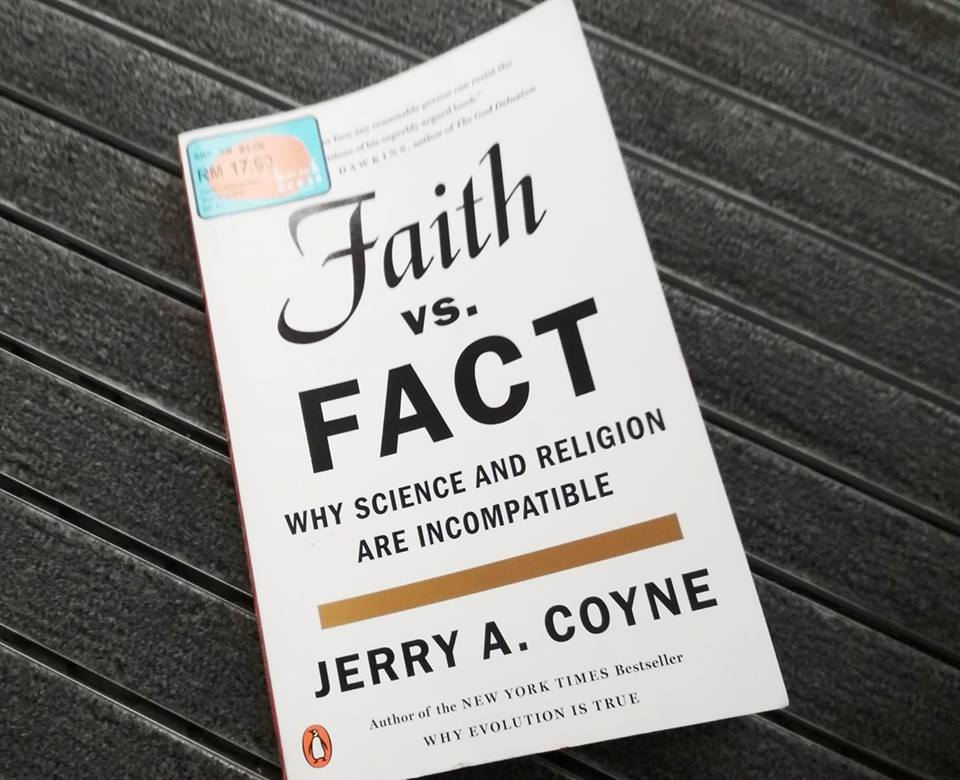
Book Review: Faith versus Fact: Why Science and Religion Are Incompatible (2015)


Faith versus Fact: Why Science and Religion Are Incompatible (2015)
by Jerry A. Coyne

The New Atheist leaders such as Richard Dawkins argues that “it’s hard to see how any reasonable person can resist the conclusions of [Coyne’s] superbly argued book”; and Sam Harris praises Coyne by saying that he “has showing that the honest doubts of science are better – and more noble – than the false certainties of religion.” Jerry Coyne, an evolutionary biologist, author of his first own book Why Evolution is True, argues that “religion and science compete in many ways to describe reality – they both make ‘existence claims’ about what is real – but use different tools to meet this goal… the toolkit of science, based on reason and empirical study, is reliable, while that of religion – including faith, dogma and revelation – is unreliable and leads to incorrect, untestable, or conflicting conclusions. Indeed, by relying on faith rather than evidence, religion renders itself incapable of finding truth.”

In May 1988, a 13-year-old girl named Ashley King was admitted to Phoenix Children’s Hospital by court order. She had a tumour on her leg—an osteogenic sarcoma—that was “larger than a basketball” and was causing her leg to decay while her body started to shut down. Ashley’s Christian parents, however, refused to allow doctors permission to amputate and instead moved their daughter to a Christian Science sanatorium, where, in accordance with the tenets of their faith, “there was no medical care, not even pain medication.” Ashley’s mother and father arranged a collective pray-in to help her recover—to no avail. Three weeks later, she died. Had Ashley received medical care, Coyne writes, she would likely have recovered. The Kings, tried in an Arizona court for negligent homicide, expressed no remorse, pleaded no contest, and were convicted on a lesser charge. They effectively escaped punishment, because their actions were faith-motivated. “Had the Kings been atheists,” Coyne writes, “there was a good chance [Ashley] would have lived.”

One day after Coyne giving a talk on evolution, one of the attendees approached him, shook his hand and said, “Dr. Coyne, I found your evidence for evolution very convincing – but I still don’t believe it.” Coyne was amazed. “How could it be that someone found evidence convincing but was still not convinced?” he writes, “The answer, of course, was that his religion had immunized him against my evidence.” He also highlighted one survey stating that 64% of Americans would retain a religious belief even if science disapproved it (which only 23% would consider changing their belief): “If science contradicts the Bible, I will believe the Bible, not science,” one interviewer responded. Some people, he writes, claiming that science and religion are not in conflict but complimenting one another. But in chapter 3, he shows that accommodationist fails.

Jerry Coyle simply argues – from historical, psychological, philosophical, sociological, historical and mainly from scientific views – that any attempt to make religion compatible with science is doomed to fail. “It is time for us to stop seeing faith as a virtue, and to stop using the term ‘person of faith’ as a compliment.” Either you agree or not with his thesis, if you read this book, your faith will be challenge and your mind will be stimulated… I mean, in a good way. What good if you read a book that doesn’t do these things?

[To help me understand this book, I’ve watched two of his interviews on YouTube entitled “Freedom from Religion” and “Faith vs. Fact”]

THINK BIG. START SMALL. GO DEEP.

Best Blogger Tips

Wednesday, May 17, 2017

Simple Book Review: "The End of Faith: Religion, Terror, and the Future of Reason" (2014)


The End of Faith: Religion, Terror, and the Future of Reason (2004)
by Sam Harris

In this book Sam Harris (one of the very vocal atheists today together with Richard Dawkins in which his book The God Delusion I have read) makes the compelling argument that "human beings can no longer afford the luxury of major religious belief systems." In a world in which we now have the capacity to kill millions of humans at one time, belief systems that are intolerant of non-believers and emphasised life in the hereafter over the present are simply "too dangerous," said Harris.

Harris claims that even moderate members of a religion are to blame for extreme acts committed in the name of their faith, because the moderates help to legitimise the acceptance of beliefs that can be easily used to support violence.

His arguments cut to the heart of the concept of faith itself, and will be unpalatable to many. But Harris does not seem to be advocating a switch to an atheist or even agnostic view (at least in my reading). He is primarily against subscribing to unexamined beliefs. As an alternative, he offers a discussion of a rational, experience-based spirituality.

This is a highly provocative book that offers many important ideas to the debate about the role of religion in modern life.

As Christian, I encourage you to read something else unless you are willing to be challenge by intellectual atheist like Sam Harris. This is a heavy stuff... I recommend you listen/watch his talks on YouTube to begin with.


THINK BIG. START SMALL. GO DEEP.
Best Blogger Tips

They Click it A lot. [Top 7 last 7 Days]