Showing posts with label Future. Show all posts

Monday, March 7, 2022

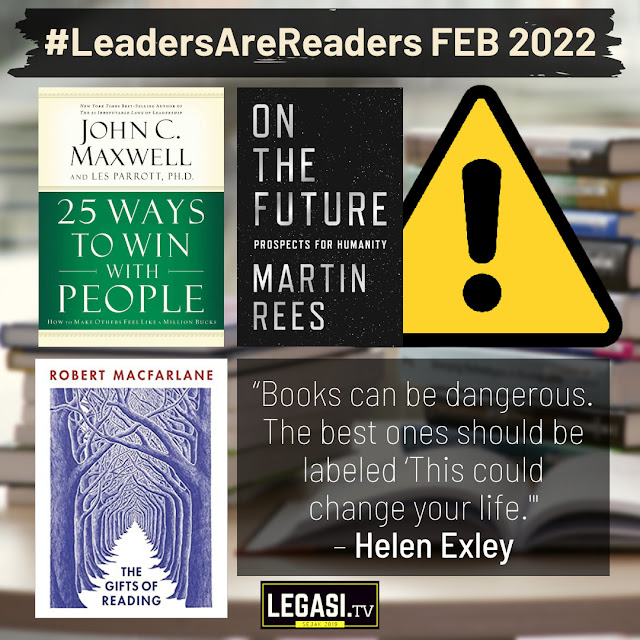
Read Books and Beat the Goldfish! #LeadersAreReaders February 2022

Currently, I’m rereading Chris Bailey’s Hyperfocus (2018). When I went to MPH Bookstore the other day, I saw a new book that interest me by Johann Hari entitled Stolen Focus (2022). But the price is so expensive, RM89.90! I understand the book business is having a hard time nowadays and in the same way, owning physical books and encouraging people to be readers is getting hard too (state libraries and discount bookstores like BookXcess are saviors for bibliophiles). Not that I cannot afford to buy the book but as I browse through the contents - besides having newer research and the author’s unique perspectives - I realize that the challenge of managing attention and focus today is the same as yesterday. No new book can claim that this is a new phenomenon. Thus, I reread Hyperfocus and settle with just listening and watching interviews of Johann Hari online… hoping that soon the State Library will have it available. Lord, have mercy.

Reading a book requires a good deal of attention,” writes Chris Bailey, “and with attention becoming a rare commodity, fewer people can devote themselves to reading without distraction.” Attention is our most limited and constrained resource. According to Microsoft Attention Spans Research Report*, the average human attention span in 2000 is 12 seconds and in 2013, it decreased drastically to 8 seconds (I don’t know how they measure this, but the goldfish have an average attention span of 9 seconds. 1 second longer than the average human!). In today’s fast-paced world of information overload, we’re constantly flooded with social media notifications, text messages, and games. Smartphone users, like you and me, check our devices about 80 to 90 times a day. No wonder we are so distracted. This is one of the reasons for the decline of book-reading culture in Malaysia and the world in general.  We still read but read bits and pieces of information. We have amassed lots of random information but lack actual knowledge, depth, and wisdom. This is not just affecting the overall quality of our work-life (or study-life, if you’re a student) but also the state of our mental health and spirituality.

Therefore, you must cultivate a love for reading books. It helps to train you (or force you, at the beginning) to increase your attention spans. It requires attention and it improves your attention. Jessalyn Lau, from the neuroscience perspective, says: “Reading has been proven to increase your focus, attention span, concentration, and to improve memory.” Perhaps you say you don’t have time to read books. I get what you mean. You have works to do, family to care for, products to promote, etc. But “no time” is a myth. Unless you move at the speed of light and the theory of special relativity applied to you, we all have the same amount of time. It's not about you don’t have time but it's about you MAKE time. We have no problem carving out time for things we want to do. So, take or buy a book that interest you, set an uninterrupted time (10 to 15 minutes for a start) today, turn off or switch your smartphone to silent mode and put it away from your reach, make a cup of hot coffee or tea or chocolate and start reading! Start small but do it frequently. At first, you will still be easily distracted. However, over time it will become a habit. And soon, you will be proud of yourself because you have beat the goldfish attention span record! Congratulation!

*https://www.scribd.com/document/265348695/Microsoft-Attention-Spans-Research-Report  

#ServeToLead #Hyperfocus #AttentionSpans #BeatTheGoldfish #LetsMakeReadingCoolAgain

To read my book reviews of #LeadersAreReaders FEBRUARY 2022, CLICK LINKS below:

1) On the Future: Prospects for Humanity (2018) by Martin Rees https://bit.ly/OnTheFuture

2) The Gift of Reading (2016) by Robert Macfarlane https://bit.ly/MacfarlaneReading 

3) 25 Ways to Win With People (2005) by John C. Maxwell https://bit.ly/25WaysPeople 

4) The Previous book reviews https://bit.ly/1Book1Week 


FB Page: https://facebook.com/LEGASI.tv/                             
Podcast: http://bit.ly/LegasiSpotify                            
YouTube: https://www.youtube.com/c/LEGASItv/                        

THINK BIG. START SMALL. GO DEEP.

Best Blogger Tips

Tuesday, February 22, 2022

On the Future: Prospects for Humanity (2018) by Martin Rees, Book Review

 On the Future: Prospects for Humanity (2018) by Martin Rees

I enjoy watching the YouTube Originals series on The Age of A.I. eight science-documentary episodes covering the ways how Artificial Intelligence is and will change the world in various fields such as robotics, health, food, space travel, relationships, and others. It is narrated and hosted by Robert Downey Jr. with the vibe of Tony Stark’s coolness and humor (actually it is more interesting if J.A.R.V.I.S. or F.R.I.D.A.Y. be the one who narrated the series). I’m always fascinated by how fast we humans have progressed in terms of knowledge, science, and technology. It is both creates excitement and anxiety. When I watched the series, I realize that the producers want to highlight the wonderful positive aspect of A.I. implementations in many areas of our human experiences, but I still can’t help to think realistically (with a mix of negative thinking), of “what if” this or that happened. What if we create evil Ultron with the good intention to protect ourselves? What if there are powerful but bitter people like Magneto who decided to choose only special people like them to survive? What if there are people with the Thanos ideology that in order to bring peace and order there must be wars and necessary sacrifices needed to be made?

These existential questions and more leads me to this book. Martin Rees, an Astronomer Royal, renowned scientist, and futurist, examines the critical issues that will define the future of humanity on earth and beyond. His insights into cutting-edge science and technology and global trends are very helpful. His main argument is that if we approach the future with short-term thinking, polarizing debates, alarmist rhetoric, and pessimism, we are doomed to extinction (my language). But if we take responsibility for the future NOW with long-term thinking, rational discussions, solution-oriented partnership, globally, collectively, and optimistically, we can flourish.
“This book offers some hopes, fears, and conjectures about what lies ahead,” said Martin who doesn’t claim to be a prophet of the future but trying to act like one anyway due to the urgency of the subject at hand. “Surviving this century, and sustaining the long-term future of our ever more vulnerable world, depends on accelerating some technologies, but responsibly restraining others. The governance challenges are huge and daunting.” I agree. As a Christ-follower, I wholeheartedly believe that the future is in the hand of the sovereign God. But from the humanistic perspective, as the author seems to be one (he said he is a ‘cultural Christian.’ It doesn’t matter what he meant, for this book is not a Christian book anyway), the future is in our hands.

Overall,
On the Future is an excellent read. The author’s careful and brief treatments on the issues like nuclear threats, eco-threats, climate change, biotech, cyber technology, human consciousness, robotics, A.I., and spaceflight are both encouraging and alarming for obvious reasons. Of course, a book like this is not without speculations such as the possibilities of our dominion outside our planet (for example, colonization of Mars), and the ongoing search for extraterrestrial intelligence. I find that it is interesting when Martin also discusses the limits and future of science. By the way, I want to share one thing that probably going to spark your interest. This book is published in 2018 and about two years after that, in March 2020, the WHO declared COVID-19 a global pandemic. This is a glimpse of one of Martin’s worst nightmares coming true when he wrote: “Pandemics are an ever-present natural threat, but is it just scaremongering to raise concerns about human-induced risks from bio error or bio terror? Sadly, I don’t think it is. We all know too well that technical expertise doesn’t guarantee balanced rationality. The global village will have its village idiots and they’ll have a global range… Bio error and bio terror are possible in the near term - within ten or fifteen years. And in the longer term, they will be aggravated as it becomes possible to ‘design’ and syntheses viruses - the ‘ultimate’ weapon would combine high lethality with the transmissibility of the common cold.” 10 to 15 years, huh? How about 1-2 years?!

After I finished reading this book, I still have the “what if” questions about the future of humanity from the humanistic perspective. The difference is that I have moved from some (Oh, there are many!) of my ignorance to more informed “what if” question
s.

#ServeToLead #LeadersAreReaders #OnTheFuture #ScienceAndTechnology #LetsMakeReadingCoolAgain

[P. 
s: Two other issues/topics that are important, in my opinion, that should be covered in a book on the future like this one are cryptocurrency and the metaverse. Check it out!]

To read my other book reviews (and articles) based on science, CLICK HERE 


FB Page
: https://facebook.com/LEGASI.tv/                          
Podcast: http://bit.ly/LegasiSpotify                          
YouTube: https://www.youtube.com/c/LEGASItv/                      

THINK BIG. START SMALL. GO DEEP.

Best Blogger Tips

Sunday, October 3, 2021

Unveiling the End Times In Our Time: The Triumph of the Lamb In Revelation (2004) by Adrian Rogers, Somewhat Review


Unveiling the End Times In Our Time: The Triumph of the Lamb In Revelation (2004)
by Adrian Rogers

 Before I became a full-time staff worker, I used to listened to hours of the late Adrian Rogers' sermons when I was working in Kuala Lumpur on the way to work and back using public transportation. I was not a serious Christian, I didn't go to church regularly, and I lived a rebellious lifestyle. I was like sinful king Herod who loved to listen to John the Baptist even though he became greatly disturbed every time he heard him preach (Mark 6:20). But instead of beheading Adrian Rogers, I bought this book to learn more about the Book of Revelation that he passionately preached in a weekly series through the Love Worth Finding radio ministry. I cannot say I was convinced during that time (still skeptical and dabbling with the world philosophies), but it does spark my interest to read the 'weirdest' book of the Bible firsthand.

Fast forward 14 years later(?), I'm rereading this book. Now that I have more knowledge of the Bible, become matured in the faith, have more experience in life, and have a better understanding of our time, I can grasp much more truths taught in this book. Most importantly, the Holy Spirit uses it to open my spiritual eyes to understand the big picture of the Book of Revelation when I read it. I was blind, but now I see! Men of God like Adrian Rogers, David Pawson, Chuck Missler, Tim LaHaye, and John MacArthur have been a great help for me in deciphering the Book of Revelation (learn widely but weigh their teachings wisely). As I look back, I'm amazed how God led me to read this book and be interested in the subject all over again. There are three (3) main reasons: 1) I was researching for my exposition Bible study podcast on Matthew chapter 24 on the end times and suddenly remembered that I have this book somewhere inside a box in my library; 2) Currently, I'm doing an audio recording chapter by chapter on the Book of Revelation in Bahasa Iban, and along the way, questions arise, and so I need to find answers; and 3) When I watch the news of what is happening in the world today like the pandemic, wars, global warming, society breakdown, political chaos, restriction laws, the rise of technology, extreme narcissistic behavior in social media, etc. I cannot help but see signs of Biblical prophecies, particularly in the Book of Revelation, on the end times are being fulfilled before my eyes.

Although I'm concerned and curious about what will happen next, I'm not afraid of the future as a Christ-follower. I know for sure who holds it (the past and the present too!), namely, the sovereign God of the Bible. Some things in the Book of Revelation will remain a mystery to me and will not be known until they are unfolded. But as Adrian Rogers said, the bottom line is this: "Jesus is coming, and I am certain of that and very, very glad. I have resigned from the program committee, and have moved over to the welcoming committee. Even so, come Lord Jesus!" Pastor Rogers writes in straightforward language, clear exposition but not too details, from a devotional point of view, and the outlines - like his sermons - are easy to follow. (For serious study, I recommend reading classic commentaries from e-Sword or Logos Bible apps). At the beginning of the book, Pastor Rogers straightaway tells the reader that he is a "convinced pretribulation premillennialist." I like that. No more guesswork! I haven't decided either to subscribe to premillennialism or amillennialism. No rush. What's more urgent and important is this, our Lord Jesus Christ declares: "Look, I am coming soon, bringing my reward with me to repay all people according to their deeds. I am the Alpha and the Omega, the First and the Last, the Beginning and the End" (Revelation 22:12). Amen! Come, Lord Jesus!


#ServeToLead #GrowingLeaders #LeadersAreReaders #LetsMakeReadingCoolAgain

To read my previous #1Book1Week book reviews, CLICK HERE  

FB Page
: https://facebook.com/LEGASI.tv/                            
Podcast: http://bit.ly/LegasiSpotify             
YouTube: https://www.youtube.com/c/LEGASItv/         

THINK BIG. START SMALL. GO DEEP.


Best Blogger Tips

Sunday, February 28, 2021

A Survey of Bible Doctrine (1972) by Charles Caldwell Ryrie, Book Review


A Survey of Bible Doctrine (1972) by Charles Caldwell Ryrie

When I found this book, there were no covers. I have to make these blue covers by myself 😁 Most seminarian students (I'm not one) and Bible students (I'm one) know or at least have heard about Charles Ryrie (1925–2016). His life and books have influenced many people like Charles Swindoll and John MacArthur. The critical ones will remember him as a dispensationalist only; the learners, however, as a theologian first. Nobody, including me, will agree with everything he writes and teaches. But nobody can deny his contribution of making the written Word of God accessible and understandable through his writings and teachings.

"God intended you to understand what the Bible teaches," encourage Ryrie in the introduction, "This does not mean that you will comprehend all its truths at first reading or even in a lifetime, but it does mean that you can expect to learn a great deal. God used language which He meant to be taken as normally and plainly as the words in this book. So take it that way and assume He means what He said. When a problem arises, look at it again and remember too that God has promised that the Holy Spirit will also help you to understand His truth (John 16:13; 1 Corinthians 2:12)." Before I ever understand that 'normally and plainly' or 'literal interpretation' of the Bible is synonymous with 'dispensationalism' (false assumption), I already believe that, unless otherwise, the Bible MUST be interpreted literally. And so, as I read this book, I have little disagreements (so far) and am very much pleased by his simple but thoughtful interpretation of the Scripture. Keep in mind though that men of God like Ryrie are not infallible and it is idolatry to expect one redeemed-sinner to know it all. Plus, my knowledge is still limited. In fact, my disagreements might be due to my faulty beliefs and ignorance. I'm glad I'm not yet arrived. By God's grace, I'm still growing 🙏 At the end of the day, we must examine everything with and by the Scripture. Sola Scriptura.

Contents: 

1) What Is God Like?

2) Is the Bible Inspired?

3) Jesus Christ the Lord

4) The Holy Spirit

5) The World of Angels

6) The Nature of Man

7) Christ's Salvation

8) What Is the Church?

9) What Does the Future Hold?

To go in-depth, read his later works such as Basic Theology and The Ryrie Study Bible 😊💪⚡ #1Book1Week #ServeToLead #LeadersAreReaders #LetsMakeReadingCoolAgain #CharlesRyrie #BibleDoctrine

FB Page: https://facebook.com/LEGASI.tv/                
Podcast: https://anchor.fm/LEGASI.tv/            
YouTube: https://www.youtube.com/c/LEGASItv/

THINK BIG. START SMALL. GO DEEP.

Best Blogger Tips

Sunday, May 13, 2018

The Secret: What Great Leaders Know And Do (2009) Book Review


The Secret: What Great Leaders Know And Do (2nd Edition 2004, 2009)
by Ken Blanchard and Mark Miller

Am I a serving leader or a self-serving leader? For Ken and Mark, to lead is to serve. The Secret is a well-known international bestseller for a leadership book, and I'm excited to read and review it. Why? The format of this book is easy to read. They presenting major leadership topics in a way that is enjoyable, easy to understand, and applicable. I HIGHLY recommend this book to anyone – especially young people – who aspire to be a great leader. Bottom line: If you want to be a great leader, get this book, read it, and apply it!

Both authors are great teachers and story-tellers. In their fictional character, Debbie Brewster, a young executive, they tell about her journey to become a more effective leader – servant leader. When asked about "What is a leader?" Debbie came out with at least three answers: first, "a leader is the person in charge"; secondly, "a leader is the person in the position that others report to"; third, "a leader is a person who makes things happen." Finally, she settled with this definition: "A leader is a person in a position of authority who is responsible for the results of those under his or her direction." When she met her mentor, Jeff Brown, he explained to her that actually "true leadership has nothing to do with one's level in the organization… great leaders SERVE." A person can serve without leading, but a true leader can't lead well without serving. Throughout many months of mentoring, Jeff explains to Debbie how leader SERVE:

SEE THE FUTURE. "Leadership is about taking people from one place to another. One of the leader's top priorities must be to assure that the team knows where you are headed. Seeing the future is all about creating a compelling vision and is one of the privileges and most serious demands of leaders. It may sometimes be difficult to determine where the enterprise should be heading. But heading somewhere is a must. Envisioning and communicating a future-oriented vision is a huge part of leadership." Keyword is Vision. Vision must be constantly communicated or it will faded in people's minds. What do I want my organization or team or group to accomplish? What would that look like? How would we measure our success? What is our benchmark?

ENGAGE AND DEVELOP OTHERS. "Engage has two distinct components. The first has to do with selection… Getting the right people in the right jobs… [and the second] has to do with the level of buy-in people have for a cause, their work, and a leader. You want to do more than enlist their hands – you want to engage their heads and hearts also… with every pair of hands you hire, you get a free brain." Developing others, on the other hand, is about investing in the development of the people. It involves "creating the expectation for learning and growing; creating training and development opportunities; providing education resources… even mentoring." The keyword is people. What do my people need to be more engaged? How can I help my people grow – as a group and individually?

REINVENT CONTINUOUSLY. "First, great leaders Reinvent Continuously on a personal level. They are always interested in ways to enhance their own knowledge and skills. The very best leaders are learners. They like to read and are always open to training that will help them perform better… if you stop learning, you stop leading"; "The second part of Reinvent Continuously applies with systems and processes. Great leaders are always seeking answers to questions like these: How can we do the work better? How can we do it with fewer errors? How can we do it faster? How can we do it for less?" The keyword is Improvement. Progress is impossible without change.

VALUE RESULTS AND RELATIONSHIPS. Ultimate success always includes both people and performance. "The way to maximize your results as a leader is to have high expectations for both results and relationships. If we can take care of our customers and create a motivating working environment for our people, profits and financial strength are the applause we get for a job well done. You see, success is both results and relationships. It's a proven formula." The keyword is Success. What happens if I overvalue results? What happens if I overvalue relationships? What will be the consequences if I don't broaden my definition of success?

EMBODY THE VALUES. "You must gain the trust of your people. If you don't have their trust, you'll never be a great leader." But what does trust have to do with embodying the values? "All genuine leadership is built on trust. There are many ways to build trust. One way is to live consistently with the values you profess. If I say customers are important, my actions had better support that statement. If I choose to live as if customers are not important, people will have reason to question my trustworthiness. And in the final analysis, if I am deemed untrustworthy by my people, I will not be trusted – or followed as a leader." The keyword is Credibility. What values do I want to drive the behavior of my organization? How can I communicate these values? Which of these values do I need to work on?

Leader SERVE: SEE THE FUTURE, ENGAGE AND DEVELOP OTHERS, REINVENT CONTINUOUSLY, VALUE RESULTS AND RELATIONSHIPS, & EMBODY THE VALUES. As I finished reading this awesome book, I need to ask myself these few reflection questions: What have I learned about leadership from this book? Why does it matter? What do I do with all that I've learned? What am I willing to do today to improve my leadership? What one thing can I put into practice this week? Who can I ask for help? (Mean, who I can ask to mentor me in leadership and personal development?). Last month I've read The Heart of Leadership by Mark Miller, then this book and currently Great Leaders Grow by Ken and Mark. I've learned tremendously from this series. I've use lessons I learned from The Heart of Leadership to trained young leaders, and I wish to use The Secret for the next leadership training. Buy this book!

THE ULTIMATE QUESTION:
AM I A SERVING LEADER OR A SELF-SERVING LEADER?

Best Blogger Tips

Friday, May 11, 2018

John C. Maxwell on Leadership #16 The Power of Dream


I believe that each of us has a dream placed in the heart. I’m not talking about wanting to win the lottery. That kind of idea comes from a desire to escape our present circumstances, not to pursue a heartfelt dream. I’m talking about a vision deep inside that speaks to the very soul. It’s the thing we were born to do. It draws on our talents and gifts. It appeals to our highest ideals. It sparks our feelings of destiny. It is inseparably linked to our purpose in life. The dream starts us on the success journey.

A dream does many things for us:

§  A dream gives us direction
§  A dream increases our potential
§  A dream helps us prioritize
§  A dream adds value to our work
§  A dream predicts our future

Oliver Wendell Holmes noted, “The great thing in this world is not so much where we are but in what direction we are moving.” This is also one of the great things about having a dream. You can pursue your dream no matter where you are today. And what happened in the past isn’t as important as what lies ahead in the future. As the saying goes, “No matter what a person’s past may have been, his future is spotless.” You can begin pursuing your dream today!

[Taken from Your Road Map for Success: You CAN Get There from Here (2010) by John C. Maxwell. Published by Thomas Nelson]

Dare to dream and act on that dream.

THINK BIG. START SMALL. GO DEEP.
Best Blogger Tips

Sunday, June 4, 2017

Jesus' Leadership #8 Must Felt a Sense of Destiny


Do you sense you were destined to be doing what you are doing? If not, you have not yet found your harmonic C. Jesus said, “I know where I came from and I know where I am going” (John 8:14). Although he may not have known every detail of his journey (or was he? if yes, which part is fully human? If no, which part is fully divine? Mystery), Jesus felt a sense of destiny about his life. When the storm at the sea of Galilea arose that threatened to sink his ship, he slept calmly, knowing it was not his time to die. Even when he was turned over to the authorities, he said to them, “You could have no power over me unless it was given to you from on high” (John 19:11). In other words, it had to be part of the plan.

When you are surrounded by the state of grace where nothing else matters except the feeling you have within yourself that is your intersection with destiny. If our cells contains DNA molecules that determine what we are supposed to look like, isn’t it possible that at some level they also know – and can recognize – what we are supposed to act like? People get emotional goose bumps when something strikes them as a moment of truth and destiny. I believe that your destiny is like a magnet that pulls you – not a brass ring that only goes around once. Jesus felt a sense of destiny.

Do you feel as if you were destined to be doing what you are doing?
What’s it?
THINK BIG. START SMALL. GO DEEP.


Best Blogger Tips

They Click it A lot. [Top 7 last 7 Days]