Showing posts with label Truth. Show all posts

Tuesday, November 28, 2023

The True Jesus: Uncovering the Divinity of Christ in the Gospels (2017) by David Limbaugh, Book Review

 The True Jesus: Uncovering the Divinity of Christ in the Gospels (2017) by David Limbaugh

This is a sequel to Limbaugh's previous book, Finding Jesus In the Old Testament (I've read it but I didn't write a review. Sad). I bought both books from the BookXcess bookstore.* As of writing, our Bible study group is studying the Gospel of Luke, and this week we are going to look at Luke 9:18-20 when Jesus asked His disciples two questions, "Who do the crowds say I am?" (v.18) and most importantly, "Who do you say I am?" (v.20). The first question is an opinion, a survey, or a general inquiry. But the last question is more personal, direct, and life-changing because the answer to the question is not neutral. Everyone must go through C.S. Lewis's famous trilemma: either Jesus is a 'lunatic, liar or Lord' or a 'mad, bad or God' man. No in-between.

Lewis wrote in his classic book Mere Christianity: "You must make your choice. Either this man was, and is, the Son of God, or else a madman or something worse. You can shut him up for a fool, you can spit at him and kill him as a demon or you can fall at his feet and call him Lord and God, but let us not come with any patronizing nonsense about his being a great human teacher. He has not left that open to us. He did not intend to... I have to accept the view that He was and is God." Lewis, the most reluctant convert (but intellectually honest), had made the verdict: Jesus is the Son of God. But, for you (yes, you!), who do you say Jesus is? This book can help you on your faith journey to answer this question for yourself. Here Limbaugh combines the four Gospel records (Matthew, Mark, Luke, and John) into a chronological account of the deeds, words, and life of Jesus Christ. You'll see His humanity and divinity perfectly blended in One Person jump off every page into our hearts.

This book is good for skeptics who want to know the big picture of the Gospel accounts in one volume (although, impatient skeptics might not like it because it's a long book, 353 pages in total). It is also helpful for students of the Word like me to recall and be reminded again about how cool, awesome, and epic our Lord Jesus is (although, this book or any book is pale in comparison to the Gospel accounts themselves). Limbaugh's comments, sound exegesis, and references to other respectable Bible scholars and authors are the best features of this book. "The ultimate goal is not to perfectly reconcile the four accounts," said Limbaugh in his interview with Sean McDowell, "but to inspire people to read the Gospels for themselves, where they will encounter for themselves the living Son of God." Amen.

 *currently out of stock
**btw, there is only one Gospel (not "Gospels") but four accounts

#ServeToLead #LeadersAreReaders #TheTrueJesus #DavidLimbaugh #OneGospelFourAccounts #JesusChrist #LetsMakeReadingCoolAgain

To read my other book reviews/summaries, CLICK HERE

THINK BIG. START SMALL. GO DEEP.

Best Blogger Tips

Saturday, May 6, 2023

What of Those Who Have Never Heard? (1986) by J. Oswald Sanders, Book Review

Whenever someone asked me, "Is Jesus the only way to salvation?" my answer is, "Yes." Jesus said, "I am the Way, and the Truth, and the Life. No one comes to the Father except through Me" (John 14:6). It's not a way or one of the ways but "the Way" and He emphasized on exclusivity,  "No one... except through Me." But what about those who have never heard about Jesus and the Gospel? My initial response is that, except for children and the mentally deficient who are covered by the blood of Jesus, everyone is morally responsible for the light that they have received and for the law written on their hearts through nature, tradition, and conscience (refer to Romans 1-2). So, even if they never heard about Jesus once in their lifetime, on judgment day, they will have no excuse. As for what will happen to them, I say, we can be certain that the God who exhibits His love on the cross will be absolutely fair and that the righteous Judge of all the earth will do right!

Now, where do I get a such conviction? Through the written Word of God, the Scripture, and with the help of books such as this one, that is, by divine revelation (mainly) and critical thinking. I'm all for originality but when it comes to eternal matters, I go to the Author of life and His (flawed yet faithful) saints. J. Oswald Sanders writes this book with compassion, conviction, and clarity. He cares for souls and set out his Biblical position clearly by quoting relevant Scriptural passages with context and supporting them with thoughts from recognized evangelical scholars. He begins not by answering the question directly but first and foremost, with the urgent call of mission and evangelism.
Chapter 1: Why Mission? I love it! If you read books on an important topic like this one only out of curiosity, then, it is of no use. But if it's also out of concern for others, then, it will move you to action. This book is a great tool to do just that.

"If what is written in the foregoing pages is the Scriptural teaching concerning the spiritual condition of the unevangelized heathen - and I see no alternative to believing that it is - then how URGENT is our obligation to make Christ known to all men as speedily as possible. We should throw ourselves into the missionary enterprise with abandon,"
 challenge Mr. Sanders to us, the receivers of God's gracious salvation. A student once asked Charles H. Spurgeon about this very same topic. He answered him very directly, "It is more a question with me whether we who have the Gospel and fail to give it to those who are lost can be saved." Amen.

Note: I would like to recommend another short book that covers this topic but from a different theological perspective (a.k.a. Calvinism), namely, John Piper's
Jesus The Only Way to God: Must You Hear the Gospel to Be Saved? (2010)

#ServeToLead #PreachTheWord #LeadersAreReaders #JesusTheWay #MissionAndEvangelism #GospelOfSalvation #JOswardSanders #LetsMakeReadingCoolAgain

To read my other book reviews/summaries,
 CLICK HERE

THINK BIG. START SMALL. GO DEEP.

Best Blogger Tips

Saturday, November 12, 2022

The Disappearing Act: The Impossible Case of MH370 (Mudlark, 2021) by Florence de Changy, Book Review

I checked the internet, how much can I quote from a book without permission? The answer is various from which sources and publications. On average, less than 300 words is safe, I estimate. Let me take the risk, assume ignorance, and quote this book at length without giving the gist and juice of the book that we - reasonable Malaysians and perhaps the majority of informed people in the world - don't already know: "The key to a successful disappearance is diversion: grab the audience's attention and make them look elsewhere while you execute your sleight of hand. If MH370's 'disappearance' is indeed a sleight of hand on a massive scale, there has been a fantastic simultaneous effort of diversion, and seemingly more than one.

"The world's media has been complicit in the affair, mostly passively, by not questioning enough, and occasionally actively, by spreading unchecked, erroneous, or false information. Public opinion is not and is not supposed to be, that gullible. Everyone knows the MH370 story does not add up. Everyone knows a Boeing 777, possibly the safest plane in the history of civil aviation does not disappear without a trace in one of the most politically sensitive regions of the planet. So rather than being incredible, the official narrative is simply not credible. Yet the idea that we are being blatantly cheated by the governments we are supposed to trust is so uncomfortable and so problematic that, for the sake of our mental comfort, we choose to look elsewhere and welcome any alternative explanation, including one that makes no sense and falsely accuses a decent man of being a mass murderer"
 (Taken from Epilogue: The Disappearing Act, page 345-346)

To quote Ms. Changy again and as she always said in all of her interviews [check YouTube] sometimes casually, sometimes
frustrate, "To me, claiming that Flight MH370 could have disappeared sounded like an insult to human intelligence." I agree wholeheartedly by underlining this phrase in the book with a 1.5mm black ink pen! Reading this book near Malaysia's 15th General Election is adding to my already lack of truth in the government. By the way, I enjoy reading Ms. Changy's 400+ pages of investigative journalism and gripping account of one of the most profound mysteries of the 21st century (although the word 'mystery' is unnecessary because there are people who knew!). I like that she provided as many facts as possible (of course, sometimes I questioned her sources), outline the incident well, explain some alternative scenarios, when into the testimonies of the families of missing passengers, interviewed interesting people, and quite a vast knowledge on current political situations, military arrangements and some aviation technical lingo (which I have to admit my limited comprehension in this area).

As any journalist would do, as much as she wanted to be objective, she is not without personal biases and interpretations. Read this book not with an open mind but with a critical mind. Focus on the obvious and always ask good and right questions. This is one of the lessons I learned from Ms. Changy. Because only with good and right questions we can get answers. Although, with MH370, it may take some time. As my favorite childhood TV series, The X-Files tagline says,
"The truth is out there." Buy this book!

#ServeToLead #LeadersAreReaders #TheDisappearingAct #MH370 #FlorenceDeChangy #CurrentAffair #LetsMakeReadingCoolAgain

To read other articles on reading and book reviews,
CLICK HERE
All things media: https://linktr.ee/LEGASI.tv 

THINK BIG. START SMALL. GO DEEP.

Best Blogger Tips

I Don't Have Enough Faith the Be An Atheist (2004) by Norman L. Geisler & Frank Turek, Book Review

David Limbaugh in his forward writes, "[This book] is the best single book I've seen to prepare believers to give the reasons for their faith, and for skeptics who are open to the truth. This book will serve as an indispensable evangelism tool, especially when dealing with nonbelievers with 'intellectual' obstacles to the faith. As we know, the intellectual obstacles are just an excuse for nonbelievers, but when you remove the substance of their excuse they are left naked to confront their real obstacles, their real demons." I agree with Limbaugh but with the exception that it is NOT "the best single book." There will be new 'intellectual' obstacles ahead of us (although principally "there is nothing new under the sun"), so, we have to always need new, fresh, and better books to tackle future issues with the same effectiveness as this one. Always preparing the way for the Lord and His Word to touch people's lives with the never-changing Gospel. Having said that, for me, this book is one of the best apologetic tools so far (probably next after Josh McDowell's Evidence That Demands a Verdict).

Between the two authors, I'm more familiar with Frank Turek because I subscribed to his podcast and YouTube channel with the same name as this book and frequently listened to his talks and interviews. Norman Geisler, now deceased, is the giant of
apologetic who wrote and co-wrote many amazing books. Together they present the essential information needed for readers either to stand firm in their faith in the God of Christianity or to make a decision to come to the God of Christianity with a reasonable faith. For believers, your faith will be strengthened; for honest seekers, your beliefs will be challenged. Some people will read this book and yet remain an atheist or skeptical but they will have no excuse that they never knew. "One beauty of God's creation is this: if you're not willing to accept Christianity, then you're free to reject it," explain Frank and Norman. "God has provided enough evidence in this life to convince anyone willing to believe, yet he has also left some ambiguity so as not to compel the unwilling." I like that. It is consistent with the character of God that I read in the Bible. No one - especially mine - can claim absolute certainty about anything. Everything requires some amount of faith. Questions such as "Is truth knowable?", "Does God exists?" and, "Is the Bible the Word of God?" even with a fair amount of evidence, in the end, require faith. Vise versa, to reject them also requires faith. But as the book argues, it takes a lot more faith to be a non-Christian than it does to be a Christian.

Let me share
five (5) reasons why I recommend this book (I could share more but, to misquote the Book of Hebrews, "time will not allow me"):

#1 The Logical Flow
 - At the outset, they outline 12 points starting from a general but crucial one "No.1 Truth about reality is knowable." What is truth? Can truth be known? Can truths about God be known? So what? Who cares about truth? Then, they progressively move to the last one "No.12 It is true that the Bible is the Word of God." Is the Bible historically reliable? Who is Jesus? If Jesus is who He said He is, what He taught about the Bible? They begin with general revelation to special revelation.

#2 Not Using the Scripture to Proof the Existence of God
 - In the first 5 out of 12 points, they argue about the existence of a theistic God not by using the Scripture but by science and reason. They use the Cosmological Argument (Beginning of the universe), the Teleological/ Anthropic Argument (Design of the universe, design of life), and the Moral Argument (Moral law). These arguments alone are enough for me to say that "I don't have enough faith to be an atheist"!

#3 Uses History, Philosophy, Logic, and Biblical Theology to Establish Their Arguments
 - For example, when they try to prove that the New Testament is reliable, they do not simply say that "The Bible tells me so" but give evidence from external and internal sources, historical and philosophical supports, logical and theological based. "We came to believe through evidence," they said, "...the fact THAT we are Christians is not the issue: WHY we are Christians is the important point."

#4 Anticipating Counter-Arguments and Answer Them Clearly
 - In the past, I almost lost my faith in Christianity. I figured, if Christianity is false then all religions* must be false too. I don't want to be an agnostic because I think the issue is simple: whether God exists or not. So my next best choice was to be an atheist. When I'm trying to explore the possibility of the non-existence of God, I have lots of questions. Every time I heard or read Christian's positive arguments, I always have counter-arguments or objections. Authors of this book anticipate objections as they presented their arguments. For example, take the case of the reliability of the New Testament again. They know those common objections such as "history cannot be known", "The New Testament documents contain miracles", "The New Testament writers were biased", and "Converted people are not objective" would be in the back of the reader's mind like I was. With vast experience, knowledge, and humility, they answer these common (not all) objections clearly.

#5 Provide More Than Enough Facts
 - To me, three reasonable facts are enough to change my opinions; five strong facts are enough to convince me to reconsider my beliefs; seven undisputed facts are enough to change my mind and make me a convert. Throughout the book every time the authors make a case they always give more than two reasons or facts. For example, in the question of "How do we know the moral law exists?" they give eight compelling reasons. In Chapter 11, they give "The Top Ten Reasons We Know the New Testament Writers Told the Truth" which is also the title of the chapter.

The authors acknowledged that
"evidence alone cannot convince someone to become a Christian. Some atheists and non-Christians may reject Christianity not because the evidence is inadequate but because they don't want to accept it." It seems oversimplified but in the final analysis, it's true. They continue, "Some people choose to suppress the truth rather than live by it. In fact, we humans have a fatal tendency to try to adjust the truth to fit our desires rather than adjusting our desires to fit the truth." Don't do that. This is about your eternal destiny. This book cannot answer ALL your questions. In fact, we will never have ALL the answers anyway. But this book - by God's grace - has more than enough answers to show beyond a reasonable doubt that Christianity is true. The Scripture says: "[If] you confess with your mouth that Jesus is Lord and believe in your heart that God raised him from the dead, you will be saved. For with the heart one believes and is justified, and with the mouth one confesses and is saved." Lord, give the reader enough faith to believe and confess! Amen.

#ServeToLead #LeadersAreReaders #IDontHaveEnoughFaithToBeAnAtheist #FrankTurek #NormanGeisler #Apologetics #LetsMakeReadingCoolAgain

To read other articles on reading and book reviews,
CLICK HERE
All things media: https://linktr.ee/LEGASI.tv 

THINK BIG. START SMALL. GO DEEP.

Best Blogger Tips

The Real Christ: Reevaluating How We See Jesus, According to Scripture (1920, 2020, audiobook) by Reuben A. Torrey, Book Review


Any book by the late R. A. Torrey is worth reading and listening to. Like Charles Spurgeon said about John Bunyan, "His blood is Bibline," meaning to say read anything of his, and you will see that it is almost like reading the Bible itself. In this book, Mr. Torrey desires to portray the real Christ, the Christ of actual fact, in all of His many characteristics and complete love, holiness, zeal, and glory. That portrait is from God’s own Word, the Bible. My favorite chapter is Chapter 8: His Manliness. Here are some quotes that I would like to highlight:

"While Christ was more gentle than the gentlest
 mother, He was at the same time the strongest and most vigorous of all the sons of men."

"To be a true follower of Jesus, one must be a fearless fighter as well as a gentle comforter."

"Remember, meekness is not weakness, and humility is not servility."

"The manliness of our Lord Jesus was manifested in His unhesitating acceptance of torture and agony in order to save others from suffering and ruin, rather than yielding one iota of the truth. Our Lord Jesus could have escaped the cross if He had been willing to compromise with the religious rulers of the day who oppressed the masses. Yes, He could have escaped easily, but He would not. He pursued the path of absolute allegiance to God and His truth though the cross loomed black and threatening in the path. He did not deviate one step in order to avoid the cross."

Chapters on
His Holiness and His Prayerfulness are also very good - and challenging. As I said earlier, any book by R. A. Torrey is worth reading and listening to. You can read the PDF updated version online and listen to the audiobook on YouTube by Aneko Press HERE: https://anekopress.com/product/the-real-christ/ 

#ServeToLead #LeadersAreReaders #TheRealChrist #ReubenATorrey #LetsMakeReadingCoolAgain

To read other articles on reading and book reviews,
CLICK HERE
All things media: https://linktr.ee/LEGASI.tv 

THINK BIG. START SMALL. GO DEEP.

Best Blogger Tips

Friday, February 4, 2022

Cracking Philosophy: You, This Book and 3,000 Years of Thought (2016) by Dr. Martin Cohen, This-Is-Not-A-Review

Why Learning Philosophy Is Important?

In 2014, the late Dr. R.C. Sproul’s book Everyone’s a Theologian was published. He argues that any time we think about God and/or the teaching of the Bible and strive to understand it, we are engaging in theology. “No Christian can avoid theology,” he said, “Every Christian is a theologian. Perhaps not a theologian in the technical or professional sense, but a theologian nevertheless. The issue for Christians is not whether we are going to be theologians but whether we are going to be good theologians or bad ones.” In the same way, I think, everyone is a philosopher. We might not be a formal one or called as one but we are a philosopher nevertheless. If you ask questions or think intentionally about specific problems and ideas or engage with others on particular issues or challenge assumptions and concepts to generate new perspectives, you’re a philosopher (philosophy comes from the Greek roots Philo- meaning “love” and Sophos- meaning “wisdom” and so is defined as “the love of wisdom”). If you philosophized, then, you’re doing philosophy. Or to put it generally, no one can avoid it because everyone has a life philosophy. However, in the same way, similar to what Dr. Sproul said about being a theologian, the issue is whether we are going to be good philosophers or bad ones.

There are many things in life - or the universe, seen and unseen - that are yet to be discovered. As Christ-follower and Bible-believer, the essentials like who is the living God are already settled in my mind and heart. Faith in Him triumphs all my doubts about Him (see, I’m philosophizing here). Unashamedly, I’m very close-minded in this matter. But in almost everything else, I remain curious and open-minded. That’s why I love science because science is about discovery. Yet it has its limit. As scientific knowledge and discoveries grow rapidly, it is impossible to know what to do with them without reflecting on what they mean to us and how to use them for the greater good rather than for self-destruction (as predicted by Ultron in MCU’s 2015 Avengers movie). From the humanistic perspective, answers to all these questions depend on what conception we have of ourselves as human beings and what we think that means for the best way to live. None of these issues are questions for science but for philosophy (I wanted to write “philosophy and theology” but I’m still struggling with the relation between these two. But to limit the scope of this short article and to show the importance of philosophy, l will just focus on one). Science gives us facts but philosophy gives us reasons. Science can create robots but philosophy makes us humans. Science deals with cause and effect but philosophy deals with ethics.

Again, everyone is a philosopher. So don’t be a bad one. Learn and study philosophy. Of course, not everything can be solved by philosophy (in fact, sometimes it can make things more complicated) but since we are philosophized about everything anyway, why don’t be a better one at that? Philip Strokes, author of Philosophy 100 Essential Thinkers, says it best in the introduction of his book: “Since philosophers are engaged in exploring every avenue of thought, it should cause no surprise that many of their conclusions strike us as unacceptable in some way or another. At least one of the merits of such work is that it can indicate what we should NOT believe. But it should be equally appreciated that the conclusions of philosophers have also had profound effects.” Yes, the ripple effects of philosophy from the dawn of civilization to the present day cannot be undervalued and overlooked. That’s why I appreciate Dr. Martin Cohen’s Cracking Philosophy very much. He provides a good introduction to the subject in a very easy-to-read format (I do not imply that it is easy to understand though), written in somewhat chronological order and filled with amazing illustrations from start to end. I have to admit that I’m not good at remembering the terms and names mentioned in the book. So Google and Index are my constant companions. The 3,000 years of the history of thought is divided into ten (10) chapters, namely:

  1. Mysteries and Wondering: Where It All Started - The First Philosophers
  2. The Golden Age of Philosophy
  3. Seeking Wisdom Through God
  4. The Renaissance and the Triumph of Reason
  5. Enlightenment, Philosophy, and the Rise of Science
  6. Sniffing Out Empiricism with Locke, Berkeley, and Hume
  7. Capitalism and the Rational Man
  8. A Fork in the Road: Philosophies of Romanticism and Human Striving
  9. Language, Truth, and Logic
  10. Beyond Science: Philosophers Still Searching for Wisdom

☕ #ServeToLead #LeadersAreReaders #EveryoneIsAPhilosopher #CrackingPhilosophy #LetsMakeReadingCoolAgain

To read my other book reviews, CLICK HERE

FB Page: https://facebook.com/LEGASI.tv/                      
Podcast: http://bit.ly/LegasiSpotify                       
YouTube: https://www.youtube.com/c/LEGASItv/                   

THINK BIG. START SMALL. GO DEEP.
Best Blogger Tips

Sunday, January 2, 2022

The Message of 2 Timothy: Guard the Gospel (1973, 1984) by John R. W. Stott, Book Review

The Message of 2 Timothy: Guard the Gospel (1973, 1984) by John R. W. Stott
 

“During the gestation of this book, I seem to have lived inside this second letter of Paul to Timothy. In imagination I have sat down beside Timothy and have tried myself to hear and heed this final charge from the aging apostle,” writes John Stott in the introduction. As for me, I imagine myself sitting down under the teachings of ‘Uncle’ Stott (1921-2011) as I read this commentary and take notes of his excellent exposition of the words of God in 2 Timothy. He also writes, “I have been impressed afresh by the timeliness for today what the apostle writes, especially for young Christian leaders. For our era too is one of theological and moral confusion, even of apostasy. And the apostle summons us, as he summoned Timothy, to be strong, brave, and steadfast.” Stott was 51 years old when he writes this and surely he had witnessed many ups and downs of Christianity in Europe particularly and the world generally during the five decades of his life. If it was true about 49 years ago when this commentary was originally published, how truer it is today!

He continues, “The words which crystallize the letter for me are the two little monosyllables su de (‘but as for you’), which occur four times. Timothy is called to be different. He is not to yield to the pressures of public opinion or conform to the spirit of his age, but rather to stand firm in the truth and the righteousness of God. In my judgment, nothing is more needed by Christians in today’s world and church than this same courage.” I couldn’t agree more. A call to be different is not a call to be a weirdo or taking it as merely a motivational talk. It’s about to be different from the world who don’t know the truth, the false teachers who distort the truth, and the unfaithful who neglect the truth. It’s about guarding and standing firm in the truth of the gospel. “Hold on to the pattern of wholesome teaching you learned from me - a pattern shaped by the faith and love that you have in Christ Jesus,” remind the apostle Paul to Timothy when he was in prison in Rome waiting for his death sentence (see 4:6), Through the power of the Holy Spirit who lives within us, carefully guard the precious truth that has been entrusted to you (2 Timothy 1:13-14). When I decided to accept God’s calling for me to enter the full-time student ministry about a decade ago, 2 Timothy is where I always go to draw encouragement from, to remind me of the mission, and to be a solid foundation for me to stand firm in the truth. My life verse - and not surprisingly, the purpose for LEGASI.tv ministry - to “Preach the Word” is taken from 2 Timothy 4:2.

In the previous article, I already shared why The Bible Speaks Today is one of the best expository ‘commentaries’ series out there and how to use it [CLICK HERE to read]. But here I would like to zero in and declare with no apology that John Stott’s The Message of 2 Timothy is one of the best and important books in this series. I highly recommend this book to every Christian minister, especially the young leaders, who aspire to serve God in this high risk but also high reward calling in their lives. Stories of fallen ‘celebrity’ preachers nowadays shouldn’t be a surprise for us. In fact, Paul has warned us about this and more in 2 Timothy 3:1-9 and 4:3-4. Thus, we all have the potential to be in the statistic. We must with all our might and rely on God’s grace to “fully carry out the ministry God has given [us]” (2 Timothy 4:5, bracket mine) faithfully till the end. I think (although I cannot confirm with surety) the late Dr. John Stott end his ministry well. Paul’s statement can be his’ and ours’ in the near future: “I have fought the good fight, I have finished the race, and I have remained faithful” (2 Timothy 4:7). Amen 😉✌💡

#ServeToLead #GrowingLeaders #LeadersAreReaders #JohnStott
#BibleCommentary #LetsMakeReadingCoolAgain

To read my other #1Book1Week book reviews, CLICK HERE

FB Page
: https://facebook.com/LEGASI.tv/                                    
Podcast: http://bit.ly/LegasiSpotify                     
YouTube: https://www.youtube.com/c/LEGASItv/                 

THINK BIG. START SMALL. GO DEEP.

Best Blogger Tips

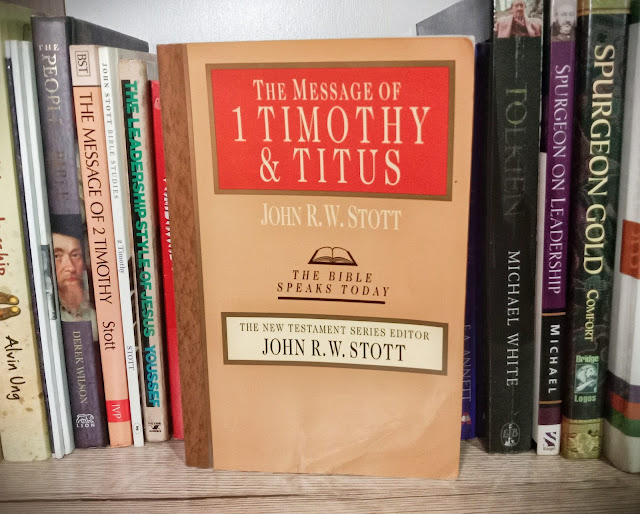
The Message of 1 Timothy & Titus: Guard the Truth (1996) by John R. W. Stott, Not A Review

The Message of 1 Timothy & Titus: Guard the Truth (1996) by John R. W. Stott
 
At first, I wanted to reread John Stott's excellent commentary on 2 Timothy because I thought it is a fitting book for me to end the year well. But when I realized that I haven't read commentary on 1 Timothy & Titus entirely, I should go for this one instead. This decision proved to be profitable and timely! Praise God. Why do I think reading good Bible commentaries is important? On the back cover of every J.C. Ryle's Expository Thoughts on the gospels says this gem of wisdom: "If the best way to understand the Christian Faith is to read the Gospels, then the next books in order of importance have to be those which aid in the understanding of those Gospels." I find that this is also true for the pastoral letters or epistles such as 1, 2 Timothy & Titus. The best way to know the truth is to read these sacred letters firsthand. The next best is to read good commentaries about them.

I love to read commentaries written by the late Dr. John R. W. Stott (1921-2011) especially on The Sermon on the Mount, Romans, and 2 Timothy. His books such as Basic Christianity, Your Mind Matters, and The Preacher's Portrait also plays a significant role in shaping my Christian faith, mind, and calling. I'm forever grateful for Uncle John's ministry! To come back to his commentaries, I find that Dr. Stott is clear in his expositions, balanced in his teachings, and faithful to the evangelical beliefs. They are both scholarly and yet readable. One very helpful feature that I like the most is that, when Dr. Stott comes to difficult or controversial passages of the pastoral letters (such as on slavery, sexual roles in the church, government, etc.), he will take extra care to outline and explain other major different interpretations before he proceeds to the most probable one with sound Biblical arguments* and applications. If you want to read Bible commentaries or looking for references to prepare for your sermon and Bible study, I fully recommend The Bible Speaks Today Series published by Inter-Varsity Press (IVP). Simply one of the best!

Before I end (sorry, this is NOT a book review after all), let me share how I use a Bible commentary like this one for all its worth. First, I will try to read 1 Timothy & Titus from at least 2 to 3 Bible translations. I read from the New Living Translation (NLT), the English Standard Version (ESV), and the JB Phillips New Testament (PHILLIPS is actually a paraphrase). This first step is important because you need to be familiarized with the Scriptures before you study the Scriptures. By the way, keep in mind that the new edition of The Bible Speaks Today Series is using the New International Version (NIV) as the main translation. Secondly, always bring the Bible with you as you read through the commentary. The reason being is that when you read something that sparks your interest or speaks to you, you need to 'see' it in the pages of the Bible for yourself. This is not just good for memorization but also good for your faith and trust in the written Word of God. Finally, share what you have learned with as many people as possible through your social media, during Bible studies, when you give counsel to others, etc. If you read, you learn once. If you read and teach, you will learn twice. If you read, teach and live it, it will be part of your life 😉✌💡

#ServeToLead #GrowingLeaders #LeadersAreReaders #JohnStott #BibleCommentary #LetsMakeReadingCoolAgain


To read my other
#1Book1Week book reviews, CLICK HERE

FB Page
: https://facebook.com/LEGASI.tv/                                    
Podcast: http://bit.ly/LegasiSpotify                     
YouTube: https://www.youtube.com/c/LEGASItv/                 

THINK BIG. START SMALL. GO DEEP.

Best Blogger Tips

Thursday, December 2, 2021

I Believe In The Holy Spirit (1965) by Maynard James, Book Review

 I Believe In The Holy Spirit (1965) by Maynard James

A good and sound Biblical book on the Holy Spirit is very hard to find. There are chapters on the subject in my systematic theology textbooks but it is either too technical or too Western-minded to appreciate the personality and work of the Holy Spirit in all phases of human life. And most of the popular modern-day books on the subject are very shallow and too self-centered (and sometimes heretics!) for me to take their words seriously. I agree with Norman P. Grubb in his foreword when he writes: "The range and aptness of [Maynard James'] Biblical references, the breadth and scope of his quotations from theological authors through the centuries, and the pungency of his facts and illustrations collected from all kinds of courses, grip my attention." Yes, it sure did grip my attention too! I opened my Bible as much as I turned the pages of this book as I read it.

In my observation, there is a good steady development in the interest of honoring the most neglected person in the Trinity, namely, the Holy Spirit today - even this year. For example, in October 2021, The Reformed Seminary of Latin America have organized a 6-day virtual conference The Person & Ministry of the Holy Spirit (I've watched most of the sermons on YouTube). Also, there was a 2-day Holy Spirit: Mantles conference held on January 2021 organized by Project ETV by well-known Charismatic preachers. Again, since last year, a popular pastor, Philip Mantofa, has made "Holy Spirit, My Best Friend" tagline known in both Indonesian and Malaysian churches through his book, song, and sermon series. For all of this exposure to bring awareness to God the Spirit (although we must acknowledge there are weird and false teachings out there), we should be deeply thankful. But overall, to the church worldwide, the reality of the person of the Holy Spirit remains neglected down the centuries until today. This is, as the author would call it, "The sin of neglect." I'm guilty of this sin too.

"It has been pointed out that the Holy Spirit is directly mentioned not less than 86 times in the Old Testament and at least 261 times in the New Testament," explained Maynard. "Some Christians would be quite surprised if told that 25 different names or titles are given to the Holy Spirit in the Scriptures." Here are just ten names: The Spirit of Holiness (Romans 1:4), The Eternal Spirit (Hebrews 9:14), The Spirit of Christ (Romans 8:9), The Spirit of Life (Romans 8:2), The Spirit of Truth (John 14:1, 17), The Spirit of Grace (Hebrews 10:29), The Spirit of Adoption (Romans 8:15), The Promise of the Father (Acts 1:4), The Comforter (John 14:26), and The Spirit of Glory (1 Peter 4:14). Needless to say, the Holy Spirit is a prominent character in the Scriptures and just because He is called the Third Person of the Trinity, it doesn't mean that He is the third in terms of importance. The Holy Spirit is coequal and coeternal with the Father and the Son. Maynard has done a good job explaining in each chapter the matchless operations of the Holy Spirit in the creation, the written Word, the incarnate Word, and the human experience. He also discusses the sanctifying power, the gracious regeneration miracle, the three baptisms*, the emblems or symbols, and the gifts of the Spirit. I find that anecdotes that he used to illustrate his points are very helpful and not as annoying as some books that always make themselves the heroes of the story!

I can sense that the author was trying his best to be as balanced in his judgment and theology as possible. But a book on this subject - often gets the critical treatments by the Reformed, often misrepresented by the Charismatic, often treated mystically by the Catholic - will always arouse internal debate among the well-meaning Christians. For sure, I have some disagreements with the author who (but not mentioned directly) comes from the Pentecostal-Charismatic movement background and is thus biased especially in his assessments involving the gifts of the Spirit and his understanding of Spirit baptism(s). I believe in both but differ from some of his interpretations. Let's say, I have my own biases. Other than that, I'm very pleased and edified by the book. Surely, both of us would agree with Charles H. Spurgeon: “Without the Spirit of God, we can do nothing. We are as ships without wind. We are useless.” Amen!

#ServeToLead #PreachTheWord #LeadersAreReaders #GrowingLeaders #TheHolySpirit #TheTrinity #LetsMakeReadingCoolAgain

To read my other #1Book1Week book reviews, CLICK HERE

FB Page
: https://facebook.com/LEGASI.tv/                                  
Podcast: http://bit.ly/LegasiSpotify                   
YouTube: https://www.youtube.com/c/LEGASItv/               

THINK BIG. START SMALL. GO DEEP.

Best Blogger Tips

Saturday, November 20, 2021

The Corinthian Agenda (1982, 2004) by Michael Green, Summary-Review

 The Corinthian Agenda (1982, 2004) by Michael Green

“The apostle
[Paul]’s love for his wayward church at Corinth is very obvious,” concludes the late Dr. Michael Green, an author, evangelist, and theologian. “He had after all found it. He had visited them at considerable inconvenience on numerous occasions. He had poured out his heart in letters to them and sent colleagues to help them. They were very dear to him. And yet, like any good father, he has to correct their failures and weaknesses. I am thankful he did. For what he has to say is of enormous value for the contemporary church, if only we will heed it.” I agree. God’s church in Corinth was very privileged in the early New Testament times. Paul testified: “I always thank my God for you and for the gracious gifts He has given you, now that you belong to Christ Jesus. Through Him, God has enriched your church in every way…” and “you have every spiritual gift you need…” (1 Corinthians 1:4-5, 7).

But with all of these gifts, it doesn’t guarantee that the church is all well. The issues within the church in Corinth were very serious and yet it is a blessing for us today. Why? Because without them, we won’t know how to think theologically and handle practically based on the Scripture the same issues facing the church today! So we should thank God for using Paul to give us these two sacred letters - 1 and 2 Corinthians. These letters (the scholars suggest that perhaps Paul have written at least three or four letters to the Corinthians, two of them completely or partially lost) are a remarkable record of the relations “between the greatest of church planters and one of the most influential communities [Paul] founded and cared for.” In the period of reading this book, I also took time to read 1 & 2 Corinthians in the New Living Translation (NLT) and listened to audio Bible in King James Version (KJV) read by the legendary voice of Alexander Scourby. In this way, I can get the most from the Scripture and the book. I recommend this practice especially if you’re reading Bible commentary!

In this book, Michael Green (1930 - 2019) selected some very important issues or major themes and devoted a short chapter for each. This is not a verse by verse commentary but the author just wants to show how “Paul speaks directly to us over a broad range of issues in the Christian life, and speaks with an incisiveness, clarity, and authority that are rare.” There are 3 parts (The Church, The Members & Authority) and 17 short chapters on Mission, Baptism, The Lord’s Supper, Body Life, Love, Worship, Prophecy, Intellect, Freedom, Giving, Sex, Suffering, Death, Leaders, Women & Apostles. As you can see, some of these themes are still hot issues nowadays and very much debate between and within the Christian denominational circles. Of course, I don’t agree with everything Dr. Green writes but if I only read books that I agree with, what benefits will I get? For sure, he was very passionate for the word of God, always trying to provide a balanced view on difficult issues, making sure that important points have Scripture references, and aim to be as plain and practical as possible so that we can apply these truths or principles in our everyday life. The Corinthian Agenda (first published as To Corinth with Love) is a good overview of these sacred letters. But if you want to study in-depth I suggest getting a set of 1 & 2 Corinthians MacArthur New Testament Commentary and those from The Bible Speaks Today commentary series.

#ServeToLead #LeadersAreReaders #GrowingLeaders #MichaelGreen #TheCorinthianAgenda #GodsChurch #LetsMakeReadingCoolAgain

To read my other #1Book1Week book reviews, CLICK HERE

FB Page: https://facebook.com/LEGASI.tv/                                 
Podcast: http://bit.ly/LegasiSpotify                  
YouTube: https://www.youtube.com/c/LEGASItv/              

THINK BIG. START SMALL. GO DEEP.

Best Blogger Tips

Tuesday, November 2, 2021

Charles Spurgeon: The Prince of Preachers (1988) by J. C. Carlile, Book Review

 Charles Spurgeon: The Prince of Preachers (1988) by J. C. Carlile
An edited and abridged version, 1997, by Dan Harmon

Once in a while, when I thought that I’ve done so many works and sacrifices for the Lord in my own small, faulty, ignorance perspective, and craving for people’s appreciation and attention, I will think of two mortal men who will have none of these and puts me - and all of us - to shame. First, the indisputable apostle Paul. “For I have worked harder than any of the other apostles; yet it was not I but God who was working through me by his grace” (1 Corinthians 15:10). And secondly, Charles Haddon Spurgeon. He was called to be a preacher when he was 16 years old. It was recorded that in his entire life he preached nearly 3,600 sermons (“The collected sermons filled 63 volumes equivalent to the 27 volume ninth edition of Encyclopedia Britannica,” observes John Piper), and published 49 volumes of commentaries, sayings, illustrations, and devotions. Every week he preached 4 to 10 times, read 6 meaty books, revised sermons for publication, lectured, edited a monthly magazine, and in his spare time, he wrote about 150 books! Not to mention, he shepherded about 6,000 church members (legend says that he knew all members by name), founded and directed a theological college, an orphanage, and oversaw 66 Christian charities.* Remember too, he was a family man with a godly wife and a healthy relationship with all his children. There are more but I think you get the point.

David Livingstone, a famous missionary, once asked Spurgeon, “How can you accomplish so much in one day?” He replied wittily, “You forget, Mr. Livingstone. There are two of us working.” No doubt, he meant the presence and grace of the living God. Reading the biographies of such godly men and women like Spurgeon is a good reminder for every Christians, especially Christian ministers, to remain faithful to His Word and be productive in doing His works. This book, under the Heroes of the Faith titles from Barbour Publishing, is a good introduction to the life, ministry, and legacy of Charles H. Spurgeon. The story of Spurgeon’s childhood and conversion are very fascinating. He was a very curious boy who love nature and learning. One of his biggest influences in my life is his thirst for knowledge. Mind you, he had no formal theological training [nor being formally ordained as a minister] but he was very well-read in Puritan theology, natural history, and popular literature. This gives me hope because I too don’t have any formal theological training (Spurgeon wrote to his father who urged him to apply for college, “You know what my style is. I fancy it is not very collegelike.” Fist bump! Although, this is not an excuse if you need one) and also a sense of unworthiness because Spurgeon is Spurgeon and he is one of a kind (to compare oneself with Spurgeon is to compare a kitten with a lion). The book outlines various aspects of his life including his development as a preacher, minister, writer, educator, and defender of the Truth. A special chapter on his belief in Calvinism is also very interesting. He famously declared: “I am never ashamed to avow myself a Calvinist; I do not hesitate to take the name of Baptist; but if I am asked what is my creed, I reply – It is Jesus Christ.”

But not all of Spurgeon’s life was bright and sunny. He shared his portion of Christ’s suffering, betrayal of friends, physical pain, and emotional depression especially due to the tragic fire incident at Surrey Gardens Music Hall and the energy-sapping ‘Downgrade’ controversy (R.J. Sheehan’s C.H. Spurgeon and the Modern Church, 1985, is an excellent short book to know more about this great battle). At the end of the day, Spurgeon is still a mortal man with flaws, and very much in need of the Saviour like the rest of us. Only by God’s grace, Spurgeon was used by Him mightily. I’m thankful for Spurgeon’s service and praise God forever. As the apostle Paul puts it: “It was not I but God who was working through me by his grace.” Amen!

#ServeToLead #PreachTheWord #LeadersAreReaders #LetsMakeReadingCoolAgain #CharlesHSpurgeon #PrinceOfPreacher #ChristianBiography

Here are a few other related #1Book1Week reviews:

1) Spurgeon on Leadership (2010) by Larry J. Michael, CLICK HERE

2) C. H. Spurgeon and the Modern Church: Lessons for Today from the ‘Downgrade’ Controversy (1985) by R.J. Sheehan, CLICK HERE

3) Words of Counsel: For All Leaders, Teachers, and Evangelists (Updated 2018) by Charles H. Spurgeon, CLICK HERE

FB Page: https://facebook.com/LEGASI.tv/                                
Podcast: http://bit.ly/LegasiSpotify                 
YouTube: https://www.youtube.com/c/LEGASItv/              

THINK BIG. START SMALL. GO DEEP.


Best Blogger Tips

Wednesday, September 8, 2021

The Blind Evangelist Who Sees! (China: Chang Shen) #PersecutedChurch

Before his conversion, Chang Shen had been known as a gambler, womanizer, and thief. When he was stricken blind in midlife, neighbors said it was the judgment of the gods for his evil doings. But everything changed when he heard about Christ for the first time. What happened next?

The story is taken from The Voice of the Martyrs Extreme Devotion Apps.

To watch other stories from this series, CLICK HERE https://bit.ly/LegasiPersecutedChurch


FB Page: https://facebook.com/LEGASI.tv/                        
Podcast: http://bit.ly/LegasiSpotify          
YouTube: https://www.youtube.com/c/LEGASItv/      

THINK BIG. START SMALL. GO DEEP.


Best Blogger Tips

Romans 1:28-32 The Breakdown of Human Society (#LetterToTheRomans)

As I observe the current world events and study the Word of God, especially Romans 1, I see the inevitable breakdown of human society. As we move further away from God, we move nearer to our self-destruction. More than ever, the wrath of God is revealed from heaven against all ungodliness and unrighteousness of men (see Romans 1:18). The question is, WHY? And is there any hope amidst all of this?

To watch my previous short studies of #LetterToTheRomans, CLICK HERE http://bit.ly/LegasiRomans 


FB Page
: https://facebook.com/LEGASI.tv/                        
Podcast: http://bit.ly/LegasiSpotify          
YouTube: https://www.youtube.com/c/LEGASItv/      

THINK BIG. START SMALL. GO DEEP.


Best Blogger Tips

They Click it A lot. [Top 7 last 7 Days]