Showing posts with label Psychology. Show all posts

Tuesday, June 14, 2022

The Art of the Good Life: 52 Surprising Shortcuts to Happiness, Wealth, and Success (2017) by Rolf Dobelli, Book Review

The Art of the Good Life: 52 Surprising Shortcuts to Happiness, Wealth, and Success (2017) by Rolf Dobelli

This is my second book from Dobelli. I enjoyed the first one, The Art of Thinking Clearly (2013), and since this is marketed as the follow-up book, I expected to have the same enjoyment with this one too (Here lie my many biases. Chief among them is the confirmation bias!). I do, most of the time. What the subtitle called shortcuts are actually Dobelli's "own collection of mental tools designed to build a good life" as he defines it. He derives these tools from classical antiquity to cutting-edge psychological research. As such, these are not original thoughts per se but packed briefly and simply for modern readers and aimed to be as practical as possible for the twenty-first century. The author, an economic philosopher, admits that "these fifty-two intellectual tools may not guarantee you a good life, but they'll give you a fighting chance." I like this kind of honesty.

Here are what I like about this book: 1) Each chapter consists of one main mental tool, with a clear definition or explanation and relatable examples. I think this is why Dobell is a good writer (it was originally written in the German language) because he can make complex concepts and academic journals accessible to common readers like me. Perhaps there are times when he oversimplified things and situations, but hey, these are just tools not laws;
 2) I appreciate Dobelli's openness about his atheism and stoicism. This understanding helps me to see from his point of view and filtered through what I read with my own worldview; and 3) Notes at the end of this book are very useful if I want to explore each tool further. There are references and credits. By the way, I noticed that he loves to quote Warren Buffett, Charles Munger, Bertrand Russell, and Daniel Kahneman. Good thinkers.


Overall, I like it. Although, if you haven't read any book by Dobelli, I recommend you start with
The Art of Thinking Clearly. That book will make you feel - and perhaps actually - smart. You may or may not read this one as a follow-up. I bought this at a massive discount bookstore. The normal price is expensive. So, borrow or find a secondhand one ☕#ServeToLead #LeadersAreReaders #TheArtOfTheGoodLife #LetsMakeReadingCoolAgain

To read my
other book reviews, CLICK HERE 
LEGASI.tv Media: https://linktr.ee/LEGASI.tv    

THINK BIG. START SMALL. GO DEEP.

Best Blogger Tips

Wednesday, January 12, 2022

You TAKE Time, You MAKE Time, You HAVE Time to Read Books #1Book1Week December 2021

According to the Statista website,* the average time spent using the internet in Malaysia in the second and third quarters of 2017 was around 8.45 hours. That’s 35.2% of our existence! No doubt, most of the time spent is for doing works such as research, communications, and promotions (especially when you’re in the social media or IT-related business and marketing). How about time spent on social media? Approximately, the respondents in this survey stated that they used social networking (such as Facebook, Instagram, etc.) sites between 1 to 4 hours per day.

Let’s take the least time, say 1 hour per day of mindless scrolling, and match that with one of the most popular excuses of not reading books
“I don’t have enough time!” (90%) and the answer is: YOU’RE LYING! (I hope that will not turn you off, but instead, it brings positive awareness to your conscious and subconscious mind. But then, who likes to be called a liar???). Ray Bradbury says, “You don’t have to burn books to destroy a culture. Just get people to stop reading them.” Everyone knows reading is a good and crucial habit in personal development, so either you TAKE time to read or you MAKE time to read. The truth is you HAVE the time. Face the book more often than Facebook and you’ll be happier and smarter; The clock is ticking, so cut the TikTok; fight instant gratification and quit Instagram if you must (or if you're not that famous).

Jim Rohn, one of my favorite speakers in the past, said this:
“Reading is essential for those who seek to rise above the ordinary.” It’s not about the number of books you read, it’s about ‘Are you hungry for knowledge?’ I like how Bertolt Brecht puts it: “Hungry man, reach for the book: it is a weapon.” Knowledge is not power. Knowledge is potential power. Knowledge plus action(s) is power. But how to take the right action if you don’t have the right knowledge? Read books. Redeem that precious 1 to 4 hours! #ServeToLead #LeadersAreReaders #LetsMakeReadingCoolAgain

Here are my
#1Book1Week for December 2021 CLICK THE TITLES to read my short comments and/or reviews:

  1. The Message of 1 Timothy & Titus: Guard the Truth (1996) by John R. W. Stott
  2. The Message of 2 Timothy: Guard the Gospel (1973, 1984) by John R. W. Stott
  3. The Man They Crucified: A Portrait of Jesus (1975) by R. T. France
  4. The Wisdom of Psychopaths (2012) by Kevin Dutton

FB Page: https://facebook.com/LEGASI.tv/                     
Podcast: http://bit.ly/LegasiSpotify                      
YouTube: https://www.youtube.com/c/LEGASItv/                  

THINK BIG. START SMALL. GO DEEP.

Best Blogger Tips

Sunday, January 2, 2022

The Wisdom of Psychopaths (2012) by Kevin Dutton, A Short Review

The Wisdom of Psychopaths: What Saints, Spies,
and Serial Killers Can Teach Us About Success
(2012)
by Kevin Dutton, Audiobook

I had just finished listening to this audiobook last week. I'm not sure whether I want to write a proper summary review about it or not. Probably a short one. First, although I'm able to comprehend the big picture of an audiobook (especially on the subjects that are very interesting to me) through listening, I cannot recall the specific juicy quotes or thought-provoking lines unless I have the actual book or ebook to refer to. So, sorry in advance. Secondly, overall this book is stimulating enough (I love psychology!) but the title and subtitle can be misunderstood by those who will never read it. Let me explain.

The word Psychopath in general is negative. The dictionary defines it as a person suffering from a chronic mental disorder with abnormal or violent social behavior. Mad and bad. Then add the word wisdom to it can be very confusing and oxymoron. Plus, "what serial killers can teach us about success" is not helpful either. But once you explore what Kevin Button writes in the book - stories, interviews, theories, research, data - you will start to get why small and control doses of 'good' psychopathic traits as psychologists define it like charming personalities, no fear of failure or risk, cold empathy, hyperfocus, somewhat intelligent and smart (now I'm thinking of my favorite fictional villain, James Moriarty), etc. are useful for us to strive in the world today. At the right place, time and amount, these traits can be very helpful without harming others as some psychopaths do. I remember Kevin Button said that some of the top career choices for 'functional psychopaths' are politicians, entrepreneurs, police, journalist, and even clergy!

Although in general, I enjoy this book, I also have some strong disagreements and dislikes about the author's theories and conclusions. It seems like, without ethical considerations (and clinical help?), someone might use this book as approval for their harmful psychopathic behaviors. From "wisdom" to "destruction." Success at all costs can prove to be a folly determination and serial killers are your worst teachers! Read or listen with care 😉🔍💬 #ServeToLead #LeadersAreReaders #LetsMakeReadingCoolAgain

To read my other #1Book1Week book reviews, CLICK HERE

FB Page: https://facebook.com/LEGASI.tv/                                    
Podcast: http://bit.ly/LegasiSpotify                     
YouTube: https://www.youtube.com/c/LEGASItv/                 

THINK BIG. START SMALL. GO DEEP.

Best Blogger Tips

Sunday, December 5, 2021

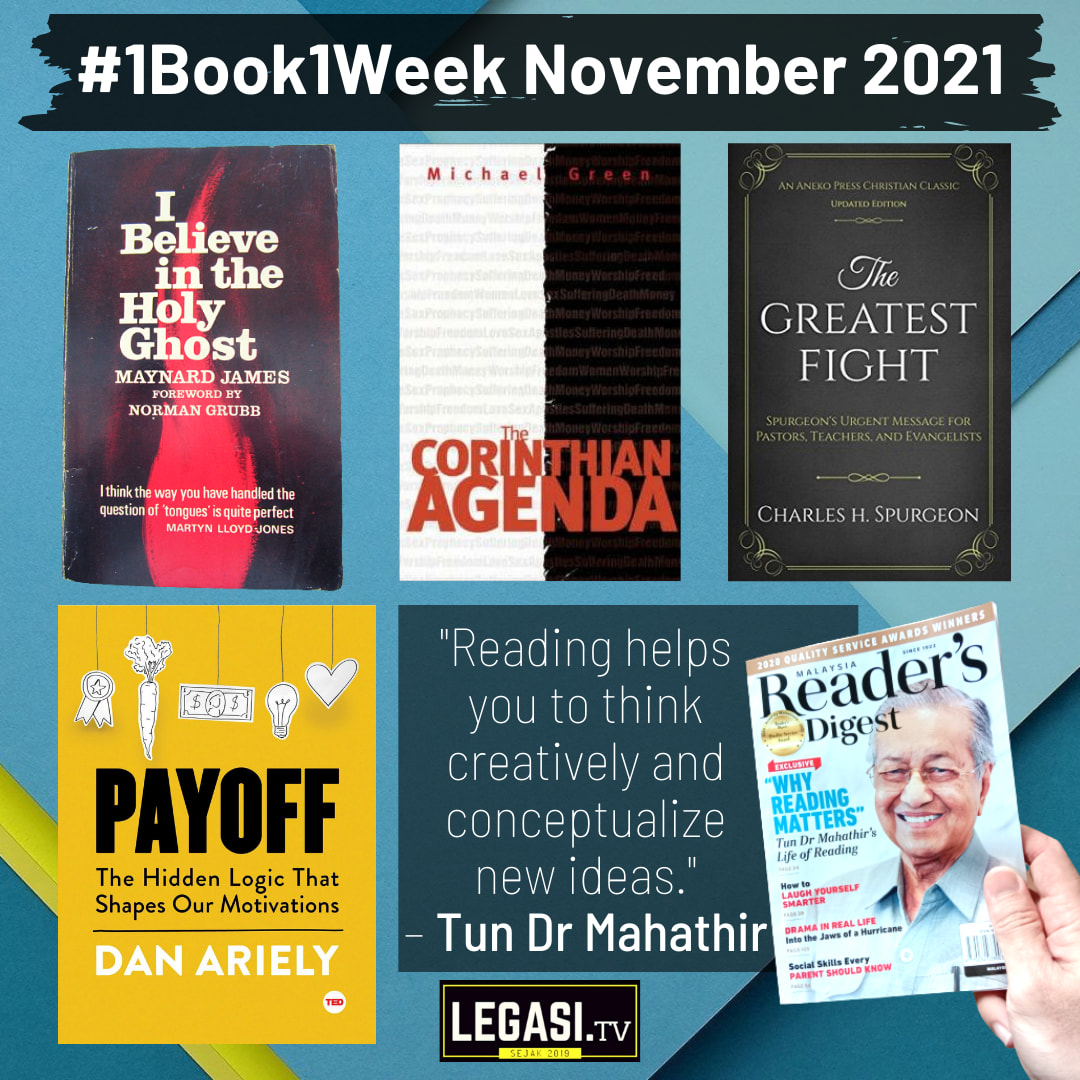
Tun Dr. Mahathir's Life of Reading #November 2021

There are so many things to disagree with Tun Dr. Mahathir Mohamad on politics but the man is a legend. In my opinion, his political stands are questionable yet his passion for the people* is admirable (I think he would be better off if he were to remain as Minister of Education in the previous government instead of being Prime Minister all over again). Set aside politics, which is a very discouraging subject nowadays, one thing that Tun Mahathir influences me the most is his love for reading. "I read books every day," he said during an interview with Reader's Digest for April 2020 cover magazine. He continues: "Reading is acquiring knowledge, and knowledge contributes toward your ability to tackle problems and your relationships with other people." He also said that reading gives him the substance to talk with some degree of authority.

At the age of 96, Tun Mahathir's mental sharpness can put many young people in their 30s to shame (Don't be one of them!). The term for this is 'super-agers' which refers to people in their 80s and above who have cognitive or physical function equal to that of people decades younger. One of the key factors is their lifestyle choices such as having a good habit of reading - and enjoying it. There are at least Five (5) Mental Benefits for seniors who enjoy reading books: 1) Enhancing memory; 2) Sharpening decision-making skills; 3) Delaying onset of Alzheimer’s and Dementia; 4) Reducing stress and anxiety; and 5) Help to sleep better. Well, you don't have to wait for your senior years to cultivate the habit of reading books and reap the benefits, you can start now. Actually, you MUST start now. The earlier the better. "Any time that I am free I read," remarks Tun Mahathir, "I cannot imagine doing nothing." Legend! 

#ServeToLead #PreachTheWord #LeadersAreReaders #GrowingLeaders #WhyReadingMatters #TunDrMahathir #LetsMakeReadingCoolAgain

To read my summary-review of these books for #1Book1Week November 2020, click titles below:

  1.  The Greatest Fight: Spurgeon’s Urgent Message for Pastors, Teachers and Evangelists (2018) by Charles H. Spurgeon
  2. I Believe In The Holy Spirit (1965) by Maynard James
  3. The Corinthian Agenda (1982, 2004) by Michael Green
  4. Payoff: The Hidden Logic That Shapes Our Motivations (2016) by Dan Ariely                            

FB Pagehttps://facebook.com/LEGASI.tv/       
Podcast: http://bit.ly/LegasiSpotify                     
YouTube: https://www.youtube.com/c/LEGASItv/                 

THINK BIG. START SMALL. GO DEEP.

Best Blogger Tips

Thursday, November 18, 2021

Payoff: The Hidden Logic That Shapes Our Motivations (2016) by Dan Ariely, Book Review


Dan Ariely is one of my favorite authors and speakers on behavioral economics, namely, someone who studies the combination of economics and psychology to understand how people decide and why they behave the way they do. I’m an observer. I love to predict people’s behavior and so, this is a fascinating subject to me. I’ve read Predictably Irrational and listened to The Upside of Irrationality and (Dis)Honesty audiobooks - I recommend it all. This short book (just 103 pages) is part of the TED Books series which is a compliment and extension of Ariely’s TED Talks on this subject.

“Human motivation is not simple,” writes Ariely, “but as we understand it more, we’ll better be able to handle ourselves, our work, our relationships, our employers, and our employees. Knowing what drives us and others is an essential step toward enhancing the inherent joy - and minimizing confusion - in our lives.” Every day we try to motivate ourselves. How to create meaning in my current work now? Why I should or shouldn’t quit? What is my end goal? If you’re in the people business or any kind of relationship, surely you spend lots of time trying to motivate others too. How to makes this partnership works? Why does this or that person enjoy life more than others? What are the determining factors of our organization's productivity? These questions and more - if you care enough - are part of our everyday life. As the author puts it: “We are all part-time motivators.” But the problem is that motivations for each person are complex, variant, and subjective. Some are driven by money or achievement or happiness or purpose or a sense of progress or as often the case, a mix of all of these and more. Plus, although Ariely shares valuable insights from the psychological experiments (Bionicles, Origami, and Intel experiments are particularly interesting) that he outlines in the book, we need to keep in mind that real life is not like a lab that we can easily predict but it is both an ugly and beautiful, messy and orderly world. Ariely can be too general and simplistic in his assessments. Keep this in mind as you explore the subject.

Having said that, there are universal and essential motivations that drive human behaviors. For example, a sense of meaning, connection, identity, and individuality. Something simple like giving a compliment or acknowledgment for a job well done can be a strong drive of motivation for most people (on the other hand, it takes a little thing like negative-aggressive feedback can kill even the tiniest motivation!). Some of our conventional wisdom about motivation are also challenged in this book. For example, the idea that giving a large amount of money or bonuses as an incentive, in the long-term, “can backfire and make people less driven.” To know more, read the book or/and watch his TED Talks on YouTube. I also recommend listening to his podcast interviews on Spotify.

#ServeToLead #LeadersAreReaders #GrowingLeaders #MotivationMatters #DanAriely #Psychology #TEDBooks #LetsMakeReadingCoolAgain

To read my other #1Book1Week book reviews, CLICK HERE

FB Page
: https://facebook.com/LEGASI.tv/                                
Podcast: http://bit.ly/LegasiSpotify                 
YouTube: https://www.youtube.com/c/LEGASItv/             

THINK BIG. START SMALL. GO DEEP.

Best Blogger Tips

Sunday, December 13, 2020

Cracking Neuroscience (Cracking Series) by Jon Turney, Not-A-Review


Cracking Neuroscience (Cracking Series) by Jon Turney

If I want to see the greatness of God, I either look at the vast universe or look into the complex brain
. This Cracking series on neuroscience is a good crash-course introduction in the latest scientific knowledge of the workings of the brain 💪 I enjoyed reading Jon Turney's bite-sized chapters (quite wordy as a whole but wonderful graphics makes it doesn't look so) on the field of neuroscience - such as memory, addiction, consciousness, brain waves, mind mapping, etc. - give me the chance to understand the brain, not fully (many things remain a mystery), but enough to be fascinated with it... and a proud owner of one 😉🧠💪

#ServeToLead #GrowingLeader #LeadersAreReaders #LetsMakeReadingCoolAgain #CrackingNeuroscience #BrainPower

FB Page: https://facebook.com/LEGASI.tv/             
Podcast: https://anchor.fm/LEGASI.tv/          
YouTube: http://bit.ly/LEGASItv

THINK BIG. START SMALL. GO DEEP.

Best Blogger Tips

Tuesday, September 1, 2020

The Art of Thinking Clearly (2013) by Rolf Dobelli, 2nd Book Review


The Art of Thinking Clearly (2013) by Rolf Dobelli, 2nd Book Review

I have read this book twice. The first was 4 years ago in 2016 (to read my first review, CLICK HERE). I love this book so much for three main reasons: 1) It’s about thinking; 2) I’m very interested in social psychology and decision-making; and 3) Each chapter is short, concise, and easy to read. It is about cognitive biases, namely, systematic errors in thinking that occur when people are processing and interpreting information in the world around them and affects the decisions and judgments that they make. The bad news is that all of us - even the most self-aware people - cannot avoid all of these biases. But the good news is that we can begin to understand why we do what we do and by deliberate practice - we can make better (not perfect) choices. Dobelli outlines 99 cognitive biases, let me share the top 3 biases, in my opinion, that we always make in our day-to-day thinking:

#1 Confirmation Bias. It is the idea that people seek out information and data that confirms their pre-existing ideas. They tend to ignore contrary information. This can be a very dangerous cognitive bias in business and especially, religion. Let say you just started a business selling Faith Fleur hair serum because your friend says it’s an excellent and the best serum in Malaysia. You post some testimonial pictures on your social media and then a few hours later, you observe (due to the algorithm) that others in your circle of social media also sell the product with very positive testimonies. You thought, “This product is the best!” Is it the best? No. There are other products in the market. Faith Fleur hair serum is a popular, safe, and good product but not the very best there is. Your friend says it’s the best, you believe her, and so you interpret everything based on that existing belief or conviction. As you can see, if you apply that bias in religion, it can be misleading, even dangerous. “The confirmation bias,” writes Dobelli, “is the mother of all misconceptions.”

#2 Groupthink. It is a phenomenon that occurs when a group of individuals reaches a consensus without critical reasoning or evaluation of the consequences or alternatives. Let me give an example in a Christian setting: during a Bible Study on the Book of Romans, the leader expounds the Scripture and concludes that Calvinist doctrines of predestination and election are the most biblical and faithful to the Scripture. When you heard it, you’re skeptical and doubtful. You wanted to respond and ask questions but since almost everyone nodded in agreement, you keep silent. Not wanting you cause division, you suppressed your opinions, and say to yourself, “Oh well, since nobody disagree with him, maybe I’m wrong.” And you say “Amen” all the way. If you want to decide with your friends where to eat for supper (Malaysian culture ma), then subjecting yourself to groupthink is harmless. But when it involves ethics or morals (and eternal consequences), groupthink can be disastrous.   

#3 Halo Effect. Simply put: it is when one trait of a person or thing is used to make an overall judgment of that person or thing. It is also known as the "physical attractiveness stereotype" or the "what is beautiful is a 'good' principle." I love this example by Dobelli: “Dozens of studies have shown that we automatically regard good-looking people are more pleasant, honest, and intelligent. Attractive people also have it easier in their professional lives - and that has nothing to do with the myth of women ‘sleeping their way to the top.’ The effect can even be detected in schools, where teachers unconsciously give good-looking students better grades.” Men, do you accept Facebook friend requests by a stunningly beautiful girl right away even though you never knew her before? Woman, do you think all the BTS members are angels from heaven? (Okay, maybe not all men or women like that). We love to think that we are fair and just, not stereotyping and anti-racism, very kind, and ‘never judge a book by its cover’ but on a subconscious level, we do. We are irrational. Why do anime fans think that Son Goku is the good guy? Because when he died, he has a halo and angel’s wings. Oh, the halo effect dies hard.

I recommend this book for beginners and for those who want to get the big picture of cognitive biases or fallacies. If you want to study deeper, I recommend reading books by Daniel Kahneman’s Thinking, Fast and Slow (haven’t finished it, so no book review yet), Nassim Nicholas Taleb’s The Black Swan (use it as reference), Robert Cialdini’s Influence (my review, CLICK HERE), Dan Ariely’s Predictably Irrational & The Upside of Irrationality (my review, CLICK HERE), and Steven D. Levitt’s Think Like a Freak (my review, CLICK HERE). But before I finished, I’m fully aware of the controversy that Rolf Dobelli is accused of - or actually, showing that - plagiarizing other authors especially his once a good friend, Nassim Nicholas Taleb... I think it’s true.

#1Book1Week #ServeToLead #LeadersAreReaders #LetsMakeReadingCoolAgain #TheArtOfThinkingClearly #SocialPsychology #CognitiveBiases

FB Page: https://facebook.com/LEGASI.tv/         
Podcast: https://anchor.fm/LEGASI.tv/        
Instagram: https://instagram.com/legasi.tv/        
YouTube: http://bit.ly/LEGASItv        

THINK BIG. START SMALL. GO DEEP.


Best Blogger Tips

Saturday, July 4, 2020

Biblical Manhood #4 Must Exercise Self-Control (Part 2)


In the previous video, I said that the fourth characteristic of Biblical manhood is that we must exercise self-control. Here I would like to extend this point by sharing three essential areas that we - as a man - must take care of:

a) Spiritual Stability
b) Emotional Stability
c) Psychological Stability

#ServeToLead #GodlyMan #MustExerciseSelfControl #LEGASIManhood

To watch other videos on #BiblicalManhood CLICK HERE:

1) Becoming A Leader https://youtu.be/s67p9D4jeQc
2) Having A Good Reputation https://youtu.be/cKNTiWard6U
3) Must Be A Faithful Man https://youtu.be/hDOw_gO62PM
4) Must Exercise Self-Control https://youtu.be/2c2k9FBpOvk


THINK BIG. START SMALL. GO DEEP.

Best Blogger Tips

Sunday, September 23, 2018

Influence: The Psychology of Persuasion (2006) by Robert B. Cialdini, Book Review


Influence: The Psychology of Persuasion (2006) by Robert B. Cialdini

This is interesting, Cialdini writes, "What I'm talking about is pre-suasion, directing their minds to the moment before they experience the content. There's this interesting study. A guy goes to a shopping mall in France. And he tries to get women's phone numbers as they pass various shops so he could call for a date. But in neither of those cases was he very successful. He only got a number 13% of the time. But there was one kind of shop that doubled his success rate when women were passing it, a flower shop. Why? Because flowers put women in the mindset of romance." Wow! I love to learn psychology and the human mind. When I listened to Les Brown, my favorite motivational speaker, he had a list of books he recommended. Top 10 on his list was this book, which was a really fascinating and enlightening read. It reminds me why being a skeptic and a cynic sometimes are so valuable and necessary – particularly in today's world.

In my observation, today the word "persuasion," especially in the Christian circles, have a very negative connotation. Sometimes we (wrongly) equate it with "deception" or "intimidation" – but not so. There are principles of persuasion that are both moral and ethical (In Acts 28:23, it is written that Paul "explained and testified about the Kingdom of God and tried to persuade [others] about Jesus from the Scripture." This is not a Christian book, but what I'm trying to say is that there is such a thing as ethical persuasion). In this book, Robert Cialdini, a well-known expert in the field of influence and persuasion, outline 6 Ethical Principles that are helpful not just for sales people but for anyone who wants to become a skilled persuader:

#1 RECIPROCITY. "In many social situations, we pay back what we received from others." When you offer something first, people will feel a sense of indebtedness, which will make them more likely to comply with your subsequent requests. We're deeply wired to be reciprocal. There are three factors that will make this principle more effective: 1) Offer something first – allow them to feel indebted to you; 2) Offer something exclusive – allow them to feel special; 3) Personalize the offer – make sure they know it's from you.

#2 COMMITMENT & CONSISTENCY. "We tend to stick with whatever we've already chosen." We are bombarded with hundreds of choices to make every single day. For convenience, we simply make a single decision and then stick to it for all subsequently related choices. Cialdini suggests three ways to leverage off this principle in sales setting: 1) Ask your customers to start from small actions – so they'll have to stick to it; 2) Encourage public commitments – they'll be less likely to back out; and 3) Reward your customers for investing time and effort in your brand.

#3 SOCIAL PROOF. "We tend to have more trust in things that are popular or endorsed by people that we trust." For examples, we tend to trust more on experts – approval from credible experts in the relevant field; or celebrities – approval or endorsements from celebrities (paid or unpaid); or users – approval from current/past users (ratings, reviews and testimonials); or ‘wisdom of crowds' – approval from large groups of other people; or peers – approval from friends and people you know, etc.

#4 LIKING. "We are more likely to comply with requests made by people we like." That can range from our closest friends to complete strangers that we are attracted to. This explains why we trust word-of-mouth recommendations from our peers, as well as stuff endorsed by our favorite artists. In marketing line, the Liking principle work like these: 1) Physical attractiveness – make your website well-designed, function and suit what you're selling; 2) Similarity – behave like a friend, not a brand. Show them that you can relate to, and understand them; 3) Compliments – have a voice; use social media platforms not to broadcast, but hold intimate conversations and form relationships with your customers; 4) Contact and Cooperation – fight for the same causes as your customers. Nothing builds rapport and closeness like good old-fashioned teamwork; and 5) Conditioning and Association – associate your brands with the same values that you want to communicate and possess.

#5 AUTHORITY. "We follow people who look like they know what they're doing." This holds especially true in fields where we aren't experts. Most headlines utilize this principle by including phrases like "Scientists say", "Experts say" or "Research shows". You can give off the air of authority if you pay attention of these factors: 1) Titles – positions of power/experience; 2) Clothes – superficial cues that signal authority; and 3) Trappings – accessories/indirect cues that accompany authoritative roles

#6 SCARCITY. "We are always drawn to things that are exclusive and hard to come by." We assume that things that are difficult to obtain are usually better than those that are easily available. We link availability to quality. You can learn to trigger your customers' sense of urgency with these methods: 1) Limited-number – item is in short supply and won't be available once it runs out; 2) Limited-time – item is only available during that time period; 3) One-of-a-kind special offers – sometimes utilize one or both of the above techniques. Also from one-off events (e.g. collaborations, anniversaries); and 4) Utilising competitions – our inclination to want things more because other people also want them is often utilized in auctions or bids.

There are lots of good, interesting and memorable examples that Cialdini used to clarify and apply each of the principles in our daily lives. Every principle is so basic that you may not realize that you’re using it all this while or were being used to you. If you're in the marketing business, definitely you have to buy this book. If you're interested in how people think and make decisions – persuading and influencing others – read this book. If you're a leader, this is a book that you must own. Why? Because Robert says, "If leadership, at its most basic, consists of getting things done through others, then persuasion is one of the leader's essential tools."

THINK BIG. START SMALL. GO DEEP.


Best Blogger Tips

They Click it A lot. [Top 7 last 7 Days]