Saturday, April 30, 2022

Tanda Akhir Zaman #3 Kekejian, Kesengsaraan & Penyesatan (Matius 24:15-28)

"Ketika itu," firman Yesus Kristus kepada para murid-Nya tentang akhir zaman, "akan berlaku kesengsaraan yang belum pernah berlaku sejak dunia diciptakan sampai sekarang, dan yang tidak akan pernah berlaku lagi" (Matius 24:21). Bagi orang yang belum menerima keselamatan, ayat ini pasti sangat menakutkan. Tetapi bagi orang yang benar-benar sudah menerima Yesus Kristus sebagai Tuhan dan Juruselamat, iaitu "umat pilihan-Nya" (ayat 22), akhir zaman seharusnya:

1] Memberikan PENGHARAPAN kerana semakin ia memuncak, semakin dekat Yesus akan datang kali kedua; dan 2] Mendorong kita untuk terus BERJAGA-JAGA (24:42) dan SENTIASA BERSEDIA (24:44). Bagaimana nubuat dalam petikan ini sudah digenapi dan akan digenapi secara keseluruhannya? Dengar… #ServeToLead #PreachTheWord #InjilMatius

Untuk mendengar episod ini, KLIK DI SINI Spotify: http://bit.ly/SpotifyMatius167 

FB Page: https://facebook.com/LEGASI.tv/                                
Podcast: http://bit.ly/LegasiSpotify                               
YouTube: https://www.youtube.com/c/LEGASItv/                           

THINK BIG. START SMALL. GO DEEP.

Best Blogger Tips

Very Short Reviews of Michael Green's The Message of Matthew & Larry Chouinard's Matthew NIV Commentary (Why and How to Use Bible Commentary)

 The Message of Matthew: The Kingdom of Heaven (1988, 2000) by Michael Green
& Matthew: The College Press NIV Commentary (1997) by Larry Chouinard

I’ve finished 198 episodes of Bible study on the Gospel according to Matthew (check it out here: http://bit.ly/LegasiSpotify) in the Malaysian language and these two commentaries are very instrumental in helping me to think contextually about some difficult passages in this precious book. I’m biased but I truly believe that the Gospel according to Matthew is perhaps one of the most important books of the New Testament next to the Epistles to the Romans and Hebrews. In it, we have the fullest account of the birth, life, teaching, miracles, death, resurrection, divinity, and humanity of our Lord Jesus the Messiah. It is an excellent continuation after we read and study the Old Testament because the Jewishness of Matthew can be best understood in this context. As the saying attributed to Augustine of Hippo: “The new is in the old concealed; the old is in the new revealed.” Matthew revealed the long-awaited Messiah foretold by the prophets in the Old Testament and expanded by the apostles in the New Testament. Matthew, in short, helps us to see the unity of God’s revelation from beginning to end.

As I have hinted earlier, Matthew is a very Jewish Gospel. This can be a challenging task for interpretation a.k.a. hermeneutics and many like myself - especially my earliest podcast episodes, I realized - probably have missed the mark. Perhaps errors, hopefully not heresies. Yes, getting so familiar with the Old Testament is a great advantage for Biblical backgrounds and theological truths (as another saying goes,
“Scripture interprets Scripture”) but we also need to know the historical insights, textual research, and cultural understandings to bridge the gap between the world of Scripture and our world today. This is where good Bible commentaries are needed. My go-to commentary is always from The Bible Speaks Today series by Inter-Varsity Press. The Message of Matthew (323 pages), the late Dr. Michael Green is the expositor and author. I love this series because each book is characterized by a threefold ideal, namely, 1) To expound the biblical text with accuracy, 2) To relate it to contemporary life, and 3) to be readable. Dr. Green is faithful to these ideals. Plus, he has a vast knowledge of Jewish customs and manners and derives many practical applications from the texts. Larry Chouinard’s Matthew (512 pages), however, was unique in the sense that it is thorough and detailed without being too technical and academic. The Greek words are not distract-full and the footnotes are just essential. Sweet!

Let me end with a word of caution: Don’t read or depend on Bible commentaries more than the Bible itself. Don’t go to it first or second or third… go to the Bible first. Gordon Fee and Douglas Stuart, authors of a classic book,
How to Read the Bible for All It’s Worth, give excellent advice: “You do not begin your Bible study with a commentary… You go to the commentary after you have done your own work; the reason you eventually consult a commentary is to find answers to the content questions that have arisen in your own study.” When I prepare for Bible study, I make sure I’ve read the entire book (e.g. Matthew) first. I read from at least 2 to 3 translations such as ESV, NIV, NLT, AVB, and TB. Then, I meditate on the passage or chapter that I’m working on and come out with rough outlines. I will refer to cross-references, if any, and check by memory for connections. Usually, I have the big picture before I go with the details. Only afterward I will consult commentaries and other tools for second opinion, expertise, verification, correction, background, insights, and wisdom. But if I don’t have the clue (which rarely happens), I will go straight to commentary on the particular verse(s). Good Bible commentaries, if used wisely and properly, will add value to your personal Bible study, teaching, preaching, and even - thinking.

Tip: You can also read (and buy) pocket-size Bible commentaries like William Barclay's The New Daily Study Bible series or Tom Wright's For Everyone series or Warren Wiersbe's BE Series or my favorite, J.C. Ryle's Expository Thoughts series as any normal books. These are easy to read. Read them at your leisure and fill the well of your knowledge. They can be handy if you needed them!

Note: D. A. Carson’s Matthew: The Expositor’s Bible Commentary, John MacArthur’s sermon series on Matthew, and David Pawson's Unlocking the Bible overview also have been valuable resources for me. Thank you, gentlemen!

#ServeToLead #LeadersAreReaders #BibleCommentary #TheGospelOfMatthew #LetsMakeReadingCoolAgain

To read my other reviews on Bible commentary,
CLICK HERE

FB Page: https://facebook.com/LEGASI.tv/                                
Podcast: http://bit.ly/LegasiSpotify                               
YouTube: https://www.youtube.com/c/LEGASItv/                           

THINK BIG. START SMALL. GO DEEP.

Best Blogger Tips

Tuesday, April 12, 2022

The Spirit-Filled Life: Restoring A Biblical Understanding and Experience of the Holy Spirit (1895, 2019) by John MacNeil, Book Review

To listen to the audiobook of this book, go to Aneko Press YouTube Channel


 The Spirit-Filled Life: Restoring A Biblical Understanding 
and Experience of the Holy Spirit (1895, 2019) by John MacNeil

If I want to listen to or read Bible-saturated Christian classics, the first place I go is the Aneko Press website and YouTube. So many good titles, sound authors, and the best is - it’s free! Although it's an old book, the heart of MacNeil’s message is timeless. Aneko Press has done a good job of updating and revising it. This book can be scary to read because it sometimes emphasized heavily the teaching of ‘inner life’ like that of Andrew Murray’s books. In fact, he, Murray, and others were parts of the controversial Higher Life Movement. If not careful, it will make you feel spiritually inferior. But with prayerful reading and Scripture meditating, your eyes will be open to how much God desire for His children to be filled with the Holy Spirit - and to know Him. “The fullness of the Holy Spirit,” writes MacNeil, “is the birthright of every believer.”

The author begins this book by quoting Acts 19:1-2, “Now it happened that while Apollos was in Corinth, Paul passed through the upper country and came to Ephesus, and found some disciples. He said to them, ‘Did you receive the Holy Spirit when you believed?’ And they said to him, ‘On the contrary, we have not even heard if there is a Holy Spirit.’” MacNeil comments on this situation, “Many - oh, so many - of God’s dear children are living on the wrong side of Pentecost, living on the same plane as that on which the disciples were living before they were filled with the Holy Spirit, and thus by their lives they practically make the sad confession, ‘We did not so much as hear whether the Holy Spirit was given or whether there is any Holy Spirit.’” Indeed, this is a sad confession. I have said it before too. Chapter 3: A Command to Be Obeyed; Chapter 4: Something Different from the New Birth; Chapter 7: The Time Between Regenerating and Filling; and Chapter 8: Other Words for Being Filled With the Spirit; are very helpful chapters to understand the distinction between being filled with the Spirit from being born (again) of the Spirit. The Scripture examples and passages that MacNeil used to support his writings are very persuasive. Don’t take it all at face value, of course, but do consider it seriously.

We need to continually be filled with the Holy Spirit (Ephesians 5:18). I find that if I don’t, my spiritual life will be dry. There were times when I preached the Word of God, it was all rhetoric but no power. Bones with no skins. iPhone 13 software with short battery life. At one-third of the book, MacNeil gave a very valuable reminder: “[Be] on guard against desiring such an important blessing from wrong motives. We must seek it for the one supreme reason - the glory of God. If self is at the root of our motives at all, God will most surely block our way to fullness of blessing... there is a need for the refining fire to go through our hearts. God must be Alpha and Omega in the matter. ‘For God’s glory, and for God’s glory alone’ must be our motto as we proceed with our search for the fullness of the Spirit.” Amen. Read it!

#ServeToLead #LeadersAreReaders #TheSpiritFilledLife #TheHolySpirit #LetsMakeReadingCoolAgain

 To read my other - a hundred plus - book reviews, CLICK HERE and all things media https://linktr.ee/LEGASI.tv 


THINK BIG. START SMALL. GO DEEP.

Best Blogger Tips

Sunday, March 27, 2022

Leadership Language: Using Authentic Communication To Drive Results (2018) by Chris Westfall, Book Review

If I read Mr. Westfall rightly, I think the main thesis of this book can be summed up in this statement: "Leadership is about doing the right things for the clients you serve." By "client" he means more than an external client, namely, someone who buys your products and services but also included internal client, namely, someone on your team, broad of director, vendor, supplier, boss, and even your family and friends. In short, someone whom you serve. "Your client is the source of your success," he wrote, "Your ability to deliver results, your ability to generate revenue, your ability to advance in your career, your ability to grow your business - it all comes from your clients." Then he added, "Your personal success - in all aspects of your life, not just in business - hinges on what you create WITH, THROUGH, and FOR OTHERS."

But then, I asked, what does he mean by
 Leadership Language? This illustration helped me a lot: Mr. Westfall asked his super-smart Millennial engineer coaching client from Hungary who can speak five languages, "Erik, why are we speaking English today?" His client said, "Because that's the only language you understand." Erik was speaking Mr. Westfall's language. Leadership language speaks your client's language. A language of words demonstrated in actions, and delivering an impact that can't be denied! Let's say one of my leadership strengths is creativity. This is useless on its own unless I use it to serve my clients. So, I need to think about how can I deliver this strength practically and in my actions. Then, I also need to ask myself, "How can my client be better off from my service?" Putting concepts into action for the clients you serve and the ability to see what the clients need and then deliver it is the path to creating real impact and authentic communication. This is the 'language' that those who follow your lead CAN understand.

This concept of leadership is interesting and essential. Although there are things that I might disagree with and couldn't relate to what Mr. Westfall was communicating (two of them are his simplistic view of human nature and overuse of high-level business examples that I can't relate to), I think overall this is a good book on everyday leadership not just in business. It's an easy read, with very engaging stories and dozens of valuable insights such as
The Ten (10) Leadership Factors that he explains throughout the entire pages of the book. To know more, read this book... Or, like me, borrow it from the library! :)

#ServeToLead #LeadersAreReaders #LeadershipLanguage #LetsMakeReadingCoolAgain

To read my other book reviews, CLICK HERE

FB Page
: https://facebook.com/LEGASI.tv/                               
Podcast: http://bit.ly/LegasiSpotify                              
YouTube: https://www.youtube.com/c/LEGASItv/                          

THINK BIG. START SMALL. GO DEEP.

Best Blogger Tips

Sunday, March 20, 2022

Jesus the Messiah: A Survey of the Life of Christ (1996) by Robert H. Stein, Book Review

 Jesus the Messiah: A Survey of the Life of Christ (1996) by Robert H. Stein

I always carry a book or two in my bag. I wouldn’t feel complete without one. A book to read for personal enjoyment and curiosity always had space. That extra weight never is unnecessary. But not too heavy, of course, so that I can still freely move around with ease. There is a problem when I wanted to read more academic or scholarly books because they usually come with huge volumes (such as N.T. Wright’s Jesus and The Victory of God). Jesus the Messiah is just the right book for me! Not too thick nor too thin. Scholarly and yet suitable for the educated layperson. Readable, sound, and sensible. This book is the result of Robert H. Stein’s career of research and writing on Jesus and the Gospels as a scholar-professor of the New Testament. Stein writes with clarity about the Jesus of the Scripture, the reliability of the Gospels, the reality of the supernatural, and at the same time interacts with a variety of contemporary critical and philosophical biblical scholarship.

There are many features that I like about this book. First, as I already hinted earlier, it is not a boring but interesting book to read as opposed to a much dry writing style written by academics (Although, the first part of this book is quite technical). Secondly, there are very helpful bibliographies at the end of each chapter for the reader to explore further on the subject discussed. Thirdly, Stein begins the book by establishing the methodology for studying the life of Jesus and argues clearly about the necessity of the supernatural approach. “A study of the life of Jesus that excludes the miraculous is destined from the start to produce a Jesus who is an aberration… Attempts to strip the supernatural from Jesus’ life can only produce a Jesus so radically different that he is unrecognizable and his impact on history unexplainable.” I agree! Fourthly, although Stein uses the Christian Gospels of Matthew, Mark, Luke, and John as the primary sources for studying the life of the historical Jesus, he also introduces the reader to the extrabiblical (e.g. apocryphal gospels) and non-Christian sources, which sub-divide into pagan (e.g. Pliny the Younger, Tacitus, and Suetonius) and Jewish (e.g. The Talmud and Josephus). These non-Biblical sources - whether they are accurate or not - are important, in my opinion, because they establish beyond reasonable doubt that Jesus was truly a historical person.

Fifthly, Stein often discusses briefly some possible theories (e.g. Jesus’ crucifixion) before he came to the most probable and biblical one. He also doesn’t hide some difficult passages and problems that sometimes arise from the study (e.g. the chronology of Jesus’ final week). Lastly - this is very important - Stein not only responded to issues and teach with broad knowledge on the subject at hand but he regularly drew some theological lessons and spiritual applications for the readers to think about (e.g. on Jesus’ ethical teaching and the meaning of Jesus’ resurrection). In conclusion, I enjoy reading Jesus the Messiah. I refer to it a lot for my expository teachings on the Gospel of Matthew in my podcast. Fully recommended it! ✔

#ServeToLead #LeadersAreReaders #TheLifeOfJesus #LetsMakeReadingCoolAgain

To read my other book reviews, CLICK HERE

FB Page: https://facebook.com/LEGASI.tv/                              
Podcast: http://bit.ly/LegasiSpotify                             
YouTube: https://www.youtube.com/c/LEGASItv/                         

THINK BIG. START SMALL. GO DEEP.

Best Blogger Tips

Monday, March 7, 2022

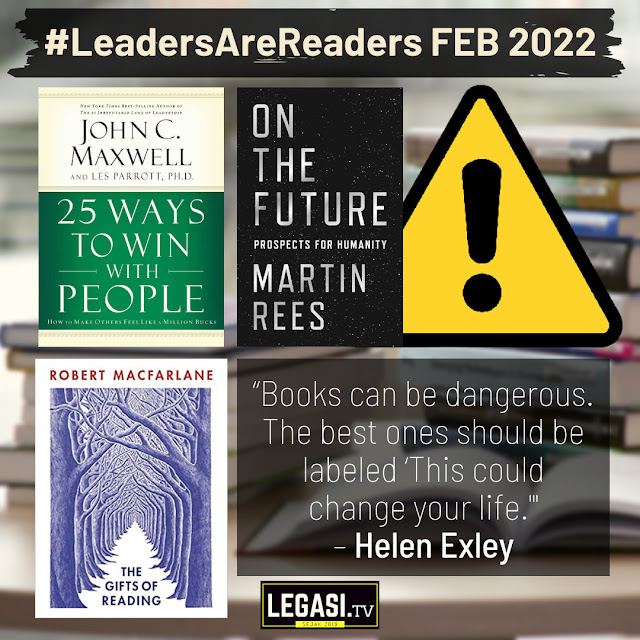
Read Books and Beat the Goldfish! #LeadersAreReaders February 2022

Currently, I’m rereading Chris Bailey’s Hyperfocus (2018). When I went to MPH Bookstore the other day, I saw a new book that interest me by Johann Hari entitled Stolen Focus (2022). But the price is so expensive, RM89.90! I understand the book business is having a hard time nowadays and in the same way, owning physical books and encouraging people to be readers is getting hard too (state libraries and discount bookstores like BookXcess are saviors for bibliophiles). Not that I cannot afford to buy the book but as I browse through the contents - besides having newer research and the author’s unique perspectives - I realize that the challenge of managing attention and focus today is the same as yesterday. No new book can claim that this is a new phenomenon. Thus, I reread Hyperfocus and settle with just listening and watching interviews of Johann Hari online… hoping that soon the State Library will have it available. Lord, have mercy.

“Reading a book requires a good deal of attention,” writes Chris Bailey, “and with attention becoming a rare commodity, fewer people can devote themselves to reading without distraction.” Attention is our most limited and constrained resource. According to Microsoft Attention Spans Research Report*, the average human attention span in 2000 is 12 seconds and in 2013, it decreased drastically to 8 seconds (I don’t know how they measure this, but the goldfish have an average attention span of 9 seconds. 1 second longer than the average human!). In today’s fast-paced world of information overload, we’re constantly flooded with social media notifications, text messages, and games. Smartphone users, like you and me, check our devices about 80 to 90 times a day. No wonder we are so distracted. This is one of the reasons for the decline of book-reading culture in Malaysia and the world in general.  We still read but read bits and pieces of information. We have amassed lots of random information but lack actual knowledge, depth, and wisdom. This is not just affecting the overall quality of our work-life (or study-life, if you’re a student) but also the state of our mental health and spirituality.

Therefore, you must cultivate a love for reading books. It helps to train you (or force you, at the beginning) to increase your attention spans. It requires attention and it improves your attention. Jessalyn Lau, from the neuroscience perspective, says: “Reading has been proven to increase your focus, attention span, concentration, and to improve memory.” Perhaps you say you don’t have time to read books. I get what you mean. You have works to do, family to care for, products to promote, etc. But “no time” is a myth. Unless you move at the speed of light and the theory of special relativity applied to you, we all have the same amount of time. It's not about you don’t have time but it's about you MAKE time. We have no problem carving out time for things we want to do. So, take or buy a book that interest you, set an uninterrupted time (10 to 15 minutes for a start) today, turn off or switch your smartphone to silent mode and put it away from your reach, make a cup of hot coffee or tea or chocolate and start reading! Start small but do it frequently. At first, you will still be easily distracted. However, over time it will become a habit. And soon, you will be proud of yourself because you have beat the goldfish attention span record! Congratulation!

*https://www.scribd.com/document/265348695/Microsoft-Attention-Spans-Research-Report  

#ServeToLead #Hyperfocus #AttentionSpans #BeatTheGoldfish #LetsMakeReadingCoolAgain

To read my book reviews of #LeadersAreReaders FEBRUARY 2022, CLICK LINKS below:

1) On the Future: Prospects for Humanity (2018) by Martin Rees https://bit.ly/OnTheFuture

2) The Gift of Reading (2016) by Robert Macfarlane https://bit.ly/MacfarlaneReading 

3) 25 Ways to Win With People (2005) by John C. Maxwell https://bit.ly/25WaysPeople 

4) The Previous book reviews https://bit.ly/1Book1Week 


FB Page: https://facebook.com/LEGASI.tv/                             
Podcast: http://bit.ly/LegasiSpotify                            
YouTube: https://www.youtube.com/c/LEGASItv/                        

THINK BIG. START SMALL. GO DEEP.

Best Blogger Tips

Sunday, March 6, 2022

How to Stay Motivated: Developing the Qualities of Success (2008) by Zig Ziglar, Audiobook Review

How to Stay Motivated: Developing the Qualities of Success (2008) by Zig Ziglar, Audiobook
 
Hilary Hinton "Zig" Ziglar (1926-2012), hands down, is one of my favorite personal development and motivational speakers of all time. There were several periods in my life where I did nothing (not literally) but listened to motivational talks for hours, day after day while I'm riding, cycling, walking, hiking, and cooking. I listened to Anthony Robbins, Brian Tracy, Les Brown, Jim Rohn, and other old-school speakers. I always get valuable lessons and inspirational boosts from them but some of their teachings are questionable and straight out New Age. This requires discernment. But two speakers that I can listen to over and over again with confidence are John C. Maxwell and Zig Ziglar. Zig doesn't hide the fact that he is a committed Christian. He, from time to time, inserted Biblical principles in his talks (He is not a Christian speaker but a speaker who is a Christ-follower). At first, I cannot bear his Southern accent but after I'm getting used to his deep and raspy voice, his sense of humor, his storyteller skill, his vast knowledge, and wisdom, I started to like him and his teachings. I can complete his sentences because they are memorable and applicable.

This 7 hours 48 minutes audiobook of How to Stay Motivated (Volume 1) is a collection of Zig Ziglar's recorded live studio audience. I love it! You can hear his passion, audience interactions and imagine as if you're there in the seminars. To be honest, some of the lessons are repetitive but like Ziglar himself said: "Repetition is the mother of learning, the father of action, which makes it the architect of accomplishment." The audiobook includes how to achieve goals, enhance relationships, improve self-image, have a winning mindset, the power of leadership, purpose, attitude, and vision, the joy of service (one of his famous quotes say it all: “You will get all you want in life if you help enough other people get what they want"), and more. When asked why we need to stay motivated, his classic response was: “People often say motivation doesn’t last. Neither does bathing - that’s why we recommend it daily.”

I don't listen and read self-help books that much anymore. If I do, I usually go for the classics. The modern-day self-help books can be very shallow, cringe (like TikTok 'preachers'), hype, similar contents, and sometimes give bad and harmful advice. There are some good ones though. Again, this requires discernment. Too much self-help can be self-harm. As you can guess, I recommend Zig Ziglar's books especially See You At The Top, Over The Top, Better Than Good and God's Way Is Still the Best Way :) #ServeToLead #LeadersAreReaders #ZigZiglar #LetsMakeReadingCoolAgain

To read my previous book reviews (grammatical errors included), CLICK HERE


FB Page: https://facebook.com/LEGASI.tv/                            
Podcast: http://bit.ly/LegasiSpotify                           
YouTube: https://www.youtube.com/c/LEGASItv/                       

THINK BIG. START SMALL. GO DEEP.

Best Blogger Tips

They Click it A lot. [Top 7 last 7 Days]