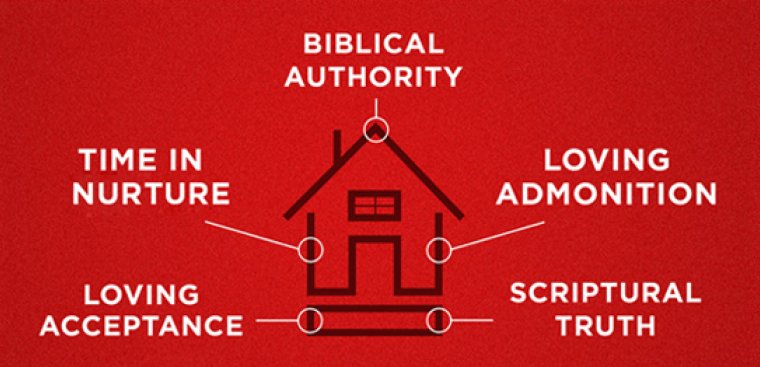
Showing posts with label Submission. Show all posts

Monday, March 19, 2018

Timothy, A Church Leader Must Know How to Manage His Own Family (1 Timothy 3:4-5)


"[An overseer] must manage his own family well and see that his children obey him with proper respect. (If anyone does not know how to manage his own family, how can he take care of God's church?)"
(1 Timothy 3:4-5, NIV)

I recently watched Billy Graham's Funeral on Youtube and I was touched by many wonderful testimonies about the man of God. Though as I read his book Just As I Am, he was far from being a perfect father (he became an absent husband and father during his crusade rallies), his life both in the ministry and home is very encouraging. Franklin Graham, who delivered the main funeral message, said, "The Billy Graham that the world saw on television, the Billy Graham that the world saw in the big stadiums, was the same Billy Graham that we saw at home. There weren't two Billy Grahams. He loved his family. He stood by us. He comforted us." Anne Graham Lotz also testified, "My Father's legacy is one that encompasses the world… and engulfs my own life.  When I think of him, I don't think of Billy Graham, the public figure.  I think of my Daddy."

As Christian leader, no matter how busy he is, no matter how much ministry he needs to do, he "must manage his own family well." If he has children, he should take great care of them. Pastor's kids (PKs), for example, are faced with problems other children do not face and more. Though most PKs become rebellious due to the pressure and the expectation from others and self, their fathers have much to do with the kind of sons and daughters they will be. Do they see one man in the pulpit and another type of man at home? A leader must be led by God's authority and good examples that his children will want to know their father's Lord and Saviour. In this way, the "children [will] obey him with proper respect." Franklin Graham respects his father because he sees that: "There weren't two Billy Grahams."

Married Christian leader "must manage his own family well." His wife and children are to be in submission (Ephesians 5:22) and obedience (Ephesians 6:1) to him, not because he is "the boss," but because the Bible teaches God has placed him at the head of the home and holds him responsible for it. "Husbands, love your wives, just as Christ loved the church…" (Ephesians 5:25) and "Fathers, do not exasperate your children; instead, bring them up in the training and instruction of the Lord" (Ephesians 6:4). Simply put, Paul says if a leader has failed at home, he cannot possibly succeed in directing the church. So the question that he puts is both for self-examine and for qualification: If anyone does not know how to manage his own family, how can he take care of God's church?

THINK BIG. START SMALL. GO DEEP.


Best Blogger Tips

Tuesday, November 24, 2015

Jesus can Transform Us: From Self-Centeredness to God-Centeredness

Phote taken from: holidaycamps.org.au
Then Jesus said to his disciples, ‘If any of you wants to be my follower, you must turn from your selfish ways, take up your cross, and follow me. If you try to hang on to your life, you will lose it. But if you give up your life for my sake, you will save it. And what do you benefit if you gain the whole world but lose your own soul? Is anything worth more than your soul?
(Matthew 16:24-26,
NLT).

Recognizing and confessing belief in Jesus as the Messiah is only the beginning of discipleship. Jesus invites every person, but those who want to follow him must be willing to “turn from,” “take up,” and “follow.” Jesus didn’t make being his disciple sound easy. To those who were hoping to have special positions in Jesus’ earthly Kingdom (see Luke 22:24), these statements would have been tough to hear. Denying their personal desires and taking up a cross in order to follow this man was not the life they had imagined.

To “turn from your selfish ways” means rejecting the “me first” attitude. Our normal, sinful human tendency is to take care of ourselves, focusing on personal desires and security (I just describing myself). Jesus was saying that anyone who wanted to follow him first had to turn away from those selfish desires and earthly security and put him in charge. This attitude transforms self-centeredness to God-centeredness. It means dying to self and living for Christ, putting personal desires and life itself into his hands.

Jesus went on to say that those who willingly “give up” their lives will “save” it. This statement was as jarring to people in Jesus’ day as it is today. The Greek word for “life” is psyche, referring to the soul, the part of the person that includes the personality with all its dreams, hopes, and goals. Those who “hang on to” their lives in order to satisfy desires and goals apart from God, ultimately “lose” their lives. Those who willingly “give up” or “lose” their lives for the sake of Christ, whoever, actually “save” them. Think about this: Nothing we can gain on our own can compare to what we gain with Christ. Jesus wants us to choose to follow him, to turn all that we are and have over to his disposal. Instead of letting us foolishly try to control our futures – which only he know – he wisely wants to take care of our lives for his own glory. In Jesus we really live. Amen.


THINK BIG. START SMALL. GO DEEP.
Best Blogger Tips

Tuesday, July 21, 2015

Jesus taught that God is our Sustainer and Provider


May your [God’s] Kingdom come soon.
May your will be done on earth, as it is in heaven.
Give us today the food we need
(Matthew 6:10-11, NLT).

The Jewish people knew the prophecies of a coming Messiah, whom they expected to throw off the nation’s oppressors, defeat her enemies, and restore Israel to her former glory under King David and King Solomon (called the “Golden Age of Israel Kingdom”). God had announced his Kingdom in the Covenant with Abraham (see Genesis 17:7-8), and pious Jews were still waiting for it – even today. So most Jews found accepting Jesus as the Messiah to be very difficult because Jesus preached a spiritual Kingdom, not an earthly, physical one. At least the physical one – future Kingdom – is coming soon but first, spiritual Kingdom.

When Jesus told his disciples to pray, “May your Kingdom come soon,” he was referring to God’s spiritual reign, not Israel’s freedom from Rome. To pray, “May your Kingdom come soon,” is to ask that more and more people will enter God’s Kingdom and to ask God to rule in their lives. It also reaffirms belief in the coming of a future Kingdom, when all evil will be destroyed, God will establish the new heaven and earth, and his glory will be known to all the nations (Psalm 110:1, Revelation 21:1).

Saying “May your will be done” acknowledge total submission to God’s rule, praying that God’s perfect purpose will be accomplished in this world (“on earth”) as it already is in heaven. With submission to God and his rule comes total dependence. The next request regards personal needs and provisions. “Give us today the food we need” or better “Give us today our daily bread.” “Food” or “bread” refers to food in general, though it could also refer to spiritual nourishment. Ask God for physical and spiritual “food.” Notice that we must trust God “today” to provide what he knows we need.

Think about this: Believers must trust God for provision and not worry. The fact that God provides daily food does not mean we should just sit back, relax, and wait for food (or money) to drop into our laps. We need to work to earn enough to pay for what we eat. Praying for daily food acknowledges that God is Sustainer and Provider. God gives us ability and opportunities to work. He provides.


THINK BIG. START SMALL. GO DEEP.
Best Blogger Tips

They Click it A lot. [Top 7 last 7 Days]