Sunday, March 20, 2022

Jesus the Messiah: A Survey of the Life of Christ (1996) by Robert H. Stein, Book Review

 Jesus the Messiah: A Survey of the Life of Christ (1996) by Robert H. Stein

I always carry a book or two in my bag. I wouldn’t feel complete without one. A book to read for personal enjoyment and curiosity always had space. That extra weight never is unnecessary. But not too heavy, of course, so that I can still freely move around with ease. There is a problem when I wanted to read more academic or scholarly books because they usually come with huge volumes (such as N.T. Wright’s Jesus and The Victory of God). Jesus the Messiah is just the right book for me! Not too thick nor too thin. Scholarly and yet suitable for the educated layperson. Readable, sound, and sensible. This book is the result of Robert H. Stein’s career of research and writing on Jesus and the Gospels as a scholar-professor of the New Testament. Stein writes with clarity about the Jesus of the Scripture, the reliability of the Gospels, the reality of the supernatural, and at the same time interacts with a variety of contemporary critical and philosophical biblical scholarship.

There are many features that I like about this book. First, as I already hinted earlier, it is not a boring but interesting book to read as opposed to a much dry writing style written by academics (Although, the first part of this book is quite technical). Secondly, there are very helpful bibliographies at the end of each chapter for the reader to explore further on the subject discussed. Thirdly, Stein begins the book by establishing the methodology for studying the life of Jesus and argues clearly about the necessity of the supernatural approach. “A study of the life of Jesus that excludes the miraculous is destined from the start to produce a Jesus who is an aberration… Attempts to strip the supernatural from Jesus’ life can only produce a Jesus so radically different that he is unrecognizable and his impact on history unexplainable.” I agree! Fourthly, although Stein uses the Christian Gospels of Matthew, Mark, Luke, and John as the primary sources for studying the life of the historical Jesus, he also introduces the reader to the extrabiblical (e.g. apocryphal gospels) and non-Christian sources, which sub-divide into pagan (e.g. Pliny the Younger, Tacitus, and Suetonius) and Jewish (e.g. The Talmud and Josephus). These non-Biblical sources - whether they are accurate or not - are important, in my opinion, because they establish beyond reasonable doubt that Jesus was truly a historical person.

Fifthly, Stein often discusses briefly some possible theories (e.g. Jesus’ crucifixion) before he came to the most probable and biblical one. He also doesn’t hide some difficult passages and problems that sometimes arise from the study (e.g. the chronology of Jesus’ final week). Lastly - this is very important - Stein not only responded to issues and teach with broad knowledge on the subject at hand but he regularly drew some theological lessons and spiritual applications for the readers to think about (e.g. on Jesus’ ethical teaching and the meaning of Jesus’ resurrection). In conclusion, I enjoy reading Jesus the Messiah. I refer to it a lot for my expository teachings on the Gospel of Matthew in my podcast. Fully recommended it! ✔

#ServeToLead #LeadersAreReaders #TheLifeOfJesus #LetsMakeReadingCoolAgain

To read my other book reviews, CLICK HERE

FB Page: https://facebook.com/LEGASI.tv/                              
Podcast: http://bit.ly/LegasiSpotify                             
YouTube: https://www.youtube.com/c/LEGASItv/                         

THINK BIG. START SMALL. GO DEEP.

Best Blogger Tips

Monday, March 7, 2022

Read Books and Beat the Goldfish! #LeadersAreReaders February 2022

Currently, I’m rereading Chris Bailey’s Hyperfocus (2018). When I went to MPH Bookstore the other day, I saw a new book that interest me by Johann Hari entitled Stolen Focus (2022). But the price is so expensive, RM89.90! I understand the book business is having a hard time nowadays and in the same way, owning physical books and encouraging people to be readers is getting hard too (state libraries and discount bookstores like BookXcess are saviors for bibliophiles). Not that I cannot afford to buy the book but as I browse through the contents - besides having newer research and the author’s unique perspectives - I realize that the challenge of managing attention and focus today is the same as yesterday. No new book can claim that this is a new phenomenon. Thus, I reread Hyperfocus and settle with just listening and watching interviews of Johann Hari online… hoping that soon the State Library will have it available. Lord, have mercy.

“Reading a book requires a good deal of attention,” writes Chris Bailey, “and with attention becoming a rare commodity, fewer people can devote themselves to reading without distraction.” Attention is our most limited and constrained resource. According to Microsoft Attention Spans Research Report*, the average human attention span in 2000 is 12 seconds and in 2013, it decreased drastically to 8 seconds (I don’t know how they measure this, but the goldfish have an average attention span of 9 seconds. 1 second longer than the average human!). In today’s fast-paced world of information overload, we’re constantly flooded with social media notifications, text messages, and games. Smartphone users, like you and me, check our devices about 80 to 90 times a day. No wonder we are so distracted. This is one of the reasons for the decline of book-reading culture in Malaysia and the world in general.  We still read but read bits and pieces of information. We have amassed lots of random information but lack actual knowledge, depth, and wisdom. This is not just affecting the overall quality of our work-life (or study-life, if you’re a student) but also the state of our mental health and spirituality.

Therefore, you must cultivate a love for reading books. It helps to train you (or force you, at the beginning) to increase your attention spans. It requires attention and it improves your attention. Jessalyn Lau, from the neuroscience perspective, says: “Reading has been proven to increase your focus, attention span, concentration, and to improve memory.” Perhaps you say you don’t have time to read books. I get what you mean. You have works to do, family to care for, products to promote, etc. But “no time” is a myth. Unless you move at the speed of light and the theory of special relativity applied to you, we all have the same amount of time. It's not about you don’t have time but it's about you MAKE time. We have no problem carving out time for things we want to do. So, take or buy a book that interest you, set an uninterrupted time (10 to 15 minutes for a start) today, turn off or switch your smartphone to silent mode and put it away from your reach, make a cup of hot coffee or tea or chocolate and start reading! Start small but do it frequently. At first, you will still be easily distracted. However, over time it will become a habit. And soon, you will be proud of yourself because you have beat the goldfish attention span record! Congratulation!

*https://www.scribd.com/document/265348695/Microsoft-Attention-Spans-Research-Report  

#ServeToLead #Hyperfocus #AttentionSpans #BeatTheGoldfish #LetsMakeReadingCoolAgain

To read my book reviews of #LeadersAreReaders FEBRUARY 2022, CLICK LINKS below:

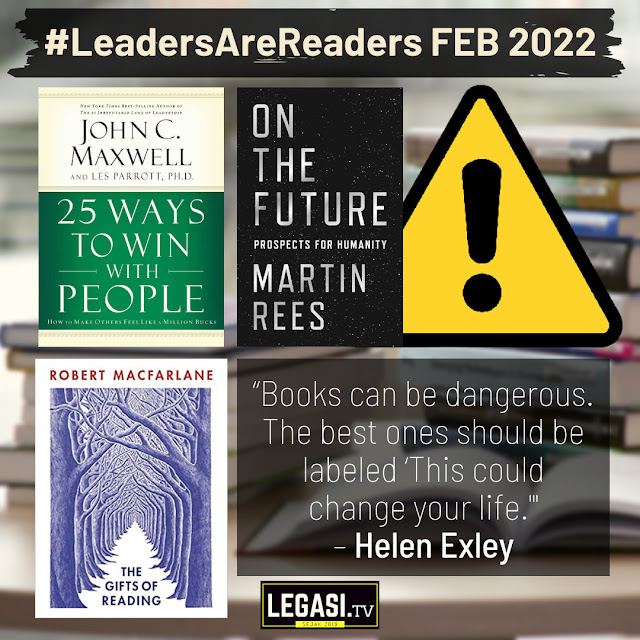
1) On the Future: Prospects for Humanity (2018) by Martin Rees https://bit.ly/OnTheFuture

2) The Gift of Reading (2016) by Robert Macfarlane https://bit.ly/MacfarlaneReading 

3) 25 Ways to Win With People (2005) by John C. Maxwell https://bit.ly/25WaysPeople 

4) The Previous book reviews https://bit.ly/1Book1Week 


FB Page: https://facebook.com/LEGASI.tv/                             
Podcast: http://bit.ly/LegasiSpotify                            
YouTube: https://www.youtube.com/c/LEGASItv/                        

THINK BIG. START SMALL. GO DEEP.

Best Blogger Tips

Sunday, March 6, 2022

How to Stay Motivated: Developing the Qualities of Success (2008) by Zig Ziglar, Audiobook Review

How to Stay Motivated: Developing the Qualities of Success (2008) by Zig Ziglar, Audiobook
 
Hilary Hinton "Zig" Ziglar (1926-2012), hands down, is one of my favorite personal development and motivational speakers of all time. There were several periods in my life where I did nothing (not literally) but listened to motivational talks for hours, day after day while I'm riding, cycling, walking, hiking, and cooking. I listened to Anthony Robbins, Brian Tracy, Les Brown, Jim Rohn, and other old-school speakers. I always get valuable lessons and inspirational boosts from them but some of their teachings are questionable and straight out New Age. This requires discernment. But two speakers that I can listen to over and over again with confidence are John C. Maxwell and Zig Ziglar. Zig doesn't hide the fact that he is a committed Christian. He, from time to time, inserted Biblical principles in his talks (He is not a Christian speaker but a speaker who is a Christ-follower). At first, I cannot bear his Southern accent but after I'm getting used to his deep and raspy voice, his sense of humor, his storyteller skill, his vast knowledge, and wisdom, I started to like him and his teachings. I can complete his sentences because they are memorable and applicable.

This 7 hours 48 minutes audiobook of How to Stay Motivated (Volume 1) is a collection of Zig Ziglar's recorded live studio audience. I love it! You can hear his passion, audience interactions and imagine as if you're there in the seminars. To be honest, some of the lessons are repetitive but like Ziglar himself said: "Repetition is the mother of learning, the father of action, which makes it the architect of accomplishment." The audiobook includes how to achieve goals, enhance relationships, improve self-image, have a winning mindset, the power of leadership, purpose, attitude, and vision, the joy of service (one of his famous quotes say it all: “You will get all you want in life if you help enough other people get what they want"), and more. When asked why we need to stay motivated, his classic response was: “People often say motivation doesn’t last. Neither does bathing - that’s why we recommend it daily.”

I don't listen and read self-help books that much anymore. If I do, I usually go for the classics. The modern-day self-help books can be very shallow, cringe (like TikTok 'preachers'), hype, similar contents, and sometimes give bad and harmful advice. There are some good ones though. Again, this requires discernment. Too much self-help can be self-harm. As you can guess, I recommend Zig Ziglar's books especially See You At The Top, Over The Top, Better Than Good and God's Way Is Still the Best Way :) #ServeToLead #LeadersAreReaders #ZigZiglar #LetsMakeReadingCoolAgain

To read my previous book reviews (grammatical errors included), CLICK HERE


FB Page: https://facebook.com/LEGASI.tv/                            
Podcast: http://bit.ly/LegasiSpotify                           
YouTube: https://www.youtube.com/c/LEGASItv/                       

THINK BIG. START SMALL. GO DEEP.

Best Blogger Tips

Tuesday, February 22, 2022

On the Future: Prospects for Humanity (2018) by Martin Rees, Book Review

 On the Future: Prospects for Humanity (2018) by Martin Rees

I enjoy watching the YouTube Originals series on The Age of A.I. eight science-documentary episodes covering the ways how Artificial Intelligence is and will change the world in various fields such as robotics, health, food, space travel, relationships, and others. It is narrated and hosted by Robert Downey Jr. with the vibe of Tony Stark’s coolness and humor (actually it is more interesting if J.A.R.V.I.S. or F.R.I.D.A.Y. be the one who narrated the series). I’m always fascinated by how fast we humans have progressed in terms of knowledge, science, and technology. It is both creates excitement and anxiety. When I watched the series, I realize that the producers want to highlight the wonderful positive aspect of A.I. implementations in many areas of our human experiences, but I still can’t help to think realistically (with a mix of negative thinking), of “what if” this or that happened. What if we create evil Ultron with the good intention to protect ourselves? What if there are powerful but bitter people like Magneto who decided to choose only special people like them to survive? What if there are people with the Thanos ideology that in order to bring peace and order there must be wars and necessary sacrifices needed to be made?

These existential questions and more leads me to this book. Martin Rees, an Astronomer Royal, renowned scientist, and futurist, examines the critical issues that will define the future of humanity on earth and beyond. His insights into cutting-edge science and technology and global trends are very helpful. His main argument is that if we approach the future with short-term thinking, polarizing debates, alarmist rhetoric, and pessimism, we are doomed to extinction (my language). But if we take responsibility for the future NOW with long-term thinking, rational discussions, solution-oriented partnership, globally, collectively, and optimistically, we can flourish.
“This book offers some hopes, fears, and conjectures about what lies ahead,” said Martin who doesn’t claim to be a prophet of the future but trying to act like one anyway due to the urgency of the subject at hand. “Surviving this century, and sustaining the long-term future of our ever more vulnerable world, depends on accelerating some technologies, but responsibly restraining others. The governance challenges are huge and daunting.” I agree. As a Christ-follower, I wholeheartedly believe that the future is in the hand of the sovereign God. But from the humanistic perspective, as the author seems to be one (he said he is a ‘cultural Christian.’ It doesn’t matter what he meant, for this book is not a Christian book anyway), the future is in our hands.

Overall,
On the Future is an excellent read. The author’s careful and brief treatments on the issues like nuclear threats, eco-threats, climate change, biotech, cyber technology, human consciousness, robotics, A.I., and spaceflight are both encouraging and alarming for obvious reasons. Of course, a book like this is not without speculations such as the possibilities of our dominion outside our planet (for example, colonization of Mars), and the ongoing search for extraterrestrial intelligence. I find that it is interesting when Martin also discusses the limits and future of science. By the way, I want to share one thing that probably going to spark your interest. This book is published in 2018 and about two years after that, in March 2020, the WHO declared COVID-19 a global pandemic. This is a glimpse of one of Martin’s worst nightmares coming true when he wrote: “Pandemics are an ever-present natural threat, but is it just scaremongering to raise concerns about human-induced risks from bio error or bio terror? Sadly, I don’t think it is. We all know too well that technical expertise doesn’t guarantee balanced rationality. The global village will have its village idiots and they’ll have a global range… Bio error and bio terror are possible in the near term - within ten or fifteen years. And in the longer term, they will be aggravated as it becomes possible to ‘design’ and syntheses viruses - the ‘ultimate’ weapon would combine high lethality with the transmissibility of the common cold.” 10 to 15 years, huh? How about 1-2 years?!

After I finished reading this book, I still have the “what if” questions about the future of humanity from the humanistic perspective. The difference is that I have moved from some (Oh, there are many!) of my ignorance to more informed “what if” question
s.

#ServeToLead #LeadersAreReaders #OnTheFuture #ScienceAndTechnology #LetsMakeReadingCoolAgain

[P. 
s: Two other issues/topics that are important, in my opinion, that should be covered in a book on the future like this one are cryptocurrency and the metaverse. Check it out!]

To read my other book reviews (and articles) based on science, CLICK HERE 


FB Page
: https://facebook.com/LEGASI.tv/                          
Podcast: http://bit.ly/LegasiSpotify                          
YouTube: https://www.youtube.com/c/LEGASItv/                      

THINK BIG. START SMALL. GO DEEP.
Best Blogger Tips

Wednesday, February 16, 2022

25 Ways to Win with People (2005) by John C. Maxwell and Les Parrott, Book Review

 25 Ways to Win with People: How to Make Others Feel Like a Million Bucks (2005)
by John C. Maxwell and Les Parrott

I believe in God’s calling in my life. As I reflect, it is impossible for me in the past to have worked in the people business and enjoy it (previously I was working in the cinema management team) and then enter into the people-centered ministry that I’m passionately doing now. Personality-wise, I’m not a people person. I was proud, selfish, and headstrong. But only by the love and grace of God, He slowly shapes my character and continues to teach - and often discipline - me to love others. When God calls, we must respond, then He will equip us. Having said that, loving people is not automatic (in my case, I need a miracle!) but it requires humility, perspective, and practice. But the question is WHY? Why it is important to love people? As Christ-followers, this should be obvious. Look at Christ’s examples and read Christ’s words. But generally speaking, we live with each other, we work with each other, we are dependent on each other, and we always meet each other. There is no such thing as a self-made man. Even Superman needs Louis! As John Andrew Holmes puts it: “It is well to remember that the entire universe, with one trifling exception, is composed of others.”

So, since we cannot avoid people, we might as well learn to love people. And when you try, you will eventually genuinely love them (Yes, some people require more grace from our part. Actually, vice versa). I brought this book back in 2010 because I saw the need for me to learn to develop relationships with my boss, colleagues, and staff to win their hearts. Besides, in the cinema business, I have to deal with many types of clients and customers. I was young and inexperienced but hungry enough to learn from my mistakes and try new things. This book together with John’s larger book Winning with People (2004) and Dale Carnegie’s classic How to Win Friends and Influence People (1936) have been a great help for me. 12 years later, as I read through this book again, I’m amazed by how relevant, important, and simply profound these twenty-five ways are to win with people. There are lots of good stories and I particularly love the “On Bringing It Home” section in every chapter designed to help the readers to put each way/lesson into action. There are lines, highlights, juicy quotes, and personal notes in my copy that bring back good memories.

Ps: One concern that I have with this kind of book is that: we must draw the line (no matter how thin the line is) between influencing and manipulating people. Use it wisely and ethically.

Truth be told, I have become slightly better in my relationships with people. Slowly yet hopeful. Some of these lessons have turned into habits; some I still have to practice; some are a bit more challenging - stubborn! - to implement. When I observe myself, people around me, and how people interact in social media and technologies like Zoom, Skype, Google Meet, etc. it reminds me that all the more we have to learn to connect with people effectively as humans, improve our interpersonal skills, breathe encouragements, be genuinely interested with others online and offline, and make the most of every opportunity to “keep winning by helping others win” said John Maxwell. I may forget my own advice or lessons that I learned from this book and realistically cannot win every people I encounter, but Lord, I pray, for me and you, to make a difference at least to one person even with a simple gesture of kindness that we meet TODAY. May he or she says, “I have become better for having known you.”

#ServeToLead #LeadersAreReaders #GrowingLeaders #WinningWithPeople #LetsMakeReadingCoolAgain

To read my other book reviews by John C. Maxwell, CLICK HERE


FB Page: https://facebook.com/LEGASI.tv/                         
Podcast: http://bit.ly/LegasiSpotify                         
YouTube: https://www.youtube.com/c/LEGASItv/                     

THINK BIG. START SMALL. GO DEEP.

Best Blogger Tips

Friday, February 11, 2022

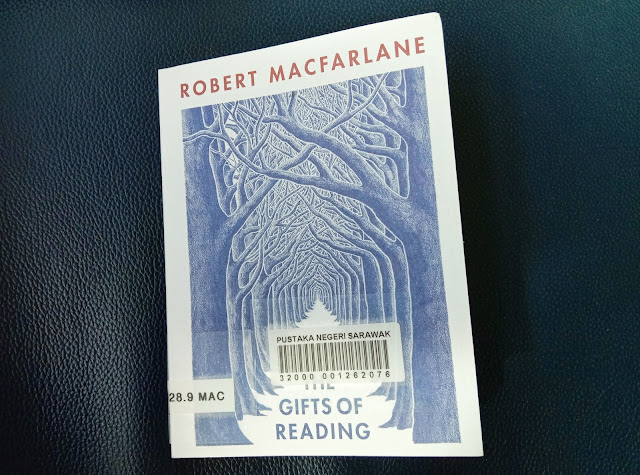
The Gifts of Reading (2016, 2017) by Robert Macfarlane, Review

In summary, this short essay by Macfarlane, the author of prizewinning and bestselling books about nature, place, and people, is his reflections on the unique emotional resonance of books given and received and how these acts of generosity "incite generosity." He begins by telling how he met his elderly friend, Don, who gave him books and their walks and conversations about their common love for literature. In between the essay, he shared about half a dozen of books that make a difference in his life and others around him, especially, Patrick Leigh Fermor's A Time of Gifts.

"Not all books received as gifts are transformative, of course. Sometimes the only thing a book gives its reader is a paper cut," writes Macfarlane. Funny and true. Then he continues, "But having been given so many astonishing books over the years, I now, in turn, give away as many books as I can. Birthdays, Christmases - I give books, and pretty much only books, as presents."

This reminds me of what I have done joyfully and aggressively in the past. When I first started blogging in 2010 - and I have a pretty good salary back then when I was working in the management and entertainment industry - I used to giveaways 3 to 5 books per month. I lost most of the connections with the recipients now (since I'm not active on social media anymore except for LEGASI.tv) but I do receive some good feedback from them years after that through email and WhatsApp. Their joy (I assume they were rejoicing) when receiving free books and my joy of giving books are interconnected and mutual. Today I still enjoy giving books but not as often as before. Perhaps this is what Macfarlane meant when he explains, "the gift can be transformative and that the act of giving encourages the onwards circulation of generosity."

Macfarlane ends his essay by telling how he and Don always wrote and sent books to each other after their farewell. One day, Don wrote to say that he had been diagnosed with cancer, and a year or so later, Don died. Rachel, Don's daughter, wrote an email to Macfarlane telling him about the news and letting him know that "reading kept [Don] alive right till the end." I closed the book and walked toward the glass window facing a peaceful lake outside Pustaka Negeri Sarawak library and whispered a thanksgiving prayer: "Thank you for the gifts of reading, Lord. Amen" 

#ServeToLead #LeadersAreReaders #TheGiftsOfReading #LetsMakeReadingCoolAgain

To read my other book reviews, CLICK HERE

FB Page: https://facebook.com/LEGASI.tv/                       
Podcast: http://bit.ly/LegasiSpotify                        
YouTube: https://www.youtube.com/c/LEGASItv/                    

THINK BIG. START SMALL. GO DEEP.

Best Blogger Tips

In the Distracted World, Cultivate These Superpowers #LeadersAreReaders January 2022


I was with a student-turned-friend when I asked my usual question, “What book are you reading now?” He said with a sound of disappointment, “I haven’t read any book consistently since last year.” I raised my eyebrows to signal him to say more. He continued, “I have been very busy with my works, and I’m addicted to social media and games too.” He needs encouragement. So I tried to spark his interest, “Do you know that there are two superpowers that are very valuable today?” (I use the word superpowers because we just came back from watching the Spiderman movie). Actually, I asked intending to answer my own question: “Focus and depth.” I told him since most people are easily distracted, if he wants to be different, he must learn to improve his focus and sharpen his attention. And since the major outcome of continuous distraction is shallow thinking, he needs to strive not to be a zombie but a person of depth, especially as a Christ-follower.

“There are various ways to exercise these superpowers,” I said as I concluded our lengthy discussion from the rise of TikTok to the Facebook Metaverse controversy to spiritual disciplines with now a friend-turned-student again, “and one of it is by cultivating the habit of reading widely and deeply.” Almost every time I asked my usual question to a student or a friend (last week was with my friend, George), it will lead me to this one passion: promoting literacy and fostering a love for reading, especially, the Scripture.

I see the urgent need to encourage our young people today - and you! - to redeem and use these superpowers (we called graces) in a distracted world for the glory of God. It's not just about our minds but also our souls. May this encourage you to think about all these things... Please consider this message ya #ServeToLead #Focus #APersonOfDepth #LetsMakeReadingCoolAgain

To read my book reviews of
#LeadersAreReaders JANUARY 2022, CLICK THE TITLES below:

1) Education, Free & Compulsory (1999) by Murray N. Rothbard

2) The Lord from Heaven (1958, 1974) by Leon Morris

3) The Notebook: A Novel (1996) by Nicholas Sparks

4) Cracking Philosophy: You, This Book and 3,000 Years of Thought (2016) by Dr. Martin Cohen (this not a review but more to an encouragement to study philosophy)


FB Page
: https://facebook.com/LEGASI.tv/                       
Podcast: http://bit.ly/LegasiSpotify                        
YouTube: https://www.youtube.com/c/LEGASItv/                    

THINK BIG. START SMALL. GO DEEP.

Best Blogger Tips

They Click it A lot. [Top 7 last 7 Days]