Showing posts with label Book of Genesis. Show all posts

Monday, April 15, 2024

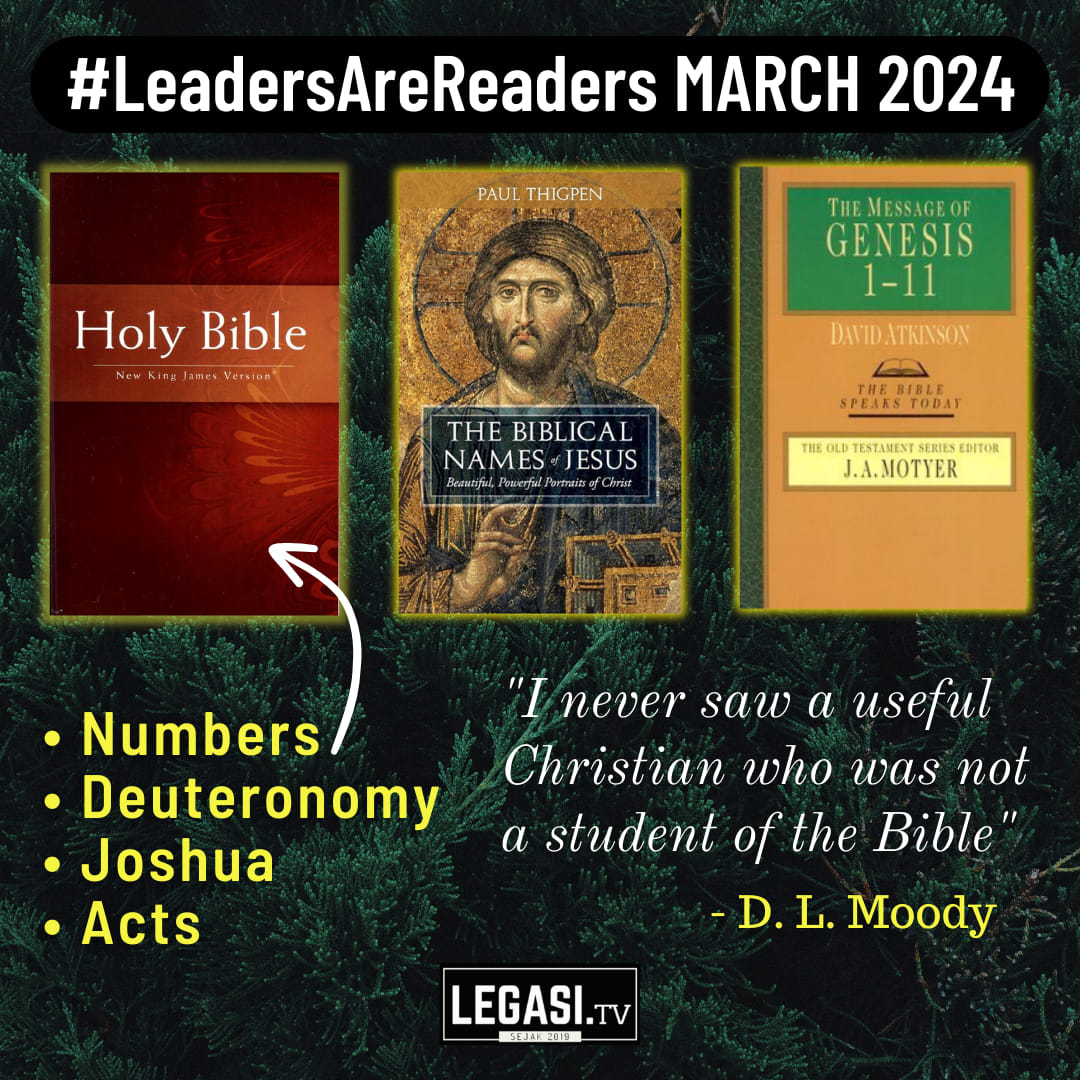
Keep On Reading! #LeadersAreReaders March 2024

I will never know which authors and/or books God will use to make a difference in my life, so I just keep reading with expectation and prayer, knowing that if I do, the possibility is high, and if I don't, it's next to zero. This reminds me of the Ethiopian eunuch who read the Book of Isaiah but didn't understand it until the Holy Spirit, through Philip the Evangelist, explained the Scripture to him. The story is in Acts 8:26-35,

"God’s angel spoke to Philip: 'At noon today, I want you to walk over to that desolate road that goes from Jerusalem down to Gaza.' He got up and went. He met an Ethiopian eunuch coming down the road. The eunuch had been on a pilgrimage to Jerusalem and was returning to Ethiopia, where he was a minister in charge of Candace's finances, queen of the Ethiopians. He was riding in a chariot and reading the prophet Isaiah. The Spirit told Philip, 'Climb into the chariot.'

Running up alongside, Philip heard the eunuch reading Isaiah and asked, 'Do you understand what you’re reading?' He answered, 'How can I without some help?' and invited Philip into the chariot with him. The passage he was reading was Isaiah 53:7-8. The eunuch said, 'Tell me, who is the prophet talking about himself or someone else?' Philip seized the opportunity. Using this passage as his text, he preached JESUS to him" - and the eunuch got baptized, and Philip went on his way.

So, you will never know which authors and/or books God will use to make a difference in your life, just keep reading with expectation and prayer and the Holy Spirit will give you understanding. Amen.

 #ServeToLead #LetsMakeReadingCoolAgain #1Book1Week #KeepOnReading #HabitOfReading #TheBook

THINK BIG. START SMALL. GO DEEP.

Best Blogger Tips

Cultivate the Habits of Reading and Writing #LeadersAreReaders January 2024

If you followed the Chronological Bible Reading Plan, you would've read the Book of Genesis and Job. Well done! Every year I try to read through the Bible, but last year I didn't manage to finish on time because I read other books too. Well, this year I want to focus more on the Bible than other books (perhaps limited to one or two or, at the most, three per month). I've come to believe that if you want to grow as a Christian, especially in full-time ministry, cultivating the habits of reading and writing are indispensable.

Reading Christians, especially those who read and meditate on the Word of God, are God-loving Christians. We are called to
 "love the Lord [our] God with all [our] heart, [our] soul," and "[our] mind." Reading helps us to grow in knowledge and equips us to contend for the faith, to gain wisdom and understanding, to have the mind of Christ and to know God's will and the Spirit leading, and in my case, to teach, preach and give answers with conviction, confidence, and compassion. Besides, reading helps our minds to think, connect, and reflect.

Next, after reading, writing is important
. Initially, I didn't like to write because it consumed a lot of time, and I always failed my grammar. But once I 'force' myself to write, the outcomes are clarity of thought, exponential learning and retention, and mental satisfaction. And if you see writing as one of the ways to bring the Word of God to readers, then you're also benefiting others other than yourself. It is said that "clear writing is a sign of clear thinking" and "clear thinking is a sign of a well-organized mind." I agree. As full-time ministers, we must nurture our minds too, not just our hearts and souls.

So, friends, read and write!

#ServeToLead #ReadersAreLeaders #TheBible #ReadingAndWriting #LetsMakeReadingCoolAgain

THINK BIG. START SMALL. GO DEEP.

Best Blogger Tips

Wednesday, August 12, 2020

Enoch: Walking With God (Genesis 5:22-24)


In Genesis 5, the life of Enoch is only told in 4 verses! But although his story is short, his example of faith is massive! 😊⚡🙏 #ServeToLead #BiblicalCharacters #LifeOfEnoch

FB Page: https://facebook.com/LEGASI.tv/          
Podcast: https://anchor.fm/LEGASI.tv/        
Instagram: https://instagram.com/legasi.tv/        
YouTube: http://bit.ly/LEGASItv        

THINK BIG. START SMALL. GO DEEP.

Best Blogger Tips

Saturday, May 16, 2020

Leaders can Come from Broken Family


I come from a broken family. But it doesn't mean that my next generations should be like that too. I believe with all my heart - based on all the biographies that I read, documentaries that I watched and the Scripture that I meditate testify - that leaders can come from broken families. Let me show you three (3) truths from Genesis 5 #ServeToLead #SpiritualLeadership #LeadersFromBrokenFamilies


THINK BIG. START SMALL. GO DEEP.
Best Blogger Tips

Leading In the Age of Grace and Lawlessness


We are both living in the best and difficult time or as I would like to say it - we are living in the age of grace and lawlessness. The question is: How to lead? Let me share with you from Genesis 4:10-26 in what way we - the believers - should lead #ServeToLead #SpiritualLeader #LeadingWithGrace #GraceAndLawlessness #LeadershipBible


THINK BIG. START SMALL. GO DEEP.
Best Blogger Tips

A Leader as Brother's Keeper


When God asked Cain, in Genesis 4, "Where is your brother?" Cain replied, "I don't know... Am I my brother's keeper?" (v.9). Is Cain Abel's keeper? Of course! By blood, cause he is his brother; by authority, cause he is the oldest, firstborn; and by spirituality, cause he should be the example. As a leader, how can you be a brother's keeper? #ServeToLead #GrowingLeader #SpiritualLeader #MyBrothersKeeper #LeadershipBible


THINK BIG. START SMALL. GO DEEP.
Best Blogger Tips

Three (3) Things that Can Destroy A Leader


Cain murdered Abel (Genesis 4) is a classic example of sibling rivalry. But from this story also, we can learn leadership lessons from Cain's downfall. What are the three things that can destroy a leader based on his character? #ServeToLead #LeadershipBible #GrowingLeader


THINK BIG. START SMALL. GO DEEP.
Best Blogger Tips

The Best Leaders Are Tough But Kind


Let me be frank, most leaders today - especially, men - are weak! Instead of being a man of God, they want to be a nice guy. A nice guy as a leader will always need approval, avoid conflict and self-centered. We need to toughen up! Based on how God confronts Adam and Eve in Genesis 3, let me share with you three (3) ways to be a tough leader. Do these and people will either respect you or dislike you. If you want to be liked, don't be a leader #ServeToLead #GrowingLeader #LeadershipBible


THINK BIG. START SMALL. GO DEEP.
Best Blogger Tips

Leaders, Take 100% Responsibility


After The Fall, Adam's and Eve's eyes were opened. They suddenly felt shame at their nakedness. When God asked Adam, "Where are you?" and inquired more, he said, "It was the woman you gave me who gave me the fruit, and I ate it." Then, God asked Eve, "What have you done?" "The serpent deceived me," she replied, "that's why I ate it." God was not asking a curious-question, He asked an accountability-question, and they - as most of us would have done - blame one another!

Instead of taking responsibility, Adam, the man who God puts in charge of everything - a leader - shift blame to others. What can we learn from this story? Why as leaders we must take 100% responsibility? #ServeToLead #GrowingLeader #LeadershipBible


THINK BIG. START SMALL. GO DEEP.
Best Blogger Tips

Leader's Greatest Failure: Communication


In Genesis chapter 1, God begins His masterpiece. He creates. From "Good" to "Very good." In chapter 2, He planted the Garden of Eden and placed Adam and Eve there. Everything was in order and shalom. But in chapter 3, everything changes - The Fall! One of the reasons for The Fall is communication. Adam failed to connect with Eve. As a leader, you may be a good speaker, but more important than that you must be a good communicator. What we can learn from Adam's faulty communication? #ServeToLead #GrowingLeader #LeadershipBible

THINK BIG. START SMALL. GO DEEP.
Best Blogger Tips

Three (3) Ways to Lead Like A Human


In the world of technology, social media and data-ism today we can sometime forget that people are not robots! Although this is common sense, we need to remember to: lead like a human. What makes us different from machines (so far, still being debated today) is that we have consciousness and feelings. In short, we are humans. Thus, how to lead like a human? #ServeToLead #GrowingLeader #LeadershipBible


THINK BIG. START SMALL. GO DEEP.
Best Blogger Tips

Tuesday, September 4, 2018

Book Review - Walking the Bible: A Journey Through the Five Books of Moses (2001) by Bruce Feiler


Walking the Bible: A Journey By Land Through the Five Books of Moses (2001)
by Bruce Feiler

This is not a theological book, not by a theologian or Christian pastor, not a textbook for seminary students. This is an adventure by a seeker, a quest for truth (or the remaining of the truths), a personal pilgrim that may or may not lead to the divine. This is not a spiritual quest… at first.

"In the Middle East," writes Feiler, an award-winning journalist, and writer, "I realized, the Bible is not some abstraction, nor some book gathering dust. It's a living, breathing entity unencumbered by the sterilization of time. If anything, it's an ongoing narrative: stories that begin in the sand, get entrenched in stone, pass down through families, and play themselves out in the lives of residents and visitors who traverse its lines nearly 5,000 years after they were first etched into memory. That was the Bible I wanted to know, and almost immediately I realized that the only way to find it was to walk along those lines myself. I would take this ancient book, the embodiment of old-fashioned knowledge, and approach it with contemporary methods of learning – traveling, talking, experiencing. In other words, I would enter the Bible as if it were any other world and seek to become a part of it. Once inside, I would walk in its footsteps, live in its canyons, meet its characters, and ask its questions in an effort to understand why its stories had become so timeless and, despite years of neglect, once again so vitally important to me."

From there, Bruce Feiler writes this 435-pages book with immersion journalism and a style that makes it flow without bogging the reader down in minutia. It is easy and fun to read (for me). It was like reading a novel but with real characters, real places and historical events. I hope potential readers will not be turned off to this book from its title. It is not written from a religious perspective but from a (fairly) objective perspective. Even though Feiler himself is Jewish and grew up in a Jewish household, he didn't attach himself to the Jewish Bible.  When visiting Jerusalem, he was shocked by being able to see the physical locations where so many stories from the Bible take place. That experience inspired him to take the journey through the five books of Moses: Genesis, Exodus, Leviticus, Numbers, and Deuteronomy.

Together with Avner Goren, his guide, Feiler travels through Egypt, Jordan, Israel, the Palestinian territories, and other lands of the Near East. They visit as many confirmed biblical locations as possible and some suspected sites. Along the way, they will read aloud the passages of the Bible applicable to that place. Slowly, Feiler's faith grows stronger and comes to find an appreciation for the biblical places. Feiler's talent for detail and imagery made this book worth reading (although I wish he can trim down the volume). I felt like I was in the desert on a camel with him. I could see myself walking deeper and deeper into the pyramids of Egypt especially (wow!). His description of Petra almost convinced me to see it for myself before I die. The characters of Abraham, Isaac, Jacob, Joseph, and Moses are told in the most interesting way. And throughout the book, my faith in the Old Testament is ever increasing. Even though that wasn't his intention at first, I thank God the Father for this book because it rekindles my trust in His Word. By the way, I also enjoy the science, archaeology, history, and traditions behind this book. Reading a book about the Bible without religious lingos is very helpful and refreshing for me.

One of the biggest questions that Feiler explores is this: "If these places existed, does that make the Bible true? If they didn't exist, does that mean the Bible is lies?" The analogy used is from "an archaeologist I met in Jerusalem who said to me, ‘You know, Americans seem to think if you can prove that two screws existed, you prove the entire machine existed.'" It's black or white, no grey in between. Feiler feels this pull of (false) reasoning a few times through his journey. At the end of the day, something in the Bible can be proven, something is not, said Feiler. Not everything will or can be proven with science! For this, I respect Feiler for leaving some questions open, without answers. Maybe that's why I like this book – its honesty and integrity. I don't agree with everything that Feiler writes. That's okay. A good book (I said it over and over again before) will make you think, challenge your beliefs or assumptions, and spark your imagination. This book has done all three! Superb!


THINK BIG. START SMALL. GO DEEP.
Best Blogger Tips

Saturday, March 4, 2017

Sarah, Why You Gotta Be so Rude? Don't You Know its God's Word? (Genesis 18:10-15)


One of them said, ‘I’m coming back about this time next year. When I arrive, your wife Sarah will have a son.’ Sarah was listening at the tent opening, just behind the man. Abraham and Sarah were only by this time, very old. Sarah was far past the age for having babies. Sarah laughed within herself, ‘An old woman like me? Get pregnant? With this old man of a husband?’ God said to Abraham, ‘Why did Sarah laugh saying, ‘Me? Have a baby? An old woman like me?’ Is anything too hard for God? I’ll be back about this time next year and Sarah will have a baby.’ Sarah lied. She said, ‘I didn’t laugh,’ because she was afraid. But he said, ‘Yes, you did; you laughed.’”
(Genesis 18:10-15, The Message)

It was the hottest part of the day, nobody travel at that time. But three strangers showed up at the tent of Abraham and Sarah beneath the oaks of Mamre (Genesis 1:1). Abraham must have recognized them as angels – the manifestation of God, “God appeared to Abraham” – for he run out to meet them and bowed down before them. Abraham insisted that they stop awhile and rest in the cooler shade of the oak trees and wash their feet. He called Sarah to prepare bread for the visitors while he selected the best calf to slaughter and cook for his honorary guests. This is MEH… Middle-East hospitality!

When they had eaten, the visitors made an astonishing announcement: within a year, Sarah would give birth to “a son.” So specific. Male. One year. A son. But behind the visitors, someone was laughing. Sarcastic laugh? Laugh of unbelief? Laugh with a touch of mockery? Maybe all of it. It was an old woman’s laugh – Sarah’s. That was rude.

As if the visitors were pissed off, one of them asked, “Why did you laugh?” Surely they understood why she laughed. The thought of a 90-year-old woman giving birth was ridiculous. Rude, yes; but understandable (I wonder if Abraham ever smile when he heard this news too, or might learned his lesson in chapter 18?). But the visitors, the angels, the messengers were serious. God was serious. God thinks higher than us… He always uses the foolish and the weak things of the world to shame the wise and the strong. Sarah would soon see that nothing is too hard – or too ridiculous – for God. The question that the visitor asked Abraham and Sarah that day is the same question that the Holy Spirit is asking us now: Is anything too hard for God? Actually, it’s a statement: Nothing is impossible to God.

THINK BIG. START SMALL. GO DEEP.

  
Best Blogger Tips

Wednesday, February 22, 2017

God Is In the Business of Impossible (Genesis 17:15-19)


God continued speaking to Abraham, ‘And Sarai your wife: Don’t call her Sarai any longer; call her Sarah. I’ll bless her—yes! I’ll give you a son by her! Oh, how I’ll bless her! Nations will come from her; kings of nations will come from her.’ Abraham fell flat on his face. And then he laughed, thinking, ‘Can a hundred-year-old man father a son? And can Sarah, at ninety years, have a baby?’ Recovering, Abraham said to God, ‘Oh, keep Ishmael alive and well before you!’ But God said, ‘That’s not what I mean. Your wife, Sarah, will have a baby, a son. Name him Isaac (Laughter). I’ll establish my covenant with him and his descendants, a covenant that lasts forever’
(Genesis 17:15-19, The Message)

Sarai was 90 year-old when God gave her a fresh start. No longer would she be known by the old Babylonian name she had been born with. From Genesis 17 onward, she would be called “Sarah” – Princess – and she, like her husband (Abram, previously renamed as Abraham), would be the mother of nations. Name is so important. It represent who we are, our origin. Good name is crucial for a new identity. Abraham and Sarah’s names are God’s prophesy of what they would become.

I’m thinking of Abraham… how his faith were stretched… he had been called upon to believe some wild things (Up-In-The-Sky-Kind-of-Promises!) over the previous 30 years. But the thought of his 90 year-old wife would “give you a son” was too much. Too impossible for him – and probably too stress – that he laughed! Abraham being Abraham, he gave God a suggestion, a solution: “Oh, keep Ishmael alive and well before you!” What he meant was, “Lord, why couldn’t Ismael, be the son of the promise? Let him be!” Perhaps Abraham truly love Ishmael. Perhaps Abraham sick of waiting. Perhaps he felt bad for the boy Ishmael, son with the servant woman Hagar. Illegitimate or not, he was till Abram’s flesh and blood.

Let me reason for Abraham… Hey, Ishmael, his son, was already there. Why wait? I think it is quite awesome if God were to make a great nation out of Ishmael (in fact, God does it). But to imagine an as-yet-unborn son of a 90 year-old woman? To me and Abraham… that was impossible to imagine...

About two thousand years later, God did the same impossible promise. Elderly Elizabeth who were barren bore a son, John the Baptist and Mary, a virgin, bore child Jesus the Messiah (read Luke 1 and 2). Both were impossible cases, but as Gabriel, the archangel said, “Nothing, you see, is impossible with God” (Luke 1:37, Msg). God had His own plans, His plans will come to past. He is in the business of impossible. “That’s not what I mean,” God insisted, “Your wife, Sarah, will have a baby, a son.” God was doing something utterly new to Abraham. In the end, Sarah gave birth to a son named Isaac (read Genesis 21).

When God plans to do something, something great
Hold fast to His promises, He keep His promises,
Remember: “Nothing, you see, is impossible with God
THINK BIG. START SMALL. GO DEEP.

Best Blogger Tips

Sunday, February 19, 2017

During the Covenant Making Abram Fell Into a Deep Sleep, So God Slapped Him? (Genesis 15:10-22)


God said, ‘Bring me a heifer, a goat, and a ram, each three years old, and a dove and a young pigeon.’ [Abram] brought all these animals to him, split them down the middle, and laid the halves opposite each other. But he didn’t split the birds. Vultures swooped down on the carcasses, but Abram scared them off. As the sun went down a deep sleep overcame Abram and then a sense of dread, dark and heavy…  When the sun was down and it was dark, a smoking firepot and a flaming torch moved between the split carcasses. That’s when God made a covenant with Abram: ‘I’m giving this land to your children, from the Nile River in Egypt to the River Euphrates in Assyria—the country of the Kenites, Kenizzites, Kadmonites, Hittites, Perizzites, Rephaim, Amorites, Canaanites, Girgashites, and Jebusites
(Genesis 15:9-12, 17-21, The Message)

Either you don’t understand what you’ve just read or you’re saying What?!! to this bloody business, I find that this encounter is interesting. Abram killed three large animals, cut each in half through bone and muscle, and laid the pieces out. But lucky birds, their bodies remain in one piece (but probably their heads were chopped off. Easy dead). Imagine the smell of meat and blood. Thus, Abram had to scare the vultures off.

I assumed Abram probably recognized the making of the familiar ritual – the Cutting of a Covenant – during the Old Testament period. When two kings made a covenant, they sometimes cut an animal in half and walked between the pieces as way of saying, “If I don’t keep this agreement, may I be like this animal.” Sometimes both parties walked between the pieces, sometimes it was only the weaker of the two kings.

As the sun went down a deep sleep overcame Abram and then a sense of dread, dark and heavy.” Many commentaries tells us that Abram woke to a vision of God. In a form of “a smoking firepot and a flaming touch” God passing between the pieces of the animals. If it was God, then I assured you, it was not the weaker of the two parties putting Himself on the line for the sake of the Covenant, but the stronger. The only One. I interprets it as of God was saying, “If I don’t give this land to your offspring as I have promised, may I be broken like these broken animals.”

God came to the man and woman who waited in faith. There is no record of Abram walking between the pieces since God’s Covenant is not a bargain between equals. It is totally dependent on God’s initiative of grace. Abram role – our role even today – is to receive what God gives, obey what God commands and so live in the enjoyment of God’s blessings. I learned, through my darkest moments, when I don’t understand why I have to wait for God’s promises to be fulfilled, I know that that is precisely the moment for faith to hold on to God’s Word and to say,

I know that the God who has brought me to this point is not going to let me down now, so I am going to confirm my commitment to Him, whatever the appearance may be, because He is committed to me forever. Amen.”


THINK BIG. START SMALL. GO DEEP.
Best Blogger Tips

Friday, February 17, 2017

A Lesson from Impatient Wife, Soft Husband and Proud Servant (Genesis 16:1-6)


Sarai, Abram’s wife, hadn’t yet produced a child. She had an Egyptian maid named Hagar. Sarai said to Abram, ‘God has not seen fit to let me have a child. Sleep with my maid. Maybe I can get a family from her.’ Abram agreed to do what Sarai said. So Sarai, Abram’s wife, took her Egyptian maid Hagar and gave her to her husband Abram as a wife. Abram had been living ten years in Canaan when this took place. He slept with Hagar and she got pregnant. When Hagar learned she was pregnant, she looked down on her mistress.

Sarai told Abram, ‘It’s all your fault that I’m suffering this abuse. I put my maid in bed with you and the minute she knows she’s pregnant, she treats me like I’m nothing. May God decide which of us is right.’ ‘You decide,’ said Abram. ‘Your maid is your business.’ Sarai was abusive to Hagar and Hagar ran away
(Genesis 16:1-6, The Message)

This is both encouraging and troubling: Abram’s life of faith was up and down like roller coaster. Encouraging because mine is like that too; and troubling because his doubtful- attitude is like mine too. Huh. In Genesis 15 we saw Abram believing God’s big-scale promise to make him a great nation. But in the next chapter we see him taking matters into his hands again.

Knowing Sarai couldn’t possibly bear children at her old age, she invited Abram to sleep with her maid Hagar in hope that she would bear a child (on behalf of her since Hagar was her bondage-servant) who would be the beginning of Abram’s great nation. At least start with one child. The promise, after all, said that Abram would become the father of great nation – it didn’t specify that the children he fathered had to be legitimate. Hello!

So Abram slept with the servant woman – clearly put: having sex – and she got pregnant. Soon Sarai began to realize what a mistake she had made. Hagar the Egyptian “looked down on her mistress.” She became proud, and probably felt loved by Abraham because she bore his child. This is a better drama than TV3 Malay drama. So Sarai could no longer stand the sight of Hagar. In her eagerness to help God keep His promise and in her unwillingness to wait for God’s timing and somewhat became queen control, Sarah traded in her dignity, and Abram (sadly) had let her. It was a tragedy, disastrous. Abram became soft. Hagar became proud. Sarai became abusive.

Wait. That’s what I learned from this story. It’s hard, but wait for God is the best thing to do. On waiting Charles H. Spurgeon writes, “If the Lord Jehovah makes us wait, let us do so with our whole hearts; for blessed are all they that wait for Him. He is worth waiting for. The waiting itself is beneficial to us: it tries faith, exercises patience, trains submission, and endears the blessing when it comes. The Lord's people have always been a waiting people.”


THINK BIG. START SMALL. GO DEEP.
Best Blogger Tips

Abram, Look at the Stars, Look How They Shine for You (Genesis 15:1-6)


The word of the Lord came to Abram in a vision: ‘Fear not, Abram, I am your shield; your reward shall be very great.’ But Abram said, ‘O Lord God, what will you give me, for I continue childless, and the heir of my house is Eliezer of Damascus?’ And Abram said, ‘Behold, you have given me no offspring, and a member of my household will be my heir.’

And behold, the word of the Lord came to him: ‘This man shall not be your heir; your very own son shall be your heir.’ And he brought him outside and said, ‘Look toward heaven, and number the stars, if you are able to number them.’ Then he said to him, ‘So shall your offspring be.’

And he believed the Lord, and he counted it to him as righteousness
(Genesis 15:1-6, ESV)

By now Abram was an old man. His wife, Sarai, was old too – in fact, decades beyond childbearing age. So when God came to him in a vision (you may called it ‘dream’) and repeated the promise He once made with Abram, it’s not hard to understand Abram’s doubt and fear. “I continue childless,” he said, “and the heir of my house is Eliezer of Damascus [his chief servant].” Lot, his nephew has gone; and Abram had left his families behind. Since he doesn’t have any children or other close relatives, by law of the land, his chief servant will inherits his properties (unless he go back to his home town). I imagine it was a painful thing for Abram to think about: It wasn’t even a distant relative, but a servant who would inherit everything he had worked for.

Even though God seems to be ‘last-minute’ to me, it wasn’t what He had in mind when He promised to make a great nation of Abram. He wasn’t talking about servant(s) that will inherit his properties and promises. No, as unlikely as it sounded, God was going to give Abram his very own son.

God took him outside the tent [still in a vision, probably in spirit?] and told him to look up to the heavens. “Number the stars, God said, “if you are able to number them.” [Again, I imagine Abram tried to count the stars with his finger and murmured 1, 2, 3, 4, 5…] “So shall your offspring be.”

Abram probably lifted his head once more, this time he looked at the stars not as numbers but possibilities. He took in the vast and shimmering sky – each star a son, a daughter, each one a blessing to the rest of the world. And somehow, Abram’s faith restored – Abram believed again.

I hope that this story – God’s Story – will lift up your faith again, restore your believe in God’s promises again, hope in Him again. May God’s righteousness be with you as you believe in His goodness and promises in His living Word.
[P.s: I’m not sure what “counted it to him as righteousness” mean; could it be God counted Abram as righteous because of his act of believe?]

THINK BIG. START SMALL. GO DEEP.


Best Blogger Tips

They Click it A lot. [Top 7 last 7 Days]