Friday, February 4, 2022

Cracking Philosophy: You, This Book and 3,000 Years of Thought (2016) by Dr. Martin Cohen, This-Is-Not-A-Review

Why Learning Philosophy Is Important?

In 2014, the late Dr. R.C. Sproul’s book Everyone’s a Theologian was published. He argues that any time we think about God and/or the teaching of the Bible and strive to understand it, we are engaging in theology. “No Christian can avoid theology,” he said, “Every Christian is a theologian. Perhaps not a theologian in the technical or professional sense, but a theologian nevertheless. The issue for Christians is not whether we are going to be theologians but whether we are going to be good theologians or bad ones.” In the same way, I think, everyone is a philosopher. We might not be a formal one or called as one but we are a philosopher nevertheless. If you ask questions or think intentionally about specific problems and ideas or engage with others on particular issues or challenge assumptions and concepts to generate new perspectives, you’re a philosopher (philosophy comes from the Greek roots Philo- meaning “love” and Sophos- meaning “wisdom” and so is defined as “the love of wisdom”). If you philosophized, then, you’re doing philosophy. Or to put it generally, no one can avoid it because everyone has a life philosophy. However, in the same way, similar to what Dr. Sproul said about being a theologian, the issue is whether we are going to be good philosophers or bad ones.

There are many things in life - or the universe, seen and unseen - that are yet to be discovered. As Christ-follower and Bible-believer, the essentials like who is the living God are already settled in my mind and heart. Faith in Him triumphs all my doubts about Him (see, I’m philosophizing here). Unashamedly, I’m very close-minded in this matter. But in almost everything else, I remain curious and open-minded. That’s why I love science because science is about discovery. Yet it has its limit. As scientific knowledge and discoveries grow rapidly, it is impossible to know what to do with them without reflecting on what they mean to us and how to use them for the greater good rather than for self-destruction (as predicted by Ultron in MCU’s 2015 Avengers movie). From the humanistic perspective, answers to all these questions depend on what conception we have of ourselves as human beings and what we think that means for the best way to live. None of these issues are questions for science but for philosophy (I wanted to write “philosophy and theology” but I’m still struggling with the relation between these two. But to limit the scope of this short article and to show the importance of philosophy, l will just focus on one). Science gives us facts but philosophy gives us reasons. Science can create robots but philosophy makes us humans. Science deals with cause and effect but philosophy deals with ethics.

Again, everyone is a philosopher. So don’t be a bad one. Learn and study philosophy. Of course, not everything can be solved by philosophy (in fact, sometimes it can make things more complicated) but since we are philosophized about everything anyway, why don’t be a better one at that? Philip Strokes, author of Philosophy 100 Essential Thinkers, says it best in the introduction of his book: “Since philosophers are engaged in exploring every avenue of thought, it should cause no surprise that many of their conclusions strike us as unacceptable in some way or another. At least one of the merits of such work is that it can indicate what we should NOT believe. But it should be equally appreciated that the conclusions of philosophers have also had profound effects.” Yes, the ripple effects of philosophy from the dawn of civilization to the present day cannot be undervalued and overlooked. That’s why I appreciate Dr. Martin Cohen’s Cracking Philosophy very much. He provides a good introduction to the subject in a very easy-to-read format (I do not imply that it is easy to understand though), written in somewhat chronological order and filled with amazing illustrations from start to end. I have to admit that I’m not good at remembering the terms and names mentioned in the book. So Google and Index are my constant companions. The 3,000 years of the history of thought is divided into ten (10) chapters, namely:

  1. Mysteries and Wondering: Where It All Started - The First Philosophers
  2. The Golden Age of Philosophy
  3. Seeking Wisdom Through God
  4. The Renaissance and the Triumph of Reason
  5. Enlightenment, Philosophy, and the Rise of Science
  6. Sniffing Out Empiricism with Locke, Berkeley, and Hume
  7. Capitalism and the Rational Man
  8. A Fork in the Road: Philosophies of Romanticism and Human Striving
  9. Language, Truth, and Logic
  10. Beyond Science: Philosophers Still Searching for Wisdom

☕ #ServeToLead #LeadersAreReaders #EveryoneIsAPhilosopher #CrackingPhilosophy #LetsMakeReadingCoolAgain

To read my other book reviews, CLICK HERE

FB Page: https://facebook.com/LEGASI.tv/                      
Podcast: http://bit.ly/LegasiSpotify                       
YouTube: https://www.youtube.com/c/LEGASItv/                   

THINK BIG. START SMALL. GO DEEP.

Best Blogger Tips

Tuesday, February 1, 2022

The Notebook: A Novel (1996) by Nicholas Sparks, Book Review

 The Notebook: A Novel (1996) by Nicholas Sparks

I love reading romantic novels by Sparks since A Walk to Remember. I’m not saying that novel is my favorite genre or I’ve read every book by him (I heard his latest novel, The Wish, is very good) but those that I do read, I love them all. Like one of the reviews said, Sparks “generates authentic emotional power.” I say, he always sparked the emo in me. I enjoy watching the movie too. Ryan Gosling as Noah, Rachel McAdams as Allie, and other cast members acted very well and almost as good as I imagined the novel could be. But, like many readers who watched their favorite novel turn into movie adaptation would say - the novel is better. There is… more. Only true readers will understand why. I’ve created the scenes in my mind. I’ve invested my precious time and emotions in the story. I’ve made some of the words, conflicts, and thoughts mine (or read mine into them). When the story so gripped you, someday you will wonder, as you forget that you have read it somewhere before, are these memories belong to me or someone else? Or a mix of both like cocktails? Whatever it is, you will hold tight to the sweet ones but the sad ones will always haunt you. Yet, the memories never let you stop believing what’s possible. That's what love does.

Truth be told, The Notebook is a bit cliche and in case you forget that it’s a fictional story - some of the details are unrealistic. When I first read it many years ago, I can very much figure out how it will end. But what makes me always come back to Nicholas Sparks’s novels (I’ve read Message In a Bottle, Safe Haven & The Best of Me too) is because he is very good with words - lyrically romantic, a gifted storyteller, and heart-touching genius. Let me quote one short paragraph among many that I’ve underlines like a textbook. A dialog. Hope this can encourage you to read The Notebook for yourself. This is what Noah said to Allie when she asked him to pick one moment he remember most from the summer they spent together:

“Poets often describe love as an emotion that we can’t control, one that overwhelms logic and common sense. That’s what it was like for me. I didn’t plan on falling in love with you, and I doubt if you planned on falling in love with me. But once we met, it was clear that neither of us could control what was happening to us. We fell in love, despite our differences, and once we did, something rare and beautiful was created. For me, love like that has happened only once, and that’s why every minute we spent together has been seared in my memory. I’ll never forget a single moment of it" ❤☺

#ServeToLead #LeadersAreReaders #LeadersReadNovelToo #NicholasSparks #TheNotebook #LetsMakeReadingCoolAgain

To read my other novel/fiction book reviews, CLICK HERE 

FB Page: https://facebook.com/LEGASI.tv/                                       
Podcast: http://bit.ly/LegasiSpotify                        
YouTube: https://www.youtube.com/c/LEGASItv/                    

THINK BIG. START SMALL. GO DEEP.

Best Blogger Tips

Wednesday, January 26, 2022

The Lord from Heaven (1958, 1974) by Leon Morris, Book Review

 The Lord from Heaven: A Study of the New Testament Teaching
on the Deity and Humanity of Jesus Christ
 (1958, 1974) by Leon Morris

This is a very worn-out book. But it is very good, insightful, and surprisingly still relevant amidst the many books on the same topic. I’ve read it during my flight to Cambodia a few years ago. Due to the holiday mood, I forget most of the contents (this is good because I can read it all over again as if it's new for me) but I remember thinking that I must read it again slowly and thoughtfully. I’m glad I did. Because over the years as I’m gaining more knowledge of the Scripture, interest in theology, and passion for the Person of Jesus Christ, I can appreciate it even more now. What I like about Leon Lamb Morris (1914-2006), a respected New Testament scholar, is that he writes in such a way that is both scholarly and yet readable, with depth and yet simple, just like the late John Stott and Michael Green. I highly recommend his Bible commentaries too especially on the Gospel of Matthew, John, and Romans.

Why this book is important? Simply this: Jesus Christ is. His question to the disciples, “Who do you say I am?” (Matthew 16:15) is what we - the believers and the potential believers - must discover over and over again for the rest of our lives. Knowing Jesus is not enough. Knowing the right Jesus as taught in the Scripture is essential. Knowledge of truth leads to saving faith, faith leads to eternal life. Our theology affects our doxology. What do we say and believe about Jesus matters! The main purpose of Leon Morris in this book is to give a short and simple outline of what the New Testament says about the Person of Jesus. He concludes that the Scripture taught clearly that He is BOTH God AND man. I agree. Morris writes, “The great thought of the New Testament is that God has taken action in the Person of His Son to put away man’s sin. This is not the idea of one or two writers, but the whole of the early church. Nowhere in the New Testament do we find any such thought as that Jesus is like one of the angels, or that He can be fully explained in purely human terms. With one accord the New Testament writers insist that Jesus must be thought of as God in the fullest sense. His relationship to the Father is the very closest relationship possible. There is no doubt about the place they ascribe to Jesus.”

He continues, “This is all the more remarkable in view of their convinced monotheism. They do not seem to have envisaged the possibility of a multiplicity of gods. They took it as an axiom that there can be only one God. Without compromise on this basic tenet, they yet affirmed the deity of Christ.” Right. When someone asks me to explain about the Doctrine of the Trinity, how can one God exist in three Persons, I usually added one more challenging issue to the inquiry by stating the Doctrine of the Incarnation, that God became human, and He - Jesus - was truly God and truly man. How can it be? Well, I can help him or her to examine the Scripture but I can never explain it fully. “How these two, the deity and the humanity, are related, or even how they could come to co-exist in the one Person, we do not know,” said Morris honestly. “The evidence does not indicate that Jesus was partly God and partly man, that He did some things as God and others as a man. Rather He was one Person, though a Person with divine and human characteristics.” This is a mystery beyond any man’s power to solve or to explain it away. I think we are free to reject this doctrine if we also reject the consistent testimonies of the Scripture, particularly the New Testament, regarding the Person of Jesus. But if we accept the Scripture as the written Word of God (I do), there is no way for us to deny that Jesus was God incarnate. As H.E.W. Turner, quoted by Morris, emphasizes strongly, “The Person of Jesus does not come apart in our hands into the two halves of humanity and divinity, one of which we have to set on one side when we begin to examine the other. His Personality is a seamless whole.”

This book is divided into eight (8) chapters, namely, 1) Jesus of Nazareth; 2) Jesus’ View of Himself; 3) Jesus the Man; 4) A Prince and A Saviour; 5) The Lord of Glory; 6) A Great High Priest; 7) God the Word; and 8) Conclusion. In each chapter, Morris unpacked what the New Testament taught about the humanity and divinity of Jesus from multiple angles, genres, and themes but leave the verdict for us to answer ourselves: “Who do you say about Jesus?”

#ServeToLead #LeadersAreReaders #TheLordFromHeaven #LeonMorris #LetsMakeReadingCoolAgain

Related book review: The Forgotten Trinity (1998) by James R. White, CLICK HERE
To read my other #1Book1Week book reviews, CLICK HERE

FB Page: https://facebook.com/LEGASI.tv/                                      
Podcast: http://bit.ly/LegasiSpotify                       
YouTube: https://www.youtube.com/c/LEGASItv/                   

THINK BIG. START SMALL. GO DEEP.

Best Blogger Tips

Wednesday, January 12, 2022

Education, Free & Compulsory (1999) by Murray N. Rothbard, Book Review

 Education, Free & Compulsory (1999) by Murray N. Rothbard, audiobook

Murray N. Rothbard, an influential American historian, natural law theorist, and economist of the Austrian School who helped define modern libertarianism*, in this short book (66 pages only and audiobook 2 hours 35 minutes), explores the history of compulsory schooling in Europe and especially in the United States. I find that the main ideas and concerns in this book are interesting although I have to keep in mind that my context is Asia or Malaysia in particular not Western countries. But it seems that, in terms of education, we almost always facing the same problem: our educational system, if not seriously reformed, is doomed to fail. For the past few weeks, I’ve been listening to an excellent podcast series by BFM radio called Malaysia’s Education Challenges with a focus on Malaysia’s Education Blueprint (MEB). As I reflect on what has been discussed in this series and Rothbard’s thoughts in this book, I cannot help but agree that we should seriously rethink public schooling. More than ever I observe that our educational system, instead of for the betterment of individuals and communities, has become very burdensome for the students, parents, and teachers and continues to be used to impose political, racial, and religious agendas or ideologies. Through the misuse of formal education, dictatorship can be disguised as democracy. Beware!

There are three (3) short but powerful chapters in this book, namely, 1) The Individual’s Education; 2) Compulsory Education in Europe; 3) Compulsory Education in the United States. There are half-a-dozen ideas that are worth considering such as the importance of individual or homeschooling, the function of the parents and the state (government) in child education, the history and philosophy of compulsory education, the shadow of ‘citizen control’, the influence of religious (particularly by Calvinism in Europe) reformation, the demons of Fascism, Nazism, and Communism. There are things that I don’t agree with, don’t understand, and don’t care much about. The most essential read, in my opinion, is the first half of Chapter 1: The Individual’s Education because regardless of our context and background, race and nationality, it deals with our universal human need and uniqueness. Rothbard writes:

“[The] entire process of growing up, of developing all the facets of a man’s personality, is his education. It is obvious that a person acquires his education in all activities of his childhood; all his waking hours are spent in learning in one form or another. It is clearly absurd to limit the term ‘education’ to a person’s formal schooling. He is learning all the time. He learns and forms ideas about other people, their desires, and actions to achieve them, the world and the natural laws that govern it; and his own ends, and how to achieve them. He formulates ideas on the nature of man, and what his own and others’ ends should be in light of this nature. This is a continual process, and it is obvious that formal schooling constitutes only an item in this process. In a fundamental sense, as a matter of fact, everyone is ‘self-educated.’ A person’s environment, physical or social, does not ‘determine’ the ideas and knowledge with which he will emerge as an adult. It is a fundamental fact of human nature that a person’s ideas are formed for himself; others may influence them, but none can determine absolutely the ideas and values which the individual will adopt or maintain through life.”

If you’re interested to dive further into this subject, you can get this ebook and audiobook for FREE at https://mises.org/library/education-free-and-compulsory-1 #ServeToLead #LeadersAreReaders #LetsMakeReadingCoolAgain

*Libertarianism: a political philosophy that advocates only minimal state intervention in the free market and the private lives of citizens.

To read my other #1Book1Week book reviews, CLICK HERE

FB Page: https://facebook.com/LEGASI.tv/                                     
Podcast: http://bit.ly/LegasiSpotify                      
YouTube: https://www.youtube.com/c/LEGASItv/                  

THINK BIG. START SMALL. GO DEEP.


Best Blogger Tips

You TAKE Time, You MAKE Time, You HAVE Time to Read Books #1Book1Week December 2021

According to the Statista website,* the average time spent using the internet in Malaysia in the second and third quarters of 2017 was around 8.45 hours. That’s 35.2% of our existence! No doubt, most of the time spent is for doing works such as research, communications, and promotions (especially when you’re in the social media or IT-related business and marketing). How about time spent on social media? Approximately, the respondents in this survey stated that they used social networking (such as Facebook, Instagram, etc.) sites between 1 to 4 hours per day.

Let’s take the least time, say 1 hour per day of mindless scrolling, and match that with one of the most popular excuses of not reading books
“I don’t have enough time!” (90%) and the answer is: YOU’RE LYING! (I hope that will not turn you off, but instead, it brings positive awareness to your conscious and subconscious mind. But then, who likes to be called a liar???). Ray Bradbury says, “You don’t have to burn books to destroy a culture. Just get people to stop reading them.” Everyone knows reading is a good and crucial habit in personal development, so either you TAKE time to read or you MAKE time to read. The truth is you HAVE the time. Face the book more often than Facebook and you’ll be happier and smarter; The clock is ticking, so cut the TikTok; fight instant gratification and quit Instagram if you must (or if you're not that famous).

Jim Rohn, one of my favorite speakers in the past, said this:
“Reading is essential for those who seek to rise above the ordinary.” It’s not about the number of books you read, it’s about ‘Are you hungry for knowledge?’ I like how Bertolt Brecht puts it: “Hungry man, reach for the book: it is a weapon.” Knowledge is not power. Knowledge is potential power. Knowledge plus action(s) is power. But how to take the right action if you don’t have the right knowledge? Read books. Redeem that precious 1 to 4 hours! #ServeToLead #LeadersAreReaders #LetsMakeReadingCoolAgain

Here are my
#1Book1Week for December 2021 CLICK THE TITLES to read my short comments and/or reviews:

  1. The Message of 1 Timothy & Titus: Guard the Truth (1996) by John R. W. Stott
  2. The Message of 2 Timothy: Guard the Gospel (1973, 1984) by John R. W. Stott
  3. The Man They Crucified: A Portrait of Jesus (1975) by R. T. France
  4. The Wisdom of Psychopaths (2012) by Kevin Dutton

FB Page: https://facebook.com/LEGASI.tv/                     
Podcast: http://bit.ly/LegasiSpotify                      
YouTube: https://www.youtube.com/c/LEGASItv/                  

THINK BIG. START SMALL. GO DEEP.

Best Blogger Tips

Sunday, January 2, 2022

The Message of 2 Timothy: Guard the Gospel (1973, 1984) by John R. W. Stott, Book Review

The Message of 2 Timothy: Guard the Gospel (1973, 1984) by John R. W. Stott
 

“During the gestation of this book, I seem to have lived inside this second letter of Paul to Timothy. In imagination I have sat down beside Timothy and have tried myself to hear and heed this final charge from the aging apostle,” writes John Stott in the introduction. As for me, I imagine myself sitting down under the teachings of ‘Uncle’ Stott (1921-2011) as I read this commentary and take notes of his excellent exposition of the words of God in 2 Timothy. He also writes, “I have been impressed afresh by the timeliness for today what the apostle writes, especially for young Christian leaders. For our era too is one of theological and moral confusion, even of apostasy. And the apostle summons us, as he summoned Timothy, to be strong, brave, and steadfast.” Stott was 51 years old when he writes this and surely he had witnessed many ups and downs of Christianity in Europe particularly and the world generally during the five decades of his life. If it was true about 49 years ago when this commentary was originally published, how truer it is today!

He continues, “The words which crystallize the letter for me are the two little monosyllables su de (‘but as for you’), which occur four times. Timothy is called to be different. He is not to yield to the pressures of public opinion or conform to the spirit of his age, but rather to stand firm in the truth and the righteousness of God. In my judgment, nothing is more needed by Christians in today’s world and church than this same courage.” I couldn’t agree more. A call to be different is not a call to be a weirdo or taking it as merely a motivational talk. It’s about to be different from the world who don’t know the truth, the false teachers who distort the truth, and the unfaithful who neglect the truth. It’s about guarding and standing firm in the truth of the gospel. “Hold on to the pattern of wholesome teaching you learned from me - a pattern shaped by the faith and love that you have in Christ Jesus,” remind the apostle Paul to Timothy when he was in prison in Rome waiting for his death sentence (see 4:6), “Through the power of the Holy Spirit who lives within us, carefully guard the precious truth that has been entrusted to you” (2 Timothy 1:13-14). When I decided to accept God’s calling for me to enter the full-time student ministry about a decade ago, 2 Timothy is where I always go to draw encouragement from, to remind me of the mission, and to be a solid foundation for me to stand firm in the truth. My life verse - and not surprisingly, the purpose for LEGASI.tv ministry - to “Preach the Word” is taken from 2 Timothy 4:2.

In the previous article, I already shared why The Bible Speaks Today is one of the best expository ‘commentaries’ series out there and how to use it [CLICK HERE to read]. But here I would like to zero in and declare with no apology that John Stott’s The Message of 2 Timothy is one of the best and important books in this series. I highly recommend this book to every Christian minister, especially the young leaders, who aspire to serve God in this high risk but also high reward calling in their lives. Stories of fallen ‘celebrity’ preachers nowadays shouldn’t be a surprise for us. In fact, Paul has warned us about this and more in 2 Timothy 3:1-9 and 4:3-4. Thus, we all have the potential to be in the statistic. We must with all our might and rely on God’s grace to “fully carry out the ministry God has given [us]” (2 Timothy 4:5, bracket mine) faithfully till the end. I think (although I cannot confirm with surety) the late Dr. John Stott end his ministry well. Paul’s statement can be his’ and ours’ in the near future: “I have fought the good fight, I have finished the race, and I have remained faithful” (2 Timothy 4:7). Amen 😉✌💡

#ServeToLead #GrowingLeaders #LeadersAreReaders #JohnStott
#BibleCommentary #LetsMakeReadingCoolAgain

To read my other #1Book1Week book reviews, CLICK HERE

FB Page
: https://facebook.com/LEGASI.tv/                                    
Podcast: http://bit.ly/LegasiSpotify                     
YouTube: https://www.youtube.com/c/LEGASItv/                 

THINK BIG. START SMALL. GO DEEP.

Best Blogger Tips

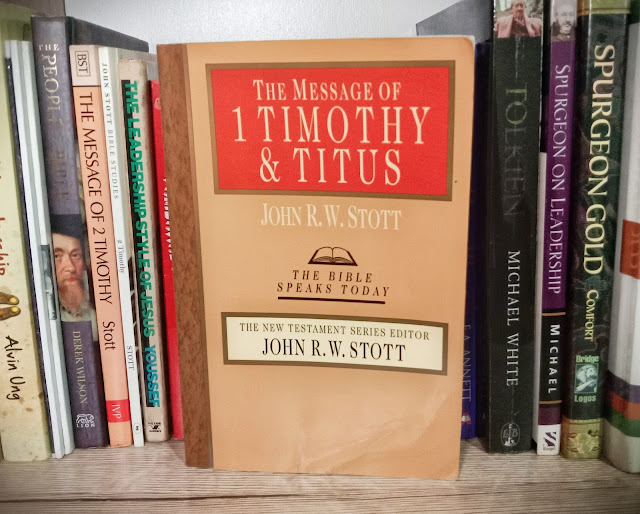
The Message of 1 Timothy & Titus: Guard the Truth (1996) by John R. W. Stott, Not A Review

The Message of 1 Timothy & Titus: Guard the Truth (1996) by John R. W. Stott
 
At first, I wanted to reread John Stott's excellent commentary on 2 Timothy because I thought it is a fitting book for me to end the year well. But when I realized that I haven't read commentary on 1 Timothy & Titus entirely, I should go for this one instead. This decision proved to be profitable and timely! Praise God. Why do I think reading good Bible commentaries is important? On the back cover of every J.C. Ryle's Expository Thoughts on the gospels says this gem of wisdom: "If the best way to understand the Christian Faith is to read the Gospels, then the next books in order of importance have to be those which aid in the understanding of those Gospels." I find that this is also true for the pastoral letters or epistles such as 1, 2 Timothy & Titus. The best way to know the truth is to read these sacred letters firsthand. The next best is to read good commentaries about them.

I love to read commentaries written by the late Dr. John R. W. Stott (1921-2011) especially on The Sermon on the Mount, Romans, and 2 Timothy. His books such as Basic Christianity, Your Mind Matters, and The Preacher's Portrait also plays a significant role in shaping my Christian faith, mind, and calling. I'm forever grateful for Uncle John's ministry! To come back to his commentaries, I find that Dr. Stott is clear in his expositions, balanced in his teachings, and faithful to the evangelical beliefs. They are both scholarly and yet readable. One very helpful feature that I like the most is that, when Dr. Stott comes to difficult or controversial passages of the pastoral letters (such as on slavery, sexual roles in the church, government, etc.), he will take extra care to outline and explain other major different interpretations before he proceeds to the most probable one with sound Biblical arguments* and applications. If you want to read Bible commentaries or looking for references to prepare for your sermon and Bible study, I fully recommend The Bible Speaks Today Series published by Inter-Varsity Press (IVP). Simply one of the best!

Before I end (sorry, this is NOT a book review after all), let me share how I use a Bible commentary like this one for all its worth. First, I will try to read 1 Timothy & Titus from at least 2 to 3 Bible translations. I read from the New Living Translation (NLT), the English Standard Version (ESV), and the JB Phillips New Testament (PHILLIPS is actually a paraphrase). This first step is important because you need to be familiarized with the Scriptures before you study the Scriptures. By the way, keep in mind that the new edition of The Bible Speaks Today Series is using the New International Version (NIV) as the main translation. Secondly, always bring the Bible with you as you read through the commentary. The reason being is that when you read something that sparks your interest or speaks to you, you need to 'see' it in the pages of the Bible for yourself. This is not just good for memorization but also good for your faith and trust in the written Word of God. Finally, share what you have learned with as many people as possible through your social media, during Bible studies, when you give counsel to others, etc. If you read, you learn once. If you read and teach, you will learn twice. If you read, teach and live it, it will be part of your life 😉✌💡

#ServeToLead #GrowingLeaders #LeadersAreReaders #JohnStott #BibleCommentary #LetsMakeReadingCoolAgain


To read my other
#1Book1Week book reviews, CLICK HERE

FB Page
: https://facebook.com/LEGASI.tv/                                    
Podcast: http://bit.ly/LegasiSpotify                     
YouTube: https://www.youtube.com/c/LEGASItv/                 

THINK BIG. START SMALL. GO DEEP.

Best Blogger Tips

They Click it A lot. [Top 7 last 7 Days]